Tension in a story is one of the best possible skills you can master as a writer.
In a finished product, how tension plays out comes down to your whole team—how actors are directed, the production design that lends visual conflict, the editing between different perspectives, and more—but it all starts on the page.
You can probably think of a few examples from film and TV, moments that made you feel the mounting dread of nearing danger. I'm a Star Wars nerd, so indulge me while I point to the Ghorman Massacre from Andor as one of the strongest recent examples in TV. It's masterful, even as the viewer might guess what exactly is about to happen.
Another one of my favorite, tense scenes is the prom finale from Carrie. All that slow-motion build-up. It's so good.
Creating that effect on the page, without music or editing or performances to lean on, requires techniques that writers have refined through the years. Your goal is it get your audience invested. Influence them to ask, "What could happen next?" Then, at the right moment, deliver a powerful release.
Here's what some of the industry's most successful screenwriters and directors have learned about building tension in their scripts.
 InceptionCredit: Warner Bros.
Give the Audience More Information Than Your Characters
Alfred Hitchcock explained the difference between surprise and suspense with what he called the bomb theory.
Imagine two people having a mundane conversation when, suddenly, a bomb explodes. That's a surprise.
"Now take the same scene and tell the audience there is a bomb under that table and will go off in five minutes," he said at AFI. "Well, the whole emotion of the audience is totally different because you've given them that information that in five minutes' time, that bomb will go off."
The same boring dialogue becomes riveting because viewers are participating in the scene, desperate to warn the characters about the danger they can't see.
Releasing key information can actually create more tension in viewers' minds than withholding it. When you know more than the characters do, every moment becomes loaded with dread.
Quentin Tarantino uses this technique in the opening scene of Inglourious Basterds. By providing the audience with pieces of information during Colonel Hans Landa's interrogation of a French farmer, he turns a polite conversation over milk into one of the most suspenseful scenes in modern cinema.
We know what Landa suspects, we know who's hiding beneath the floorboards. The tension ratchets up with every question.
Add a Ticking Clock
Time constraints are incredibly effective at adding tension. Writers call it the "ticking clock," and it forces characters to act while the audience squirms. The bomb needs to be diffused, the ransom must be delivered, or a meeting has to take place within a strict timeframe.
Push the ticking clock to its limits. You've seen this in action. Usually, the bomb is rendered inert with just one second left on the clock. Sometimes, the person the protagonist needs to find seems to be gone already, until they look again. It occurs multiple times in spy films, such as Mission: Impossible.
Screenwriter Doug Eboch, who wrote Sweet Home Alabama, explained the purpose: "The ticking clock is related to the stakes. We know something good will happen if the character succeeds, and something bad will happen if the character fails. A ticking clock gives the character a deadline to achieve success or failure."
- YouTube www.youtube.com
Raise the Stakes as the Story Progresses
Back to Andor and the Ghorman Massacre for this example.
In this climactic sequence, the peaceful protest already feels dangerous enough. We know these characters, all coming together around the plaza, are at risk. Cassian is there to kill Dedra, who is in charge of some secret plan; Syril is suspicious and angry.
But then we see the plan unfold, and things keep getting worse. Syril finds the dangerous KX security droids in a side room. Stormtroopers arrive in armor. Snipers are spotted, and TIE Fighters fly overhead. We realize this is a false flag operation meant to give the Empire an excuse to kill as many people as possible, and violence explodes a second later.
By the end of the episode, the stakes have shifted from individual survival to the birth of a full-scale rebellion. (Of course, there was plenty of foundational tension laid before this scene, but it's the climax of an entire storyline.)
"We knew that it would be a centerpiece of the show. It's a centerpiece in canon in the five years that I get to curate. It's a critical moment in the history of the rebellion," Tony Gilroy said to Variety.
By raising the stakes throughout a scene or story, screenwriters maintain tension from beginning to end.
As a writer, ask yourself constantly, "What's at stake?" If you struggle to answer that question, your story is in trouble. Stakes introduced at the beginning won't carry your script to the end. You need to escalate and evolve them, making the consequences of failure more devastating as the story progresses.
Use Dialogue to Maintain Anticipation
Tarantino uses dialogue to prolong suspense, building tension through subtext until the anticipation reaches a boiling point.
In the apartment scene from Pulp Fiction, Jules and Vincent's presence clearly makes the occupants nervous, but the dialogue is used to delay the inevitable. The suspense builds, but the dialogue isn't actually about why they're there or what's about to happen.
Dialogue (and its subtext) can and should prolong the audience's anticipation. This technique works in drama, action thriller, suspense, horror, and comedy.
Dialogue can also have a rising action, much like a scene or story can. If your characters are arguing, let their emotion build and build before they explode.
- YouTube www.youtube.com
Start Late, Leave Early
It's tried-and-true screenwriting advice for a reason. You don't have to show a character arriving at the airport, exiting a car, going through security, and only then realizing that they're late for their flight. Start with the character running through the airport trying to make it to their gate.
Similarly, not every scene has to have a tidy ending. If it's a phone call, we don't need to hear the end of it if the key information has already been conveyed to the audience. Move on to the next thing.
Aaron Sorkin understands this.
On an episode of Script Apart, he said, "I like to kind of parachute the audience into a situation that’s already going 100 miles per hour."
In this case, he was talking about The Trial Of The Chicago 7.
He added, "Any time you can get the audience to participate in the story, make them sit forward a little bit to work out what's going on, it's exhilarating for an audience."
Every scene within your screenplay should matter. Cut what doesn't keep things moving.
Cut Between Multiple Storylines
This element will likely be found in the edit, as it can be visual and depends on how a sequence is shot. But you can get it started on the page.
If you're writing a group of characters about to break into the bank, don't let us see the whole heist—switch scenes so we're now with the government agents a step behind them, hot on their trail. Just as the agents make a big discovery, return to the thieves. And so on.
Christopher Nolan accomplishes tension and momentum in several of his projects by crosscutting between various story threads. An obvious example would be Dunkirk, but he does it in Inception and The Dark Knight, and many other movies.
In filmmaking, crosscutting refers to switching back and forth between scenes to give the impression that action occurring in different locations is happening simultaneously.
In Inception, Nolan uses crosscutting across multiple dream levels, each operating on different time scales. The audience experiences the urgency in all the layers simultaneously. By cutting between these storylines, Nolan multiplies the tension as we track multiple characters racing against different countdowns in different realities.
If you're ready to attempt this, consider writing out your A, B, and C storylines in full first, either in outlines or on notecards. You'll need to understand the structure and beats of each fully. Then you can figure out how to stitch them together in a way that will maintain conflict throughout.
 12 Angry MenCredit: United Artists
Keep Characters Stuck
Every moment of a screenplay should propel the protagonist toward their finale. Characters are working toward a goal. They should meet obstacles on the way.
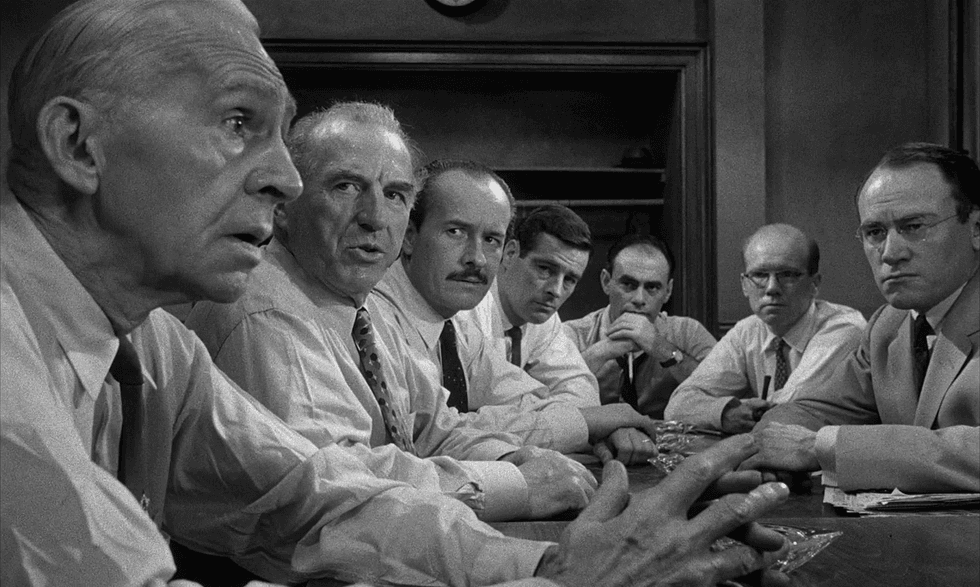
One obstacle can be finding a reason for them to stay in one place. Maybe they're in hiding from someone, in a standoff, or literally trapped in a room or elevator. Maybe they're stuck in a conversation they can't leave. Maybe they've just murdered someone, and the police are forcing everyone to remain on the scene. Maybe they feel obligated to remain at an event.
Just remember that if you try this, don't make the reason they're stuck contrived.
"Your characters don't literally have to be trapped, though," writer Cameron Chapman said in Script Magazine. "There just needs to be a compelling enough reason for them to stay in one spot. In my own comedy, Love & Marriage, the characters are all at a single location for a wedding. It doesn't make sense for any of them to leave."
Combined with a ticking clock, getting characters stuck when all they want is to keep moving will make the audience worry.
- The Best Tools for Creating Dramatic Tension—Advice from This 'Fargo' Director ›
- Video Essay: How Akira Kurosawa Used Geometry to Visually Create Tension ›
- Amplifying Tension in Every Scene With 'A Hard Place' Director J. Horton ›
- 11 Ways To Improve Tension in Your Scenes ›
- ‘Task’ Took a Page From ‘Heat’ — Here’s What Filmmakers Can Learn | No Film School ›
- The Three Types of Conflict Every Scene Needs ›
- What Bugonia Can Teach You About Building Tension ›
- The One Intense Scene From 'Sicario' That Sticks With You ›