Sue me, but my favorite Spider-Man movie is Spider-Man: Into the Spider-Verse. While the Spider-Man franchise boasts of cinematic gems such as Spider-Man 2, Homecoming, No Way Home, and Far From Home, Into the Spider-Verse (and its sequel, Across the Spider-Verse) takes the saga of the superhero to a whole other level.
While these movies, acclaimed for their groundbreaking animation and enigmatic multiverse concept, expand the Spider-Verse with their innovative world-building, if you ask me, the ingenious crossover with comics is something that isn’t talked about enough (and that’s so unfair).
In this article, we will analyze how both these animated films used comic book panels in their treatment to regulate the pacing of the narrative while enhancing the overall visual language.
Story Analysis
Before we jump into the analysis, here’s a quick recap to put things into context.
- YouTube
Spider-Man: Into the Spider-Verse follows Miles Morales, who inadvertently gets bitten by a radioactive spider and becomes Spider-Man, while there’s already another Spider-Man, Peter Parker, in his dimension. Soon after Miles’ transformation, the other Spider-Man, Peter Parker, dies in a battle, leaving Miles with the responsibility of destroying Kingpin’s collider, a device that will destroy the universe. As Miles settles into his role as a Superhero, his mission opens up different portals to the multiverse, attracting Spider-Men and Spider-Women from various universes and timelines into Miles' own timeline.
The sequel raises the stakes through the roof as Miles learns that he is an anomaly in his own dimension, which means that his getting bitten by a radioactive spider was a complete glitch. Since there can be only one Spider-Man in a single dimension, he is also the reason why the original Spider-Man of his dimension was killed. Miles travels across dimensions trying to fix things, while escaping from the wrath of the Spider-Men and Spider-Women from the various other dimensions, after he meddles with a “cannon event” in a particular timeline to save his father. The film ends on a cliffhanger with Miles trapped in a different dimension, far away from his own.
Animation Style in The Spider-Verse
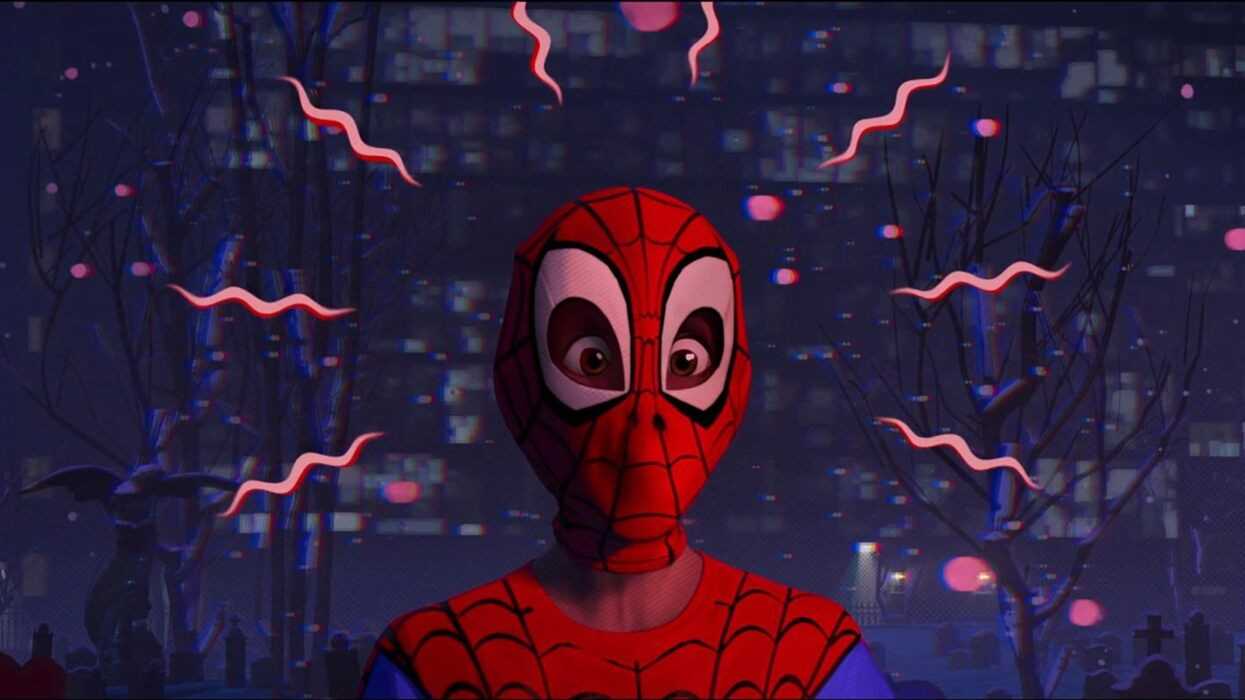
A little about the animation style to begin with: The Spider-Verse movies combine 2D comic-style animation with 3D animation. The aesthetic reimagines the comic-book aesthetic on screen, creating a look that feels like reading a comic book that’s alive.
Instead of 24fps (typical for CGI animation), the characters, especially Miles Morales, are often animated at 12fps, i.e., animated “on twos.” For instance, Miles’s spidey movements are animated at 12fps, while Peter Parker’s movements as Spider-Man are animated at the traditional 24fps, to create a contrast between a seasoned and a newbie Spider-Man.
The makers also completely ditch motion blur (using the subtle stop-motion effect to their advantage) and depth of field, to stick to the comic-book feel. At the same time, each Spider-Man dimension and Spider-(Wo)Man, is illustrated in different styles. For instance, Gwen Stacy’s world features the watercolor style.
5 Key Ways in Which the Spider-Verse Movies Use Comic Book Panels to Control Pacing
1. As Inventive Transitions
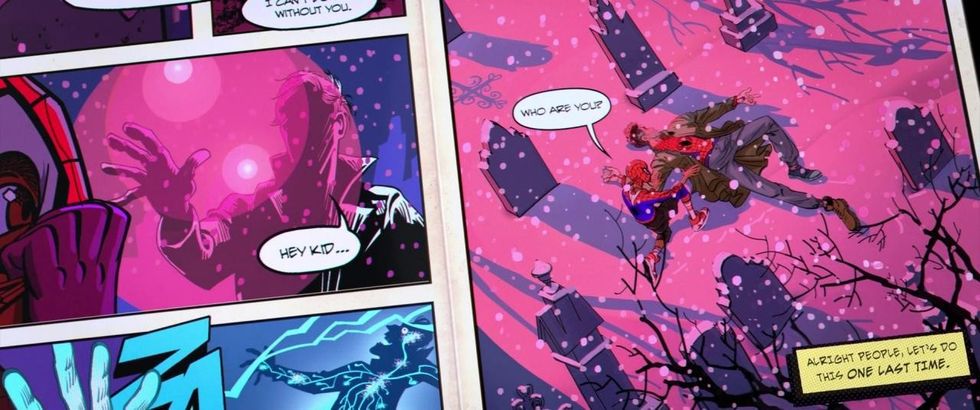
Remember the sequence in which Miles, soon after he discovers his newly gained powers, rushes back to his room in fear? As he is drowning in thoughts, a Spider-Man comic book falls on his head. The scene culminates with a cutaway to a new Spider-Man comic book, featuring Miles now.
Throughout the film, there are many such cutaways, featuring a freeze frame, that directly transition us to a fresh sequence.
2. To Articulate A Character’s Inner Thoughts

Throughout the film, there are patches of text, similar to text boxes or bubbles for dialogue or directorial scrolls in a comic book, that keep narrating Miles’ state of mind. Instead of using a voice-over, the makers opt for Comic book panels to externalize Miles’ mental chaos.
3. As A Visual Onomatopoeia
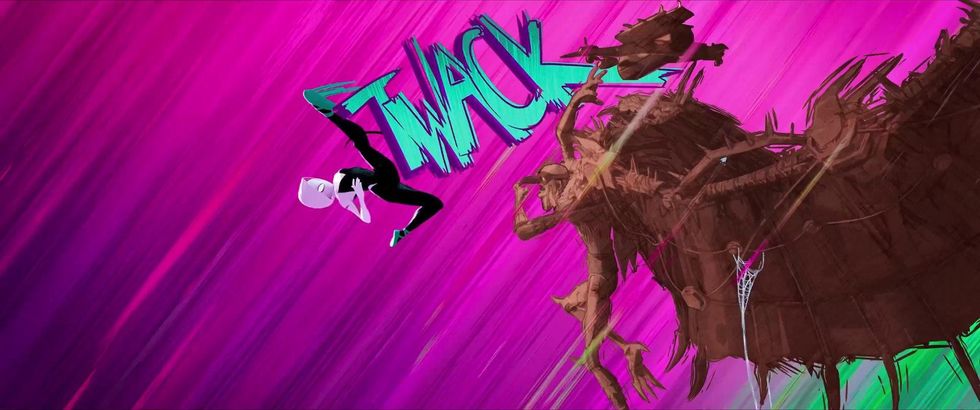
Almost all the high-octane sequences and action sequences feature written words for sound, such as Thwip, Bang, and Whoosh. The visual onomatopoeia is designed true to comic book aesthetics, invoking both nostalgia and a surge of adrenaline. At the same time, it makes the presentation even more dynamic.
4. To Guide the Viewer Through the Story While Controlling the Pacing
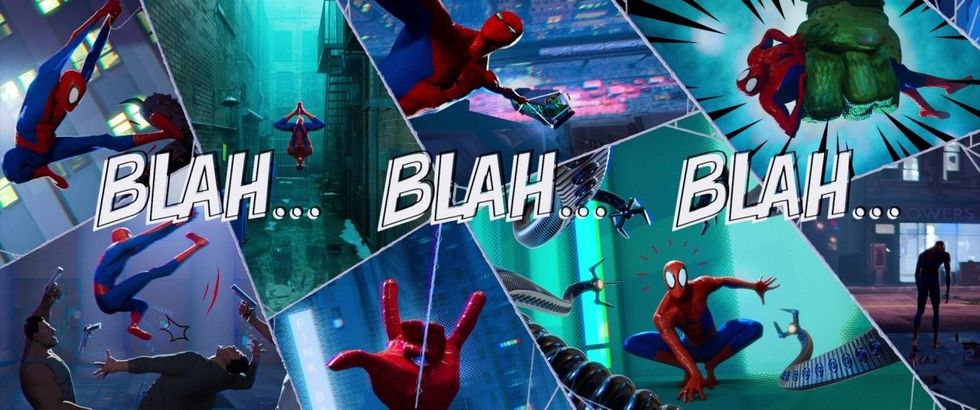
The movies also masterfully employ the comic-book style of split-screen and multi-panel layouts in their treatment to dictate the pacing while guiding the viewer through the narrative. For instance, some of the significant action sequences are presented in multiple split-screens showing multiple actions, in various dimensions, unfolding at the same time. These panels pop onto the screen in a specific order, freezing and unfreezing independently, enhancing the dynamism of the sequences while setting the chronology of the events. This treatment allows for a quicker pace without increasing the number of cuts.
5. To Reinforce a Shift in Mood or Emotion
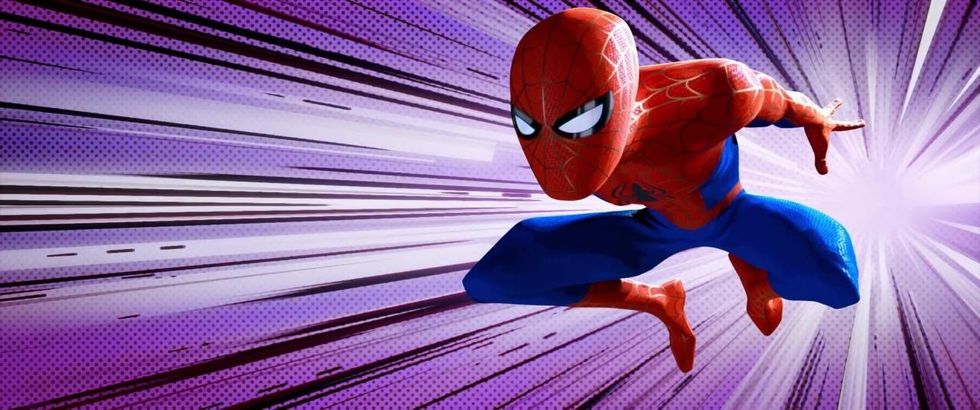
The makers also frame the illustrations in stylized borders such as the torn paper effect or lines, which not only add to the comic-book aesthetic but also serve as visual barriers in the story, for instance, to separate two characters on the frame.
In short, the Spider-Verse movies are like comic books being projected on screen!
Did you notice the use of comic book panels in The Spider-Verse movies? Let us know your favorite sequence from the two movies.