How One Line Turned 'Dirty Dancing' Into a Pop Culture Legend
The dialogue that turned Baby’s moment of defiance into cinematic history.
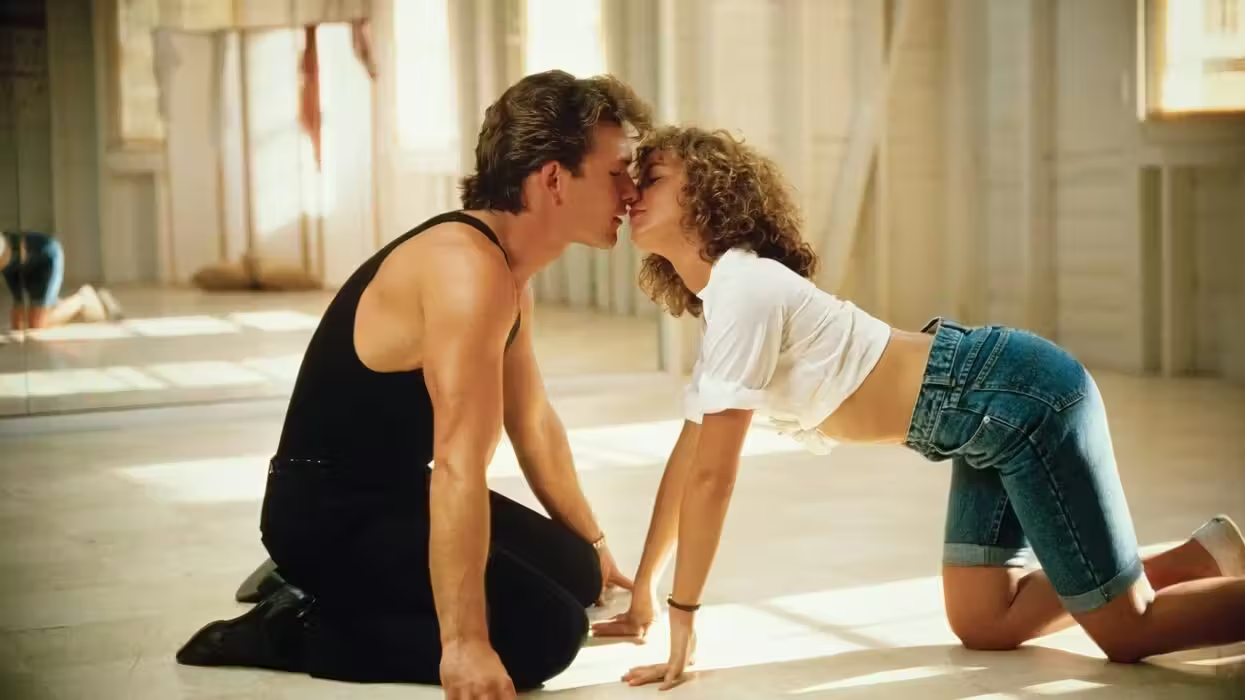
Dirty Dancing
The air is thick with tension at Kellerman’s. The resort’s summer dance show is in full swing, the audience claps politely, and Frances “Baby” Houseman (Jennifer Grey) sits in the shadows—literally sidelined by her family and the resort’s hierarchy. Then, from the back of the hall, Johnny Castle (Patrick Swayze) strides in with the kind of calm defiance that makes everyone stop breathing for a moment. He looks straight at Baby, points toward her seat, and utters the line that would ignite cheers in theaters around the world:
“Nobody puts Baby in a corner.”
In 1987, those six words landed like a lightning strike. On paper, they seemed simple—even awkward—but on screen, they became a declaration of rebellion, respect, and self-worth. The moment capped off the film’s love story, crystallizing its entire theme of liberation.
This article digs into how that single line—once almost cut from the script—grew into a cultural phenomenon that still carries weight today.
But how did this line come to be, and why does it still resonate so powerfully?
The Scene in Context
The Setup
Baby begins dirty dancing as a sheltered teenager, eager to please her father, Jake (Jerry Orbach), and live up to his picture of her as a “good girl.” Her nickname, ‘Baby,’ underscores how little control others believe she has over her own life.
But her summer fling with Johnny—the resort’s working-class dance instructor—changes everything. She moves from being hidden in the background of her family’s expectations to carving her own identity through risk, loyalty, and choice.
The Payoff
By the film’s climax, Johnny has been fired, and Baby has been humiliated for standing by him. When he storms back in and calls her out of her literal corner, the gesture is layered. It’s a middle finger to the management that dismissed him. It’s a public acknowledgment of Baby’s courage and sacrifices. And it’s a reclamation of her nickname—turning “Baby” from a diminutive into a badge of strength.
What follows is so much more than just a dance. It’s a vindication: Baby stepping into the spotlight she has earned.
The Writing and Creative Struggle
The Screenwriter’s Pen
The line belongs to screenwriter Eleanor Bergstein, who drew much of the film’s story from her own upbringing. According to interviews, Bergstein intended the dialogue as a blunt, almost theatrical cue that would signal Johnny’s determination and give Baby her final push to center stage. It wasn’t so much crafted as a slogan as it was written as emotional shorthand.
Fighting for the Line
Ironically, the studio executives weren’t impressed. Patrick Swayze himself hated the line. They all reportedly felt the line was too corny, too clunky, even embarrassing, and they pushed to cut it.
Bergstein and director Emile Ardolino disagreed. They believed the moment’s rawness was its strength—that Johnny’s words, delivered without polish, reflected the characters’ urgency and truth.
Their refusal to back down mirrored the film’s own themes: standing up for what matters, even against authority. Without that stubborn creative defense, cinema might have lost one of its most enduring quotes.
Swayze’s Performance and Direction
More Than Words
Patrick Swayze made the line work. He didn’t bark it or play it for melodrama. Instead, he delivered it low, gravelly, and unwavering—like a statement of fact rather than a plea. His body language sealed it: shoulders squared, eyes locked on Baby, posture radiating authority. In that stance, the words transcended dialogue and became action.
Jennifer Grey’s Reaction
What makes the moment truly sing is Jennifer Grey’s response. She doesn’t speak a word, but her face carries a storm of emotions—shock, awe, pride, and a deep understanding that this is her moment. That silent exchange makes Johnny’s line complete. Without Baby’s reaction, the line would be half as powerful. With it, the scene becomes cinematic alchemy.
The Quote’s Meteoric Rise to Pop Culture Immortality
Immediate Impact
Audiences embraced the line instantly. It was repeated in theaters, quoted at school dances, and replayed on VHS tapes. In a pre-Internet world, for a line of dialogue to travel that fast meant it had struck something deep.
Permeation of Culture
Its cultural afterlife has been vast. Sitcoms like The Simpsons and Family Guy have parodied it. Politicians have invoked it as shorthand for fighting against marginalization. Advertisers have twisted it into taglines.
And now, in the age of memes, it pops up on social media whenever someone—or something—breaks free from the sidelines. What started as a line of dialogue became a linguistic Swiss Army knife for defiance.
Deconstructing the Power
Universal Theme
At its core, the line resonates because everyone has been “put in a corner” at some point—dismissed, ignored, or underestimated. Hearing Johnny call it out and shatter that dismissal hits a universal nerve.
Feminist Reading
There’s also a feminist undertone that keeps the line relevant. Johnny isn’t speaking over Baby or rescuing her. He’s only creating space for her to step into—with her own power. By announcing her worth in front of everyone, he transforms his role from protector to ally.
The Perfect Storm
The endurance of “Nobody puts Baby in a corner” is a lot more than just about the words. It’s about the confluence of Bergstein’s writing, Ardolino’s direction, Swayze’s delivery, and Grey’s reaction. The narrative built up to it, the emotions justified it, and the performances made it unforgettable.
Take away any one element, and it might have been forgettable. Together, it became iconic.
Forever Out of the Corner
From a line nearly left on the cutting-room floor to a phrase etched into pop culture’s permanent record, “Nobody puts Baby in a corner” has traveled a remarkable journey. It defined a film, gave voice to its themes of dignity and courage, and grew into a universal rallying cry far beyond the dance floor.
The line endures because it traverses across the realm of romance and refuses invisibility. It’s about recognizing someone’s worth when the world tries to diminish them. And that’s why, decades later, the sentence still sends a charge through audiences.
In the end, “Nobody puts Baby in a corner” is more than dialogue. It’s a declaration that no one deserves to be sidelined. That truth keeps Baby—and all of us—forever out of the corner.
- 8 Movie Dance Scenes That Shaped Pop Culture ›
- The Romance Genre in Film and TV (Definition and Examples) ›
- Patrick Swayze's Monologue in 'Point Break' is Way More Poignant Than You Remember ›
- Film Quote of the Day: The 'Dirty Dancing' Quote That Perfectly Captures Baby's Awkwardness | No Film School ›