If you haven't seen For a Few Dollars More, it's one of Sergio Leone's classic Spaghetti Westerns. The story features two bounty hunters, both with their own codes, circling each other before the real trouble starts.
El Indio and his gang are making life miserable. There's a price on his head, so naturally, Monco (Clint Eastwood) and Colonel Mortimer (Lee Van Cleef) show up, both looking to cash in on the bounty on Indio's head.
At first, they're sizing each other up. But soon, they realize teaming up is the only way they're getting anywhere near El Indio. It's a partnership born out of necessity, not trust, but eventually leads to an unlikely friendship. The film was a follow-up to A Fistful of Dollars, the middle of the Dollars Trilogy.
Partway through the film, Monco asks the older man a question that reveals almost nothing on the page but a ton on screen. It's one of the great examples of what a refusal to answer can do in a screenplay.
The Scene
Mortimer and Monco are in the middle of tracking Indio, bunking together. The tone before the quote is quiet. Just two men in a room sharing an evening. The conversation shifts.
Monco asks, "Tell me, Colonel... Were you ever young?"
Mortimer, prepping his pipe, says, "Yup. And just as reckless as you. Then one day, something happened. It made life very precious to me."
Monco notices the colonel holds something.
"What's that?"
Mortimer shoots a glance at him. Monco reads the hesitation.
"Or is the question indiscreet?" Monco says.
Mortimer pauses, then says, "No. No, the question isn't indiscreet. But the answer could be."
First-time viewers won't know that the object he holds is a Chekhov's watch that pays off at the film's climax.
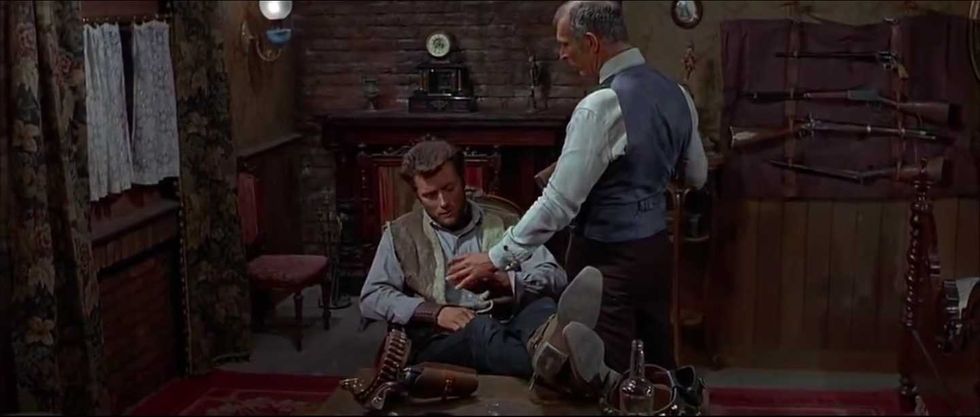 'For a Few Dollars More' Credit: United Artists
What Mortimer Refuses to Say
"Tell me, Colonel... were you ever young?"
Mortimer's answer isn't an answer, not to what was asked, anyway. When he's asked about being young, it takes him back to a moment of trauma he's not prepared to discuss with another man.
So he evades. Yes, he was young. But something happened to him.
"It made life very precious to me."
That's the backstory we get. No name, no year, no place, no body. He was once reckless, but something ended that. Now he values life. The who and the why are locked in a place Mortimer will not open.
Then Monco pushes to know what he's holding. At the end of the film, we learn it's a musical pocket watch like the one his dead sister had, and Indio took.
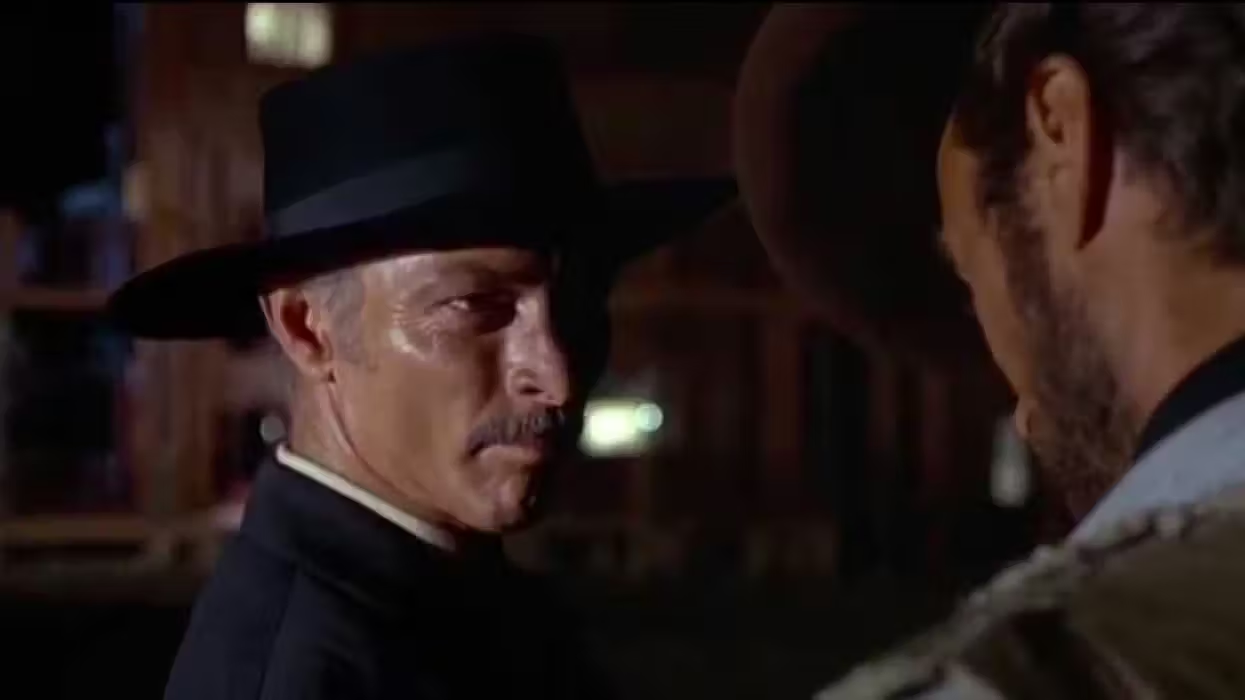
Leone cuts to Van Cleef's face for the answer before the answer. The sharp glance.
Monco reads it instantly and gives him an out. "Or is the question indiscreet?"
And Mortimer takes the out. "No. No, the question isn't indiscreet. But the answer could be."
This tells Monco, and us, that this wound is loaded. Asking again will cost someone something.
The scene isn't about aging. It's about a specific grief this man refuses to voice. Leone trusts us to wait for it. As a writing device, this beat is the plant for the later payoff.
The physical elements do a lot here, too. The colonel is literally holding the answer while refusing to give it. It's exactly the kind of visual/verbal split that makes for great subtext in dialogue. What is said? What is shown? What's withheld?
If Mortimer had explained himself here, the movie wouldn't work, and we'd lose the impact of the ending. The climax of For a Few Dollars More depends on us not knowing what we've just been shown. The refusal in this moment feels earned. It comes from the character, not from a screenwriter protecting a twist.
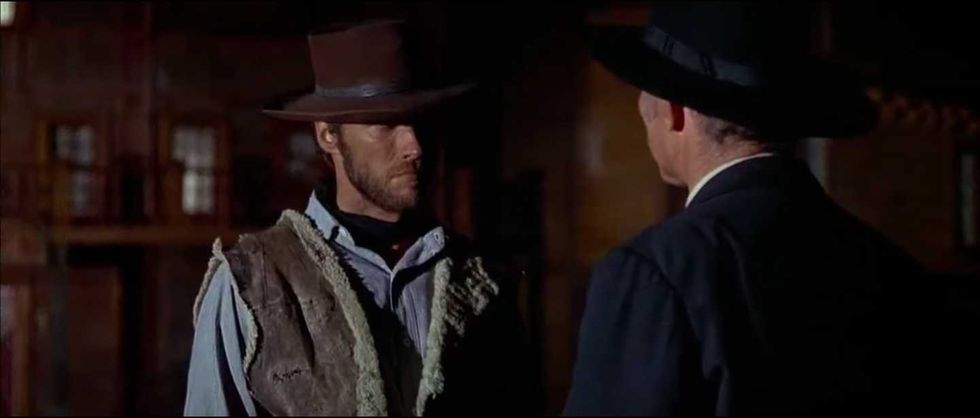 'For a Few Dollars More' Credit: United Artists
What Monco Does Say
Don't forget that the scene develops Eastwood's character, too.
The line "Tell me, Colonel... were you ever young?" is a provocation. Monco is younger, cockier, testing whether this older gunfighter is a peer or a relic.
It's the kind of thing a younger man asks partly to hear an answer and partly to pester. He wants information but doesn't want to come off as truly interested.
Then, when Mortimer bristles, Monco walks it back, smart enough to read the room and soften. That's a character who knows when to press and when to back off. It's a lot of information in a very short exchange.
Every line here does the three jobs good dialogue is supposed to do. It propels the scene, it sounds like this specific person in this specific moment, and it's what these men would actually say.
What Screenwriters Should Learn from the Scene
This is a strong Western story, but the advice applies to any genre.
We love plant and payoff because it rewards the audience. Mortimer's backstory pays off later in the film. In this scene, Leone and his co-writers keep the door closed. Every instinct you have as a writer might tell you to overwrite the moment. Reveal the thing now. Earn the audience's sympathy by explaining this man. Resist that.
Even so, the watch is in the frame. The filmmakers don't hide that it's a watch, just its significance. You don't have to get cute with an object like this, although sometimes MacGuffins are never seen. This is meant to be a quiet character beat, so it's likely that obfuscating the watch would have only distracted the audience. The object is interesting, but we move on from it quickly. It doesn't get a hero shot, and it's not deliberately hidden. It's just there, which feels natural.
Let some of the story live in the performance. Van Cleef doesn't tell us anything with words that he doesn't already tell us with his eyes. He knows the backstory, so he plays it in this moment. The pause before he speaks. The sharp look when Monco presses. It's enough to tell us something is there and pique our curiosity.
Give your scene one job. It's not a long scene, but it's an important one. It doesn't move Mortimer and Monco geographically or get them closer to Indio, but it does plant a seed. Sometimes a scene's job is just to make you feel like there's something you don't know yet.