Danny Boyle’s newest film, Ink, opened this year’s Venice International Film Festival and puts the journalism industry in the hot seat by examining the origins of the UK tabloid, The Sun. The film follows Jack O’Connell as paper editor Larry Lamb, and Guy Pearce as Rupert Murdoch in a film that tells the story of the origin of the newspaper, but also how Lamb’s motivations for growth became irrevocably corrupted in its wake.
Let’s analyze the themes of the film and how it puts the journalism industry under a microscope in a similar way to how Oppenheimer critiqued the military-industrial complex. Moderate spoilers ahead.
Exploiting the World’s “Need” For Something
Where Oppenheimer examines the US mentality to make an atomic bomb out of fear of the Nazis doing the same, Ink opens with Rupert Murdoch and Larry Lamb discusses the apparent desire from newspaper readers to be given something fresh and more informal in its coverage of pop culture, celebrities, and the world at large. These two “needs” are vastly different in severity from one another, but they are both introduced under the false guise of “the world wants/needs this” as a way to distract from the hubris of their creators.
What’s really interesting about the way that Ink introduces the characters of Murdoch and Lamb is that both characters conclude their arcs at the end of the film in an exaggerated state of what the other feels at the beginning. Larry Lamb at the start of the film is reluctant to even hear Murdoch out about the idea for The Sun, and at the end of the film he is a power-starved editor-in-chief who bypasses Murdoch at every turn to break stories with tragic results.
Murdoch opens the film as an overconfident showman who claims that his big idea is going to change the world and bulldoze competition. And it does, but much to his regret and shame by the conclusion of the film.
Riding the Brief Highs of Success
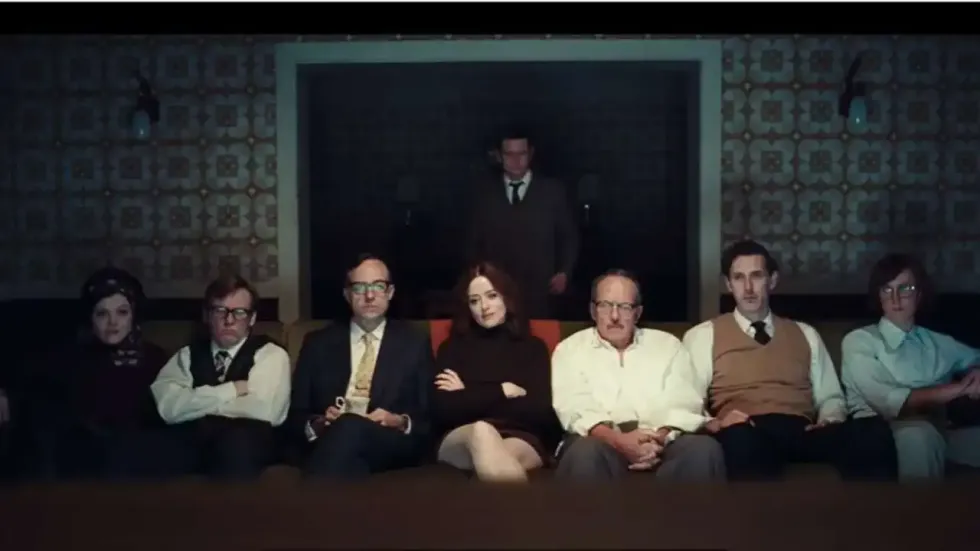
'Ink'
Credit: Netflix
Like any film about major societal disruptors that have a big idea, they find massive amounts of success very quickly. The film employs an “isn’t this so funny until it isn’t anymore” approach to its structure and showcases the excess of the newspaper’s success to reel an audience in. It’s a structure that we’ve come to expect with films of this type, but its ability to hook an audience every time shows how susceptible that level of success can really be. If it never fails to entertain us to watch, how strong would you have to be to resist it in real life?
There are cracks hidden underneath the surface amidst all of this, of course. Characters are unfaithful to their partners; there are signs of rodents entering the offices; stories that don’t seem particularly ethical to certain members of the higher-ups, but by golly they’re making so much money and crushing all of the competition so aggressively, so who really cares at the end of the day? As long as the negativity isn’t directly affecting the people in charge, it’s far easier to pretend it isn’t there at all. Until it all comes crashing down.
How We Got to Our Modern Landscape
Where Oppenheimer treated the creation of the atomic bomb as an opening of Pandora’s Box in the name of military “defense” that could inevitably spiral beyond repair, Ink does the same thing but with modern tabloid culture.
Once you tap into a previously untouched market of influence, the public’s interest will naturally become diluted until the stakes or content is elevated in some fashion. Where the responsibility then obviously lies is in the people in charge of maintaining that interest in a way that remains ethical. But most, as seen in Ink, don't have the power to keep themselves in line.
We’re seemingly past the days of classic 2010 American tabloid culture, but what has taken its place is arguably more problematic. Streaming platforms becoming almost too accessible for people wanting to use it for negativity, the phrase “sex sells” being taken to a whole new level, and the general feeling that anybody can be exploited for clicks at any given time in an unprecedented digital age. The events in the second half of Ink make it very clear that the role The Sun played in kicking off the genesis of this new age cannot be underestimated.
The film concludes in a way not dissimilar to Oppenheimer, in its cynicism towards the path we find ourselves heading down, but even though it’s not nuclear armageddon Ink is commenting on, it still allows us to infer that we may still be on a path of mutually assured destruction.