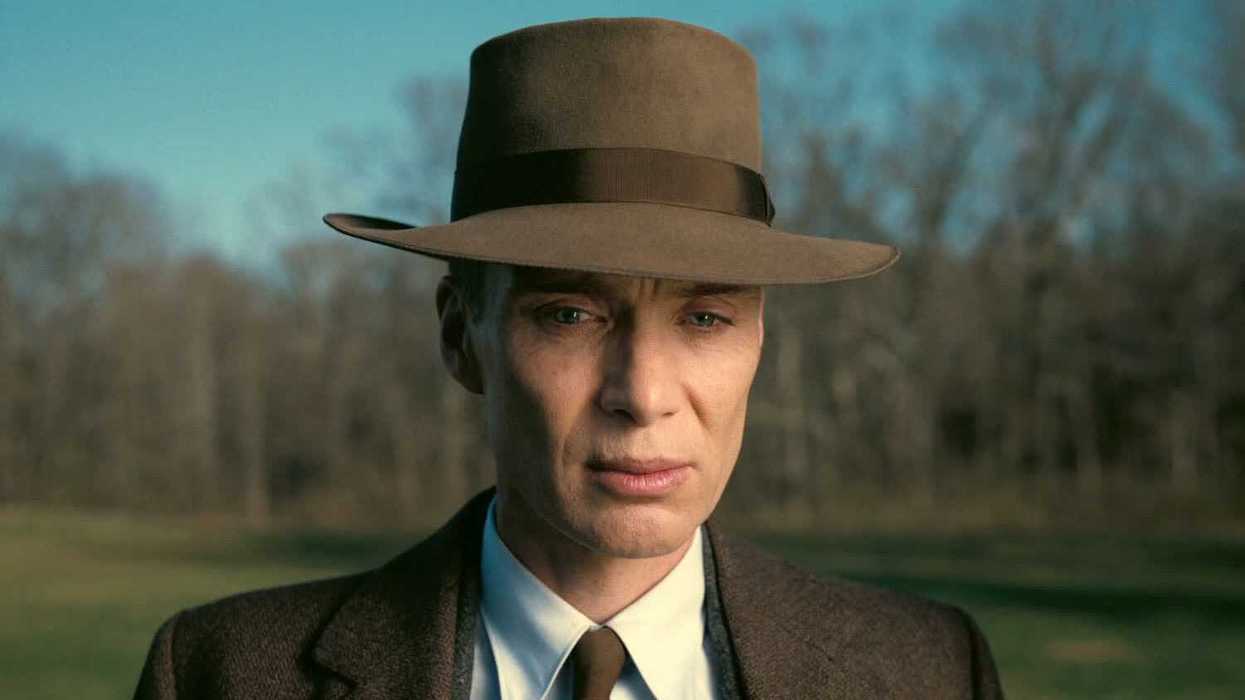
Some of the most powerful moments in the history of cinema were not a part of the script. They weren’t meticulously planned or written years in advance. They were born out of a strong human creative impulse. In Christopher Nolan’s Oppenheimer (2023), this pivotal moment occurs during a fictionalized version of the May 1945 Target Committee meeting, where Oppenheimer (Cillian Murphy) consults top government officials about their atomic bomb targets in Japan.
The line, said by the then U.S. Secretary of War, Henry Stimson (James Remar), tells a room full of officials not to attack Kyoto because he and his wife had honeymooned there.
This chilling, darkly ambiguous scene is one of the most profoundly disturbing moments in the movie. What makes this line so powerful? How can we learn from it?
Let’s jump right in and explore.
Context Of The Scene
In Oppenheimer (2023), during a retelling of the May 1945 Target Committee meeting, J. Robert Oppenheimer consults top U.S. government officials about the proposed targets for the atomic bomb he and his team are in the process of building.
I consider this scene one of the strongest in the movie as Nolan, along with his cast and crew, perfectly captures the moral ambiguity of a crucial moment in human history. Secretary of War Henry Stimson (James Remar) reveals that he has taken Kyoto off the list of targets due to its cultural and religious significance to the Japanese people.
In a casual and resultantly shocking way, he says, “Also, my wife and I honeymooned there. It’s a magnificent city.” The personal nature behind a decision as monumental as this one reveals the fragility of human decision-making, even when the decision is about one of the most profoundly dangerous and irreversible acts in the history of civilization.
What makes this line even more special is the fact that it was an improvisation that stemmed from James Remar’s own research and understanding of his character.
The Power Of An Actor’s Improvisation
For a regular movie-going audience, the planning and plotting that goes into warfare is typically what they have seen in movies. What I mean is, an audience’s reference point for what war strategy must have been like is largely based on what they have seen in films.
When James Remar researched Henry Stimson’s character, he found that Stimson and his wife visited Kyoto on their honeymoon. He and the director Christopher Nolan found this fact to have probably had a profound influence on his reasoning to strike Kyoto off the list of atomic bomb targets.
The depth of Remar’s research not only had an impact on the director, but it also created a whole new, dark, and troubling layer to the scene and consequently the entire movie. Oppenheimer has a plethora of characters, all of whom are based on real-life people. A writer-director’s research, as vast as it may be, will still only cover limited ground. Good actors have a knack for digging up as much information as they can on their characters, and James Remar did precisely that.
 'Oppenheimer' CREDIT: Universal Pictures
That was as far as the line and its research were concerned, but Remar’s delivery has an offhand and casual feeling to it, which only makes the scene more chilling. He is well aware of the commanding nature of his character and his authority in the scene, and he uses that to make sure his offhand reasoning sounds like a simplistic personal decision.
Perhaps the only aspect of the scene that is more disturbing than this line itself is the silence it results in. None of the men in the room is quick to react. In fact, it feels like they don’t know what to say. Stimson’s words don’t sound like a war strategy; they come across like a relaxed contemplation or loud thinking behind an act with undeniably dangerous repercussions.
Finding Horror In The Mundane
Not all horrifying moments in movies happen in a scene that is actually horrifying. Some of them are thrown at us when we least expect them. This particular line in Oppenheimer is one of those shocking cinematic moments that comes through a simple, mundane line.
What are human beings without their emotions and sentiments? This line reminds us how personal sentiment can be a foundation for the greatest acts of war. Not every move is decided with sheer practicality and strategy in mind. Some seismic decisions are made in the most pedestrian and mundane manner.
Horror in the mundane is an undercurrent to Henry Stimson’s line. The trivial basis for his decision-making reveals how self-interest is more important to some people than anything else, even if they are trusted with colossal war decisions that would have an irreversible impact on humanity as a whole.
The idea of a clash between ethics and human ambition is another important aspect of this scene. Ambition clearly takes the upper hand. But what about ethics? How much does it even matter? Remar’s improvisation, very carefully, subtly, and sharply reminds us that ethics were nowhere in sight during this conversation. In fact, ethics weren’t even on the table. A few men in a room had the power to decide the future of humanity, and this single improvised line perfectly crystallizes the horrific nature of such a power dynamic.
Even though this line is rooted in historical myth rather than direct fact, it cleverly incorporates a fact (that Stimson and his wife did, in fact, honeymoon in Kyoto) into a war strategy that results in a chilling effect on the officials in the room and on the audience as a whole.
Final Thoughts
James Remar’s incredible improvisation reveals the blatantly casual nature of thought behind some of the most dangerous war decisions in human history. Christopher Nolan’s confidence in using this unscripted line shows us, yet again, why he is considered one of the greatest filmmakers currently working.
What is your favorite line from Oppenheimer? Tell us in the space below.