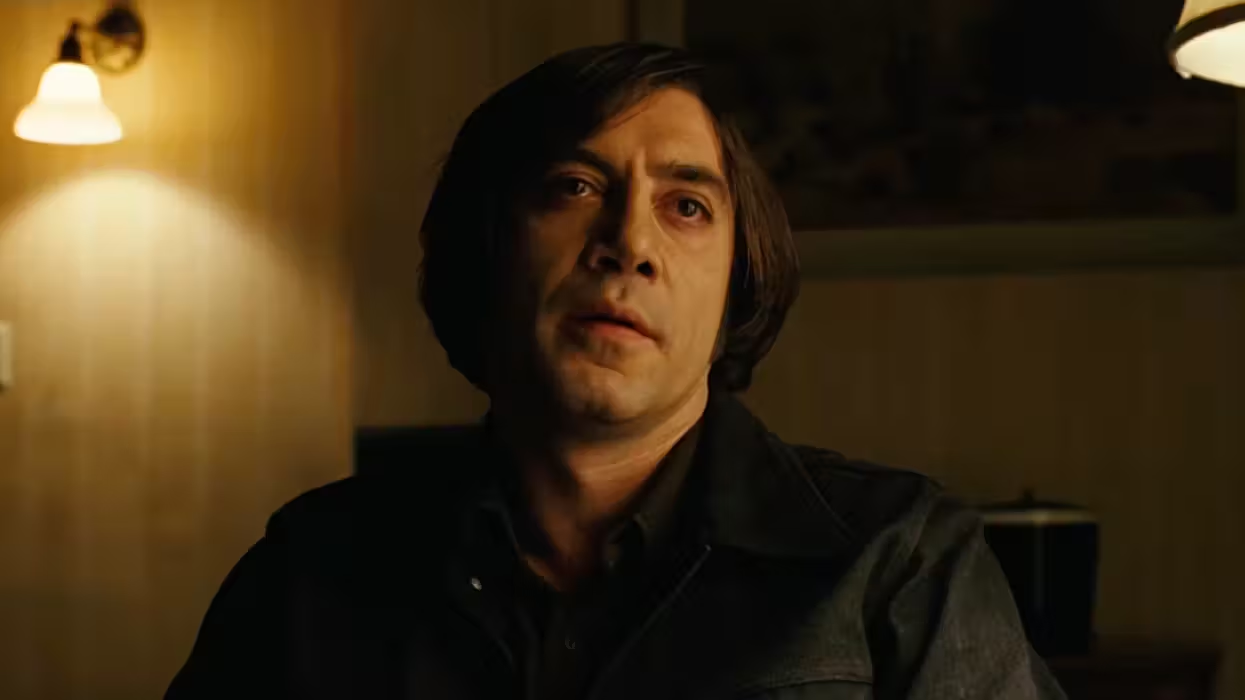
Anton Chigurh is a uniquely terrifying villain. He never really threatens anyone in a traditional movie villain way. No mustache-twirling, no extremely evil tropes we can poke at. More often, he interviews other characters to see how they operate and know how to take them down if he needs to.
In No Country for Old Men, the Coen brothers built a killer who takes a life the way other men keep an appointment. All business.
And one of his most chilling moments lands as a question rather than a threat. "If the rule you followed brought you to this, of what use was the rule?"
He asks it of a cornered rival seconds before pulling the trigger. Let's look at how this question tells you everything about the man asking it.
- YouTube www.youtube.com
The Scene
Carson Wells is a slick bounty hunter who thinks he can handle Chigurh. He's obviously wrong.
Chigurh ambushes him calmly, waiting for him in his own hotel, and the conversation that follows in his room only ever runs one way.
In the hotel room, Wells tries everything a reasonable man would.
"You don't have to do this. I'm a day trader. I could just go home," he says.
He offers up thousands of dollars, no hard feelings. He says he knows where the missing money is, that he can walk Chigurh right to it from the riverbank.
Chigurh isn't interested in any of this. He tells Wells he knows something better. He knows where the money will be, because it will be brought to him and set at his feet.
There's no bargaining with a man that certain, especially when Wells is trying to make himself useful to save his own life. When Chigurh suggests, almost gently, that Wells should admit his situation because there would be more dignity in it, Wells drops the act.
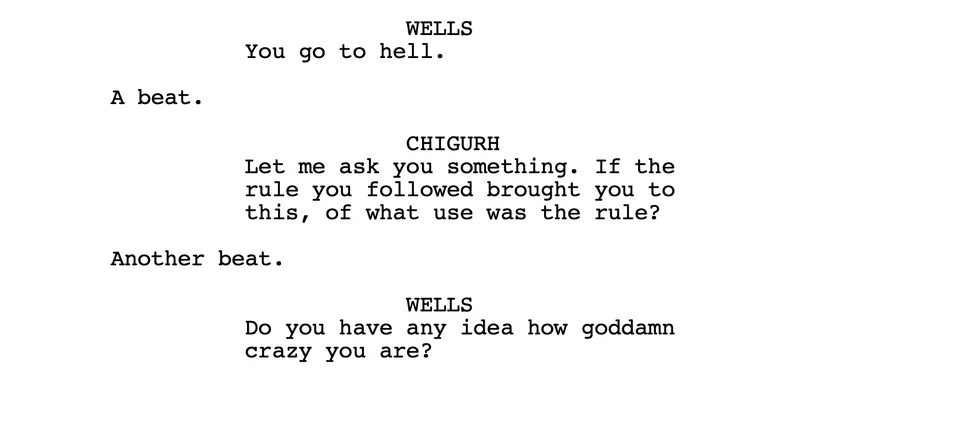
"You go to hell," he says.
Chigurh only smiles. Then he leans into the real question, the one he seems to have been saving.
"If the rule you followed brought you to this, of what use was the rule?" he says.
"You have any idea how crazy you are?" Wells says.
"You mean the nature of this conversation?"
"I mean the nature of you."
A phone starts ringing in the room. It's revealed that Chigurh already has his gun on Wells. He shoots him.
What the Line Reveals About Chigurh
Look at what Chigurh is really doing here. It's a genuine question. He's evaluating, and maybe passing time a little. To him, a rule is only as good as the result it produces, and Wells followed some professional code (instincts about money, risk, and staying alive) that has landed him in a chair waiting to die.
The rule failed. In Chigurh's accounting, that makes it useless, and Wells along with it.
Chigurh has traded human morality for a private logic he applies without exception, even when he doesn't enjoy the outcome. It's why the coin tosses feel so awful. He believes he's being fair, that he's only the instrument carrying out a verdict already reached. When the Coens adapted Cormac McCarthy's novel, they pared his speeches down until what's left is just certainty, a man who feels less like a person and more like an automaton.
His certainty and his code make him charismatic in his own way. He never wavers, and a villain who is intelligent and unshakeable frightens us more than one who only rages and strokes his pet cat menacingly and enacts world-domination plans.
Chigurh doesn't raise his voice. He just asks you about your philosophy and renders it useless.
 Credit: Miramax Films
How One Line Builds a Worldview
Chigurh's question works because it's doing several jobs at once, and it looks like small talk while basically functioning like a death sentence.
First, it reveals his character without being on-the-nose. The Coens never let Chigurh monologue about his philosophy. He never says, "I am doing this because I believe this," and it's all subtextual.
In this case, one line implies a worldview and shows us how Chigurh looks down on those around him. Every sentence is the belief in motion.
On the surface, Chigurh is asking a rhetorical question about the rules of a man in the same field. Underneath, he's informing Wells that he's already dead and inviting him to agree. There's horror in that subtext, menace hiding between the words.
Secondly, the line makes the antagonist the smartest force in the room. Chigurh is so scary because we always feel like he's already won. He's three steps ahead. He's calm and mechanical and unflappable. He wins this one before Wells can speak, because the question has no good answer. Any reply just proves his point.
If you want your antagonist to feel as strong as your hero, let him question others in ways that are difficult to refute.
In the End, the Question Turned Back on Him
What keeps the line from being a simple villain's flourish is what the movie does with it afterward. Chigurh spends the film certain that he stands outside luck, that he's the rule other people run afoul of.
Then, near the end, a car runs a red light and slams into him for no reason at all. It's totally random and outside the parameters of the story we've been experiencing. He climbs out with a bone jutting through his arm, with bloodshot eyes, suddenly as breakable as anyone else he's already killed.
The film is asking Chigurh his own question. If the rule you followed brought you to this, to a shattered arm and a concussion in a stranger's intersection, at the mercy of a coin you didn't get to flip… of what use was the rule?
The film's title says it plainly enough. This is no country for old certainties, and the world it describes doesn't answer to anyone's code, not even his.
The question Chigurh uses to condemn other men is the same one the universe is holding in reserve for him. He asks it like a man who knows the answer. But the end of the movie suggests he is just as vulnerable to whims and chance as anyone else.
- How The Coin Toss Scene in 'No Country for Old Men' Grounds the Theme ›
- The Real Meaning Behind the Title ‘No Country for Old Men’ ›
- Did You Know? This Oscar-Winner Has Almost Zero Music ›
- 7 Best Lines From ‘No Country For Old Men’ Ranked ›
- Iconic Film Introductions: Anton Chigurh’s First Few Minutes Are a Masterclass in Fear ›