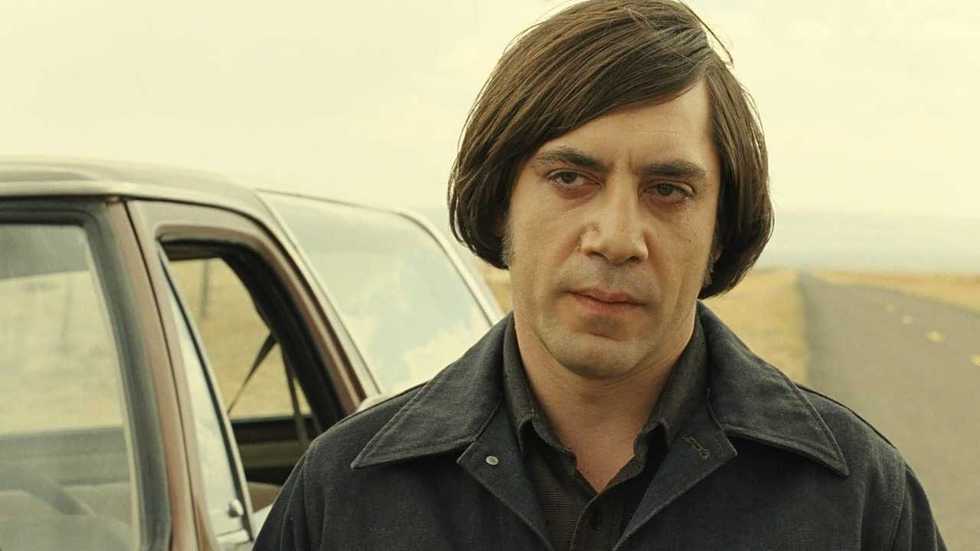
One of the most chilling performances of the 21st century is Javier Bardem’s turn as serial killer Anton Chigurh in the Best Picture winner, No Country for Old Men. The film dissects the nature of evil and the cynicism of human nature through the film’s narration, combined with his performance.
Let’s take a look at the opening sequence of the film and why Bardem’s introduction has always stuck with us.
Tommy Lee Jones’ Narration
Throughout the film, Tommy Lee Jones’ Ed Tom Bell chimes in to narrate his troubles and thoughts about the world. These monologues are plucked from Cormac McCarthy’s original novel, and in the opening scene as Chigurh is arrested and placed in a squad car alongside his CO2 canister weapon, we get our first instance of this. He talks about a young man he arrested and sent to the electric chair who bragged about the murder he committed, would absolutely commit more, and that he was anticipating going to hell. Ed knew not what to make of that.
It’s in this moment where we quickly realize that Anton Chigurh is about to be depicted as the version of that young man who was never caught. The one who mysteriously always evaded capture, a proper identity beyond a name, a motivation for his crimes, and any ounce of regret. Chigurh’s face is hidden in the shadows even when shot from the front during this narration to emphasize his mythical nature that will be echoed throughout the entire film. Even when he is known by other characters, his elusiveness allows him to blend right in.
The Presence of the Score
 ‘No Country for Old Men’Credit: Miramax/Paramount Pictures
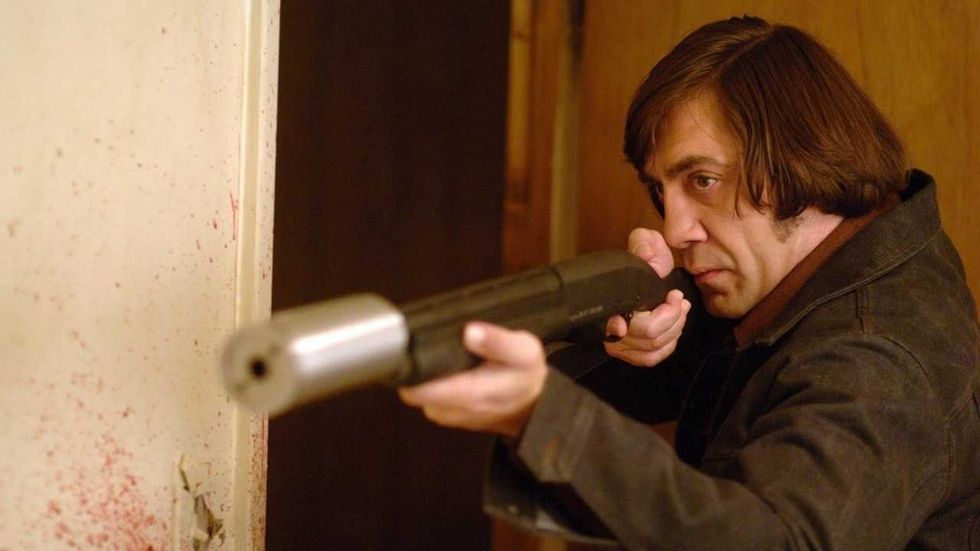
No Country for Old Men famously lacks a musical score almost entirely. The Coen Brothers were very particular about making sure the unpredictable nature of the film was emphasized, and that every moment of emotion lacked a sense of manufacturing via musical intervention.
With all of that said, the ambient score makes its first appearance in the opening scene. It slowly fades into the background when Chigurh walks into frame for the first time, shot from behind, and it very quietly crescendos into a more prominent presence as he is shot from the front dash of the car, obscured by shadows. The car then drives away, as the static shot watches from the same, voyeuristic position.
We Can’t See His Face Yet
Obviously, it’s clear visually that this is a character we should be feeling a great deal of dread over being in the presence of. The direction and stiltedness of Bardem’s physical performance makes that perfectly clear.
But in one of the only moments where Chigurh’s character is technically the “vulnerable” one in a confrontation, his face is entirely obscured. The car crash scene at the end of the film gives viewers a more intimate look at who Chigurh is when he’s in trouble, but this early on in the film, it’s not time yet for that veil to be lifted.
The First Time We See His Face
 ‘No Country for Old Men’Credit: Miramax/Paramount Pictures
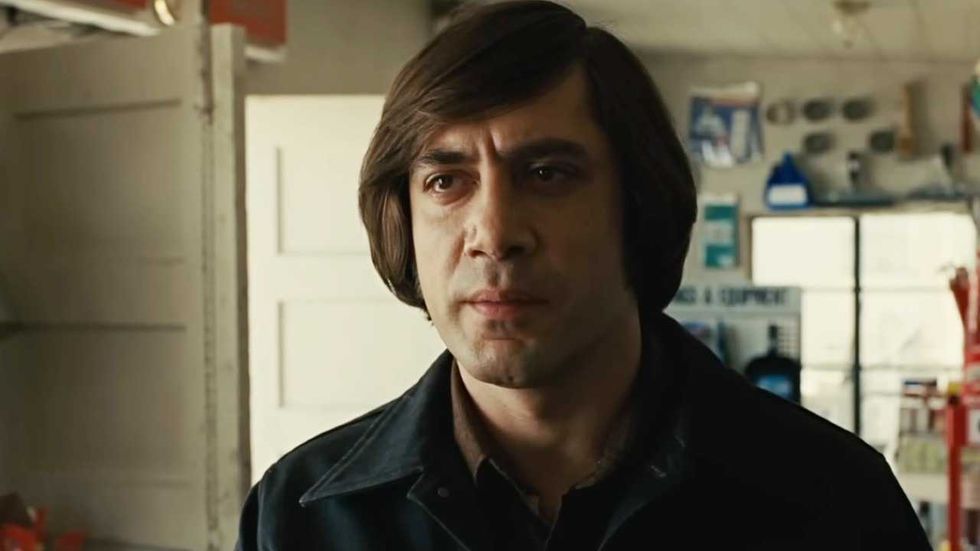
The film doesn’t wind up making us wait very long at all to get a glimpse of Chigurh’s face. In the scene immediately following Chigurh’s arrest, we see him very calmly slip from his restraint in the police precinct chair, calmly walk up behind the arresting officer, and strangle him to death with his handcuffs.
Perhaps the most emotion we ever get to see on Chigurh’s face at a single time is shown while he is committing the act. His face is full of an indescribably chilling passion and rage towards the officer he’s strangling that is easily burnt into the viewer’s mind for long after it’s over. Interestingly, that emotion fades almost instantaneously once the job is done. In fact, Chigurh takes a deep breath as if he just found out he got a good grade on a math test.
It’s also the most effort we see him put in to actually kill someone throughout the entire film. Obviously, he has multiple confrontations with Josh Brolin throughout that end in stalemates, but in one sitting, without a gun or his oxygen tank weapon, even by his standards he gets his hands dirty.
How it All Coalesces
In the end, Chigurh wins. He is able to get the money and escape into the shadows, maintaining his chilling sense of anonymity. Not without a severely broken arm to show for it, with a couple of witnesses, but for all anyone knows, he’s never seen again.
The embodiment of evil incarnate Chigurh represents is one that the writers of both the book and the film believe is one that will unfortunately not only endure, but thrive as the world continues to spin. Chigurh may be the antagonist of this particular story, but he’s just one of countless others just like him that we’ll never get to see.