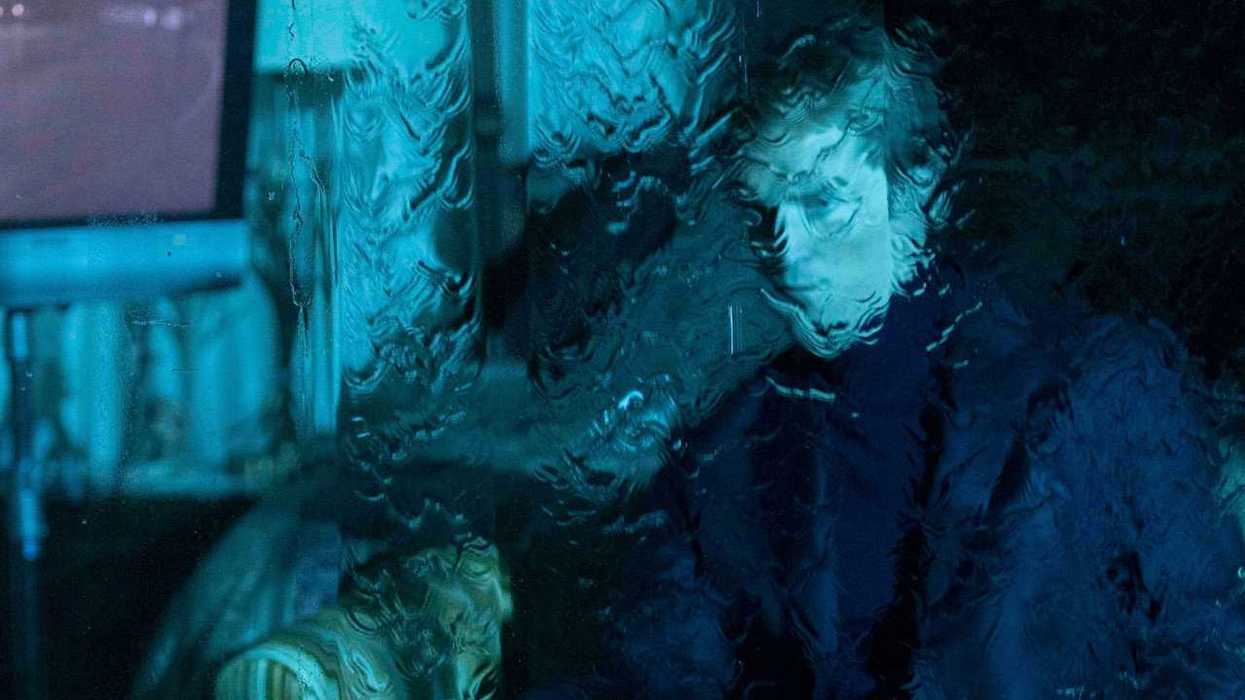
Lance Oppenheim’s newest film, Primetime, a soft biopic on To Catch a Predator host Chris Hansen, is far from your traditional life story, sanitized true-story piece. Robert Pattinson’s stunning transformation into Chris Hansen is one that is far from glamorous and often unkind to the legacy of the man himself.
Let’s examine how the film analyzes the people that Hansen is shown exploiting in the film, under the guise of catching other exploiters.
Chris Hansen’s Psyche
Chris Hansen is shown in a very interesting state of mind at the beginning of the film. Where your traditional biopic might follow the man initially coming up with the idea for To Catch a Predator, workshopping it around, and trying and failing at it a few times before finally hitting big, Primetime cuts out so much of the extra fat. The film opens with Hansen already filming an episode of the show, which at the start of the film is already a sensation.
Hansen has already sunk his teeth into the show. He cares deeply about hamming up the confrontations, keeping ratings up, and catching even more disgusting creeps than the episode before. His mind has already been perverted in a way that many other films would spend almost the entire runtime building toward. This allows the viewer to really get a firsthand look into how Hansen’s increasingly deteriorating sense of priority negatively affects the people working with him and in his personal life. His marriage is failing, his employees are being poached to other networks, and he stops pursuing predators for the sake of good, instead pursuing them for personal gain without regard for the safety of those around him.
Chris’ Influence on 'Decoy Dan'

'Primetime'
Credit: A24
Skyler Gisondo’s character in the film, Dan Plumb, sneaks in early on as the character with probably the most meat on their entire arc. Plumb is a struggling actor desperate to obtain his SAG card, and accepts a job as one of To Catch a Predator’s decoy minors as a way to get him there. It's in this role that he’s groomed by Hansen to stick around amidst less than desirable working conditions and problematic personal environments. He starts to become obsessed with making the role his own, amidst taking direction from Hansen and the rest of the crew.
He is also one of the first characters alongside Phoebe Bridgers’ Del, who starts to see the cracks in Hansen’s framework, and the exploitation of the men being caught by the show for their own personal gain. The film examines through his eyes the fine line between justice and public humiliation for the world’s entertainment. Gisondo’s character acts as a voice of reason for the audience, but is constantly under the spell and trap of what Hansen’s character wants, regardless of the consequences.
What the World Deems Powerful
Power takes many different forms for many different characters throughout the film. For some of the more prominent predators featured in the film, the sense of power for them is obvious. For Chris Hansen, it’s being able to have authoritative, humiliating power over others that gives him strength. With his family life crumbling under absence and allegations of affairs, it’s really all that he has to hold on to.
For other characters like Merritt Wever’s Andie, it's being someone in a position of authority at a TV show that both the network and the public really love. She prides herself on being able to be the one person in a professional environment who has control over Chris Hansen. As the film progresses, and Hansen becomes more and more unpredictable and uncontrollable, her loyalty begins to really be tested. Other networks try to poach her from NBC to varying degrees of convincing, and it’s clear that the power of whatever she’s associated with presently is her driving mode of influence. If NBC starts to lose faith in To Catch a Predator, her self-security becomes unstable. If their show achieves a win in the eyes of the network or the public, all of a sudden she’s right where she wants to be once again.
The film treats power as this intangible allure that functions as a shroud for something much more spiritually dark. The visual imagery and symbolism of the film channels 2001: A Space Odyssey more times than you’re probably expecting, and achieves everything you would want a biopic to achieve through its visuals that we rarely, if ever, get to see anymore.
We understand very early on that the ethics of someone like Chris Hansen are incredibly ambiguous, but not in a corporatized, sanitized manner like we’re so used to nowadays with these kinds of films. The film’s stance is always that it doesn’t have one, and allows the seediness of the character's motivations to be the driving force of whatever emotional reaction you have. It’s already sparked hours of conversation since its release, and I’m excited to see how it continues to evolve.