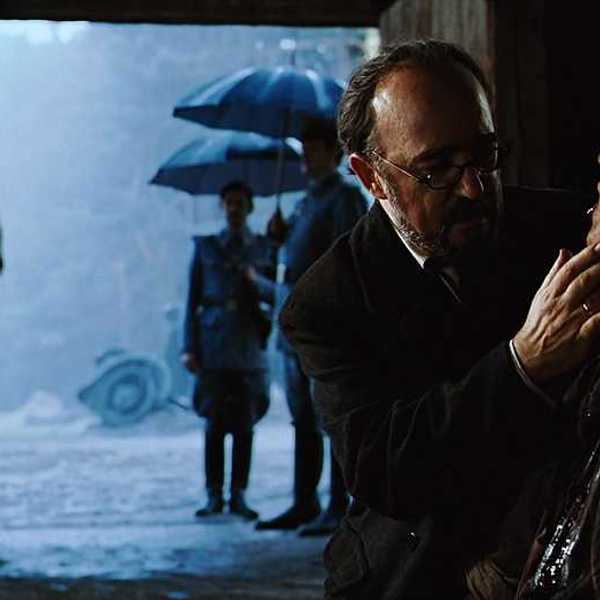
Tim Robinson's new HBO series The Chair Company is getting praise for a lot of reasons. It's a surprising cringe comedy with absolutely paranoid energy, and Robinson is bringing his signature unhinged performance into each episode.
The show follows William Ronald Trosper (Robinson), a project leader at a property development firm, whose chair collapses during an important presentation. When he attempts to complain to the chair manufacturer and can't seem to reach a human, Ron uncovers an apparent conspiracy and becomes obsessed with learning the truth.
The show really is delightful. But if you're a screenwriter paying attention, you'll notice something else happening in almost every scene.
The show quietly demonstrates one of screenwriting's most fundamental principles—start late, leave early.
What "Start Late, Leave Early" Means
The concept, often credited to screenwriting professor Syd Field, is straightforward. Enter a scene as late as possible and exit as early as possible. This approach keeps stories moving at a pace that holds the audience's attention. Go too slow and viewers disengage, move too fast and they can't follow. This technique helps find that sweet spot.
Once the scene's purpose is accomplished, you're out. No lingering goodbyes or tidy wrap-ups.
 The Chair Company Credit: Sarah Shatz/HBO
How the Show Puts It Into Practice
The series constantly throws Ron from one uncomfortable situation to another without dwelling on transitions. As The A.V. Club points out, the show maintains its momentum through quick cuts and constant forward motion, never pausing to let Ron (or the audience) catch their breath.
Take the first episode. The show opens on a family dinner in a restaurant. Through economic dialogue (and a brief fight about the definition of "malls"), the scene quickly sets up something about each character. We don't need to see the whole dinner, or the family arriving or leaving.
Suddenly, it cuts to Ron and his wife asleep in bed. We don't know how long it's been. Ron sits up suddenly, lamenting, "I swear I have the worst pillow in town!"
The joke is nonsensical and there's no set-up or resolution, but we don't need any more than that. The whole scene is maybe nine seconds long.
This tactic is used constantly in every episode. If we see something, it's in service of a visual gag or joke or plot detail. After those jokes land, we're on to the next. Sometimes, the shock of how funny something is and how quickly it moves on only adds to the show's humor. There's not a lot of breathing room, but the jarring nature works to the series' benefit.
Another example is the start of the most recent episode ("Bahld Harmon birthplace (disputed)"). By this point, a mask-wearing Tecca crony has appeared on Ron's security cameras. After a brief flashback scene, we see Ron with his own crony (Mike Santini, played by Joseph Tudisco). They are already looking at the footage, in awe of how fast the strange figure's head is wiggling. No further setup needed. Mike agrees to watch the house. The scene ends.
Multiple scenes throughout the series show Ron at his computer. Making a scene about Internet research or spreadsheet creation could be very boring, but the show manages to make it tense each time and end on a strong button or new discovery, then it moves on.
This approach keeps The Chair Company moving despite dealing with potentially mundane material. A middle manager investigating a chair company. How exciting could it be? Really exciting, it turns out.
 The Chair Company Credit: Sarah Shatz/HBO
This Makes Stronger Writing
Every moment on screen costs money and demands viewer attention. Scenes need to justify their existence by moving the story forward, revealing character, or both.
If there's setup in a scene that's not needed (a character entering a room, sitting down, starting his computer, waiting for a phone call), it probably means the scene has started too early. Just show the character on the phone already.
You can start mid-conversation or mid-trip or anywhere that gets us closer to the conflict, as long as it makes sense.
Screenplay Readers points out that arriving late into scenes forces you as a writer to focus on what's actually important.
When to Break the Rule
Of course, there are exceptions. Sometimes you need a breather or a moment to let emotions land. Blue Pencil Agency points out that good pacing requires both compression and expansion. You can't sprint for two hours straight
The Chair Company works super well because Robinson and co-creator Zach Kanin trust their audience to keep up with their quick pace. We just need the good stuff. And here, those are mostly the moments when things get weird and uncomfortable.