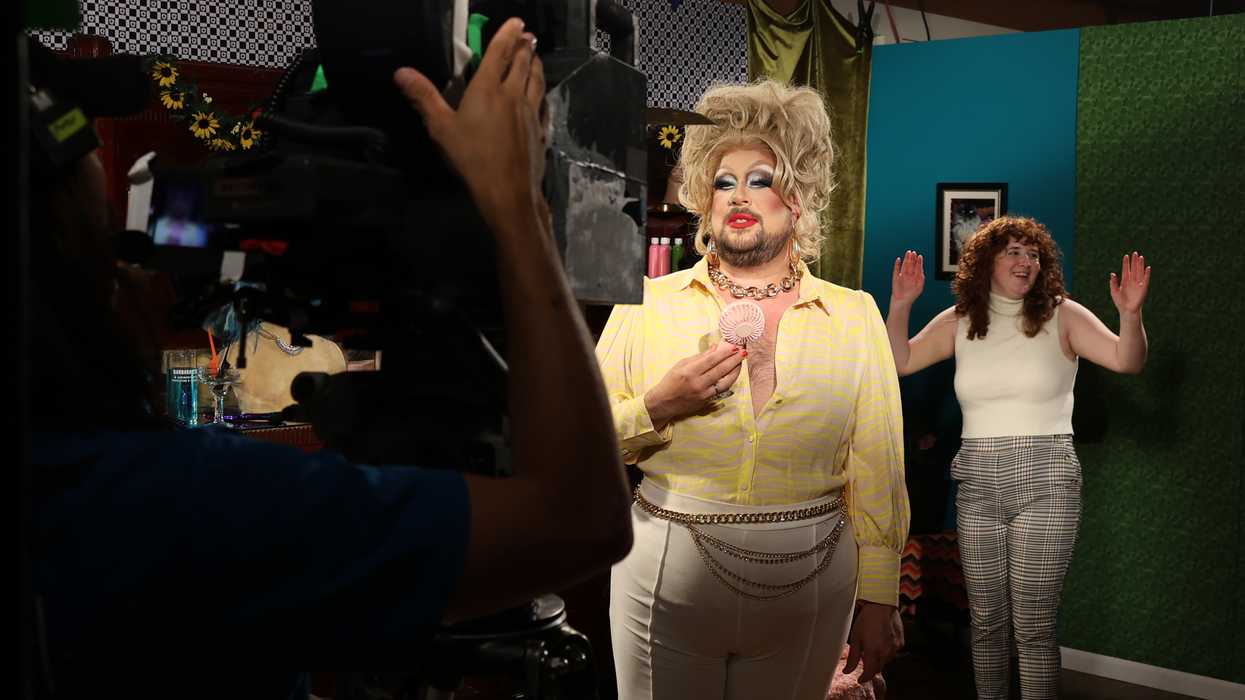
John Waters, eat your heart out! Inspired by the writer and director’s own battle with endometriosis, Brooke H. Cellars’s debut feature is a bold, fun, and—at times—psychedelic look into the comedy and horror of menstruation.
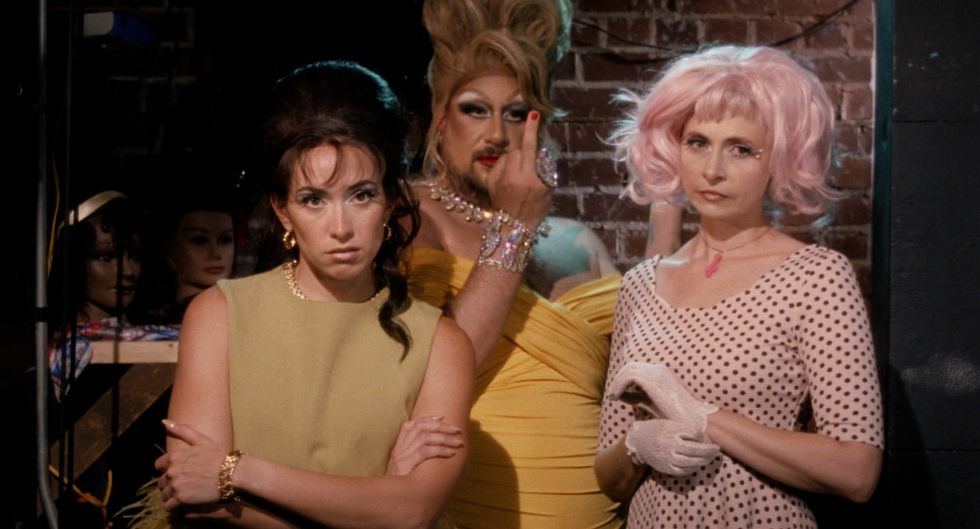
With a heavy influence by the mid-century films of John Waters, THE CRAMPS: A Period Piece manages to both look like it’s a dusty VHS discovery from the back of a thrift store, while still presenting a narrative that feels important and empowering today.
To explore how Cellars and her team achieved such a nostalgic and entertaining aesthetic, we spoke with Cellars about her horror filmmaking journey. We also sought her advice for those looking to create their own Fantastic Fest-worthy shorts and features.
NFS: How did you first get into writing and directing, and what is your background as a filmmaker?
Brooke H. Cellars: I grew up around stories. My dad was a writer. He wrote Cajun children’s books that were kind of like Cajun superhero comics, and he always said he knew one of his five kids would end up being a writer. He was right, and it was me. Though he wanted me to write Cajun stories, I was never interested in that. I was always drawn to the weird stuff. Horror movies were my jam. I was the weird kid, of course. Surprise! I started writing horror stories when I was really young and even won awards for them in grade school.
My two younger brothers and I basically lived at the video store. We rented VHS tapes constantly and watched everything we could. Some of our favorites that we rented over and over were The Lost Boys, The Goonies, and Bloodsport. We memorized the lines, knew all the actors, and wore out the tapes.
Funny thing, the film that really made me curious about how films were actually made was the making of Michael Jackson’s Thriller, especially the special effects makeup for the werewolf. My little self said, ‘I wanna do that.’ But making movies seemed like a pipe dream, and I would have to live in Los Angeles or New York, or have lots of money or a filmmaking parent or something. I had no idea I could have always just done it.
But unfortunately, in my family, being an artist wasn’t encouraged. It was all about business or “find something to sell,” as my parents always said. So I got pulled in a lot of different directions, even though I knew deep down what I wanted to do, which was to make a horror movie. As an adult, I tried college so many times but couldn’t stick with it, mostly because of the pain from my undiagnosed endometriosis. For twenty years, I worked as a waitress, partly because it was flexible enough to let me take time off when I was in too much pain. I got hired and fired more times than I can count. It was definitely a life of ‘what’s it matter?’
It wasn’t until I was 34, after my first endometriosis surgery, that I finally felt well enough to try school again. That’s when I discovered my local university had just launched a brand-new film program. Holy shit, is this really happening? From my very first student project, I knew exactly what I wanted: I wanted to direct. And once I stepped onto that set (which was at my house!) that’s all it took. I hit the ground running.
Since then, I’ve directed eight short films and now my first feature. Honestly, it still feels surreal. I don’t take a single bit of it for granted.
Credit: Fantastic Fest
NFS: What was your initial inspiration for the film?
BC: The inspiration came from wanting to create a world that reflected what it was like to live with endometriosis for most of my life. To me, it always felt like there was this obvious creature inside me, taking over my body, yet no one else, not even doctors, could see it. That invisibility was just as painful as the illness itself. It shaped the way I lived, the choices I made, and the person I tried so hard to become, even while it was holding me back.
The actual spark, though, came from a joke I made one day, “What if I made a period piece about actual periods?” As soon as I said it, my brain lit up. That mix of humor, horror, and honesty clicked immediately, and it became the foundation for the story. It was my way of finally giving that invisible experience a voice and a form. The evil endometriosis.
NFS: The film feels like it was found in a vault of lost John Waters films from the 1970s. Can you tell us a bit about how you developed such a retro-fashioned look and style for the project?
BC: I’m a huge John Waters fan. Even as a kid, before I even knew who he was, I was watching his films, especially Cry-Baby and Serial Mom. I even had a Serial Mom poster on my wall when I was about eleven or twelve. So his influence has always been there for me, even unknowingly.
Yes, the most obvious inspiration for this film is Waters, but it’s not about copying him. What I take from his work is the unapologetic spirit, the colorful characters, the bold, exaggerated looks, and the freedom to say exactly what the hell I want without holding back. I also really connect to the way he made movies back then: with whatever he had, with whoever was willing, and with this raw, do it your damn self energy that made the films feel alive.
While I appreciate modern film, mid-century films are the ones that truly make my eyes light up. I’m like a cat, and they are the glitter. The colors are so bold and vibrant, the costumes and set designs feel so intentional that they become characters themselves, helping to create entire worlds. It’s like being “Twilight-Zoned” into another universe. That’s the kind of filmmaking that excites me, where anything is possible. I don’t like rules. Or uniformity. Or math. Or spreadsheets.
That’s why I leaned into the retro style for this film. It let me build a world that feels alive, surreal, and always unusual. Paying homage to what inspired me, but also something entirely my own.
NFS: What cameras did you shoot on? Any insights into why you picked your gear?
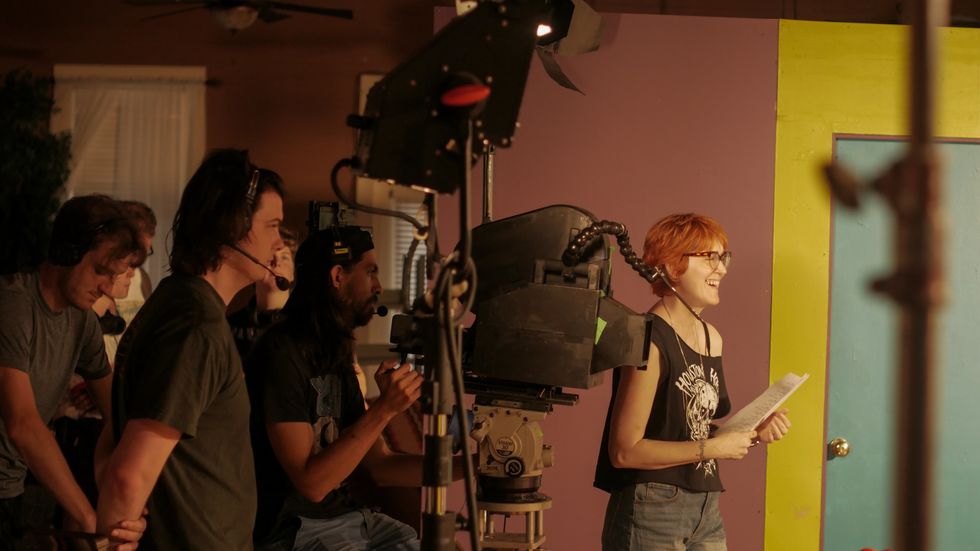
BC: I work very closely with my director of photography, Levi Porter, one of my true filmmaking partners in crime. He’s shot all of my films and is one of the few people who can translate my scrambled-egg-brain language. For THE CRAMPS, we decided to shoot on 35mm film, which, for a feature, made the rest of the crew understandably nervous. Shooting on film is a risk; there’s a limit to how many takes you get, and things can go wrong. But for me, that’s a plus. I like a little chaos and pressure. I’m not someone who wants twenty takes; I’d rather rehearse, rehearse, rehearse, and then shoot it in three takes or less.
With Levi, I had complete trust. He’s as passionate as I am, and even more deeply versed in the world of film. We had producers and mentors warning us not to do it, telling us it was a bad idea. But I don’t listen to people I don’t trust, and in the end, I always listen to my gut, and my gut said we’re shooting on film.
Thank you, gut. I know that sometimes my gut decisions stress the crew out, but it always comes from a place of passion and intention. What’s best for the film is best for all of us, and I never lose sight of that.
We ended up shooting on an Arriflex 2C, first released in the 1960s. Ours was modified to 2-perf to save film stock, customized with a blimp for sync sound, and it perfectly captured that midcentury Technicolor world we wanted to recreate.
NFS: As a seasoned horror filmmaker, how have you found that your appreciation for the genre has evolved over the years?
BC: Seasoned? Ooh, that feels so fancy. Thank you! Oh, let me tell you, it has evolved so much. Growing up, I was fascinated by horror films. I loved them deeply without really knowing why. But the more I watched, and especially once I started making my own, my appreciation just flourished.
I’ve always adored horror, but it wasn’t until I began creating my own stories that I realized how powerful the genre really is. Horror is very cathartic. I believe it’s the best genre to say the things we’re too afraid to say out loud, to confront the real horrors in our lives, and to process things that are often invisible or unspoken. Through metaphor, absurdity, and extremes, horror gives us a way to talk about what really hurts.
There’s also a healing quality in it, finding catharsis in the scares, in the release, maybe making light of the darkness. What I love is how horror can be both unexpected and expected at the same time. It can follow familiar rhythms while still surprising you, which makes it endlessly creative.
Credit: Fantastic Fest
NFS: What advice would you give to any aspiring horror filmmakers looking to find their own voices and tell their own Fantastic Fest-esque stories?
BC: Everyone has a story, but it’s how you tell it that draws people in. Ask yourself, What do you want to say? What’s important to you? How do you see the world? That perspective is what makes you unique, and it doesn’t matter if other people see it the same way. That’s the whole point.
My advice is to wrap yourself in everything film—immerse yourself in the process—and for god’s sake, watch more movies! The more you see, the more you understand what excites you, what doesn’t, and where your own voice can break through.
If you want to make a film and tell your story…do it. I hear so many excuses from people who say they can’t. No money? No camera? No crew? So what. Use what you have. Figure it the fuck out. You can. If I can, you can. I’m not special. Also, I didn’t make my first student film until I was 37. I’m 44 now. It’s NEVER too late. Ever.
- Fabricate True Crime Documentary Style With 'Strange Harvest' ›
- Cinematic Eccentricity on a Budget: Joe Badon on Directing 'The Wheel of Heaven' ›
- How 'FISHMONGER' Created Practical Horror Effects on a Tight-Budget ›
- When is Harsh Criticism Appropriate? Mumblecore's Joe Swanberg Boxing His Toughest Critic, Literally ›
- Laugh at the Filth With ‘Heads or Fails’ Filmmakers Lenny & Harpo Guit ›
- Laugh at the Filth With ‘Heads or Fails’ Filmmakers Lenny & Harpo Guit ›
- A Look at the Award Winners from This Year’s Fantastic Fest ›
- Balancing Studio and Indie Genre Filmmaking with "Faces" Director Blake Simon ›
- Why the 20th Edition of Fantastic Fest is the Most Important One for Filmmakers | No Film School ›
- Here Are All of the Fantastic Shorts and Features That Won Awards at Fantastic Fest 2025 | No Film School ›
- Horror Film Season is Officially Here as Fantastic Fest 2026 Kicks Off This Week | No Film School ›