The 1948 Gregory Peck Western Movie That Became One of His Most Underrated Classics (Yellow Sky)
It's an odd movie that owes its plot to a classic Shakespeare play.
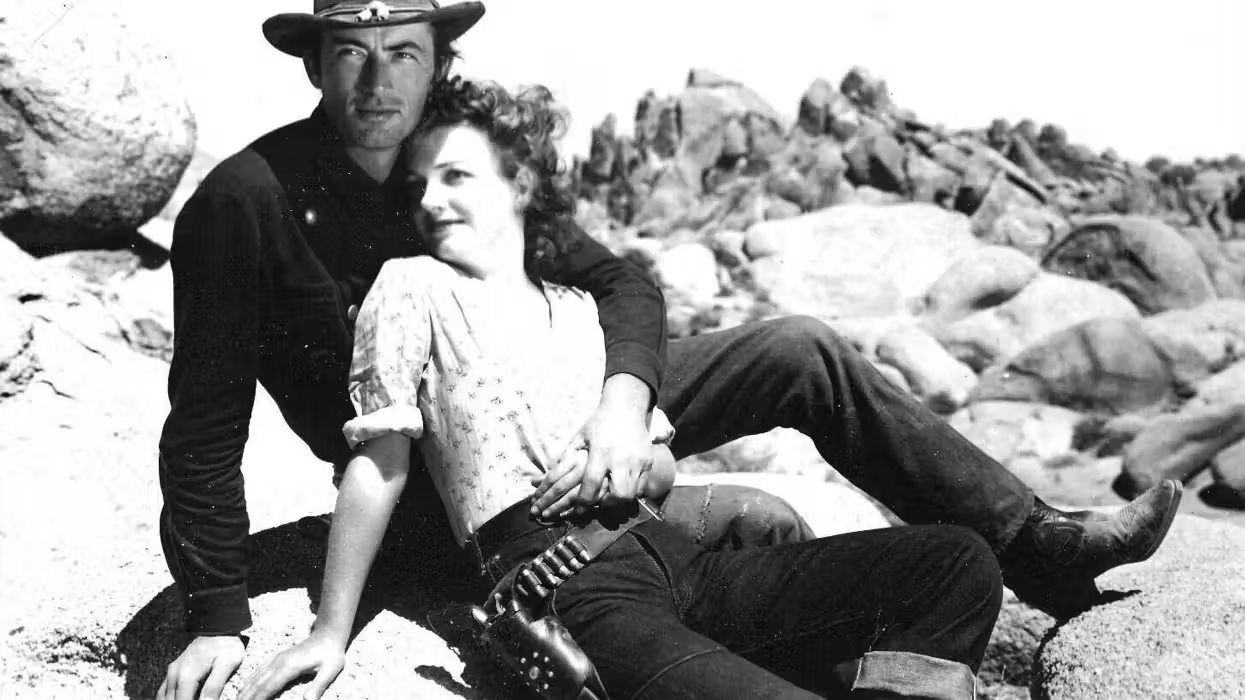
'Yellow Sky' (1949)
There are so many famous Westerns out there that are easy to find, but today, I want to talk about a lesser-known one that I consider to be a hidden gem.
During the '40s and '50s, Hollywood was pumping out so many of these that they were easy to miss and even easier to forget.
But hidden between names like Stagecoach, The Searchers, or High Noon is William A. Wellman’s Yellow Sky (1948). It's this beautiful post-war movie that uses wide-open spaces as a character and isolates its story in a very bold way.
It's a case study in cinematography and just building tension over the course of its runtime to its inevitable showdown.
Let's dive in.
- YouTubewww.youtube.com
Shakespeare Meets the Salt Flats
There are many Shakespeare adaptations in Hollywood, but this one rides a horse and has six-shooters. The film was written by Lamar Trotti (adapted from a story by W.R. Burnett).
Yellow Sky follows a band of bank robbers on the run after a heist. This band of outlaws is led by James "Stretch" Dawson (Gregory Peck). They barely survive a trek across Death Valley only to stumble upon a town called Yellow Sky.
But this is unlike most towns in the West. This is a ghost town where everyone has moved away except for its last two residents: an old prospector and his granddaughter, Mike (Anne Baxter). As it turns out, they are sitting on a pile of gold they don't want to let go.
What started as a survival tale quickly devolves into a psychological stand-off between both factions, as Peck falls for the woman and also has to hold off his own gang.
Now, I know that doesn't sound like Shakespeare you read in high school, but it's loosely based on The Tempest, where a small group is stranded, and an old man with his daughter guards their enclave from invading schemers.
Yes, it's loose, but it's there.
Why Filmmakers Should Study Yellow Sky
Look, I'm here to stump for lots of old movies. I think we're becoming way too obsessed with the new, and we have so much more ot leanr from how filmmakers did things in the past. Especially as we search for new genre conventions or ones we can resurrect.
So I compiled a few things I think this movie does well that can send you on your way with lessons you can use in your own material.
High-Contrast Lighting in a Western Landscape
Even if you're not going to make a Western or a film noir, the lighting here is something to take with you.
Cinematographer Joe MacDonald (My Darling Clementine, Pickup on South Street) took full advantage of deep focus and gave us these sweeping vistas that completely isolate the gang. They use this isolation to mask safety and then claustrophobia in a wide-open place when they feel isolated.
In the saloon scenes, you’ll often see Peck in the foreground deciding his next move, and Richard Widmark’s menacing villain character ("Dude") lingering in the mid-ground whispering rebellion to the crew.
All this gets juxtaposed against a door or window, where you also get the idea of a threat coming for these bank robbers.
The shadows in the ghost town are like right out of a horror movie with their low-key lighting. There are contrasts here that also show what can be hidden in far corners or behind curtains as they skulk around.
Subverting the Gregory Peck Persona
Another thing this film does is take a lead actor we love from one genre and thrust him into another, completely changing the way the audience knew him.
By 1948, Gregory Peck was established as Hollywood's moral center.
People loved him as the good guy.
So why not make him an outlaw?
They do give him a character arc back to the guy you know, but he starts pretty far away. Peck's performance is very surprising and starts you off in your town, which draws us in.
The Legacy of Yellow Sky
Yellow Sky bridges the gap between the traditional Westerns of the 1930s and the revisionist, gritty Westerns that would dominate the late 60s and 79s (think Sergio Leone or Sam Peckinpah).
You can see how people like Tarantino might take inspiration from this film for Reservoir Dogs or the sharp dialogue, too.
This is a good movie to seek out and one to watch and just enjoy people working at the top of their game, bringing a unique story to life.
Let me know what you think in the comments.