Film Quote of the Day: The Most Underrated Rocky Line Redefined What Winning Really Means
"All I wanna do is go the distance."
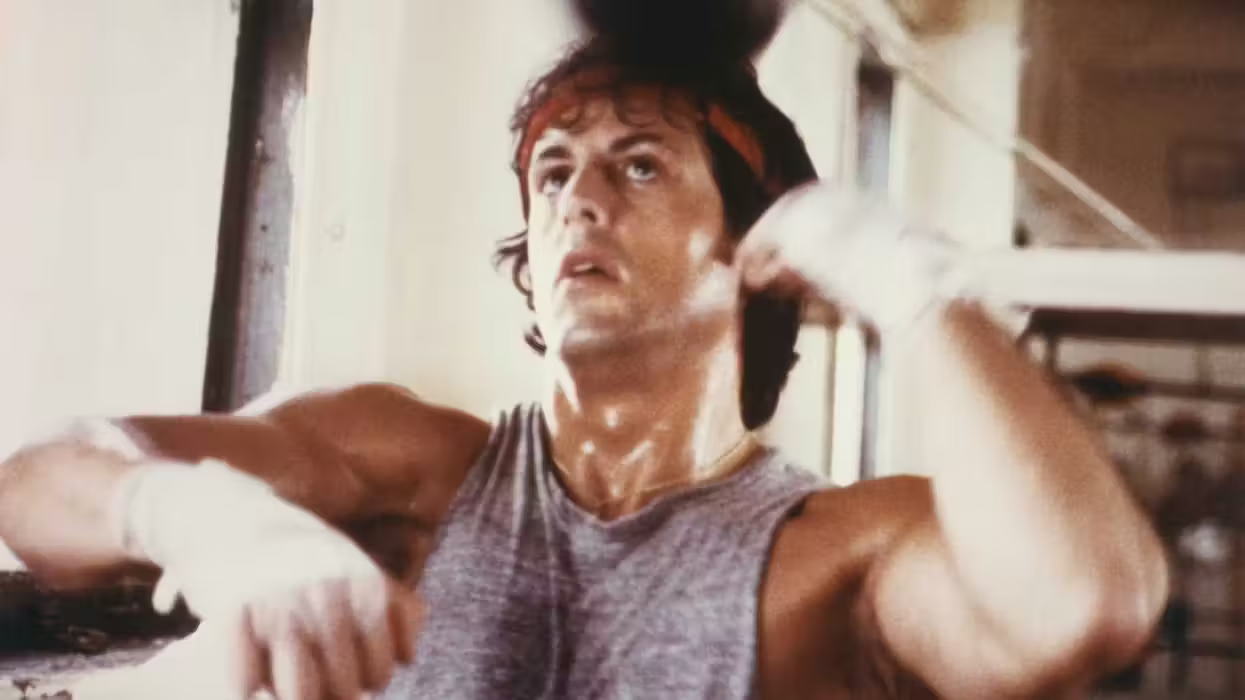
'Rocky'
The thing about a movie like Rocky, which is so part of the cultural lexicon that you don't even have to have seen it to quote it, is that I think people miss out on a lot of its lessons because they assume they know everything about it.
Everyone knows about the climax of Rocky. You get the swelling brass of Bill Conti’s score, the loss to Apollo, and the primal scream of "Adrian!" echoing through the Philadelphia Spectrum. It's someone's triumph even though Rocky loses the fight.
But Sylvester Stallone understood something fundamental about screenplay structure and human nature that the studio executives didn't at the time.
Rocky winning wasn't the point of the movie...the point was just being able to fight. And he set that up early on, so we'd have both the internal and external conflicts resolved in the final moments.
And he summed all that up in one line.
Let's dive in.
- YouTubewww.youtube.com
The Scene In Question
Go watch Rocky. I legitimately think people talk about this movie having never seen it, and it really is one of the greatest American movies ever made.
Rocky was directed by John G. Avildsen, but the soul of the film belongs entirely to its writer and star, Sylvester Stallone.
The story tracks a down-on-his-luck Philadelphia loan shark collector and club fighter who gets a million-to-one shot at the heavyweight title against the champion, Apollo Creed, in an exhibition match.
You root for Rocky not because you think he has a chance, but because you're so excited he's getting a shot at doing something that will make him memorable.
The whole of the movie gets summed up in one dramatic bedroom scene. Rocky comes home from walking through an empty, cavernous arena, crawls into bed next to Adrian, and confesses his deepest fear to her, thus really letting his guard down and allowing himself to be totally vulnerable with the woman he loves and the audience.
Rocky: I can't do it.
Adrian: What?
Rocky: I can't beat him.
Adrian: Apollo?
Rocky: Yeah. I been out there walkin' around, thinkin'. I mean, who am I kiddin'? I ain't even in the guy's league.
Adrian: What are we gonna do?
Rocky: I don't know.
Adrian: You worked so hard.
Rocky: Yeah, that don't matter. 'Cause I was nobody before.
Adrian: Don't say that.
Rocky: Ah come on, Adrian, it's true. I was nobody. But that don't matter either, you know? 'Cause I was thinkin', it really don't matter if I lose this fight. It really don't matter if this guy opens my head, either. 'Cause all I wanna do is go the distance. Nobody's ever gone the distance with Creed, and if I can go that distance, you see, and that bell rings and I'm still standin', I'm gonna know for the first time in my life, see, that I weren't just another bum from the neighborhood.
- YouTubewww.youtube.com
Not Just Another Bum From the Neighborhood
The Rocky script is an impeccable display of screenwriting. We have this guy who purely wants this clear goal; we think it's to win, but the reveal here is that he knows he can't win, but he wants to just belong. To be someone bigger than anyone thought he could ever be.
This character development is so clean. We buy this back-and-forth dialogue because we understand now who both these characters are in the scene and what they need from the other person.
Rocky needs to say this out loud to the one person he trusts, because the weight of the world's expectations is crushing him, kike they have his whole life.
This shift in perspective makes the audience lean in because we suddenly realize the true stakes of the story, not the external ones, but internally what it means for Rocky to just be in this fight and to hang.
"Go the distance" is exactly the kind of gritty, working-class mentality that makes Rocky a character we love and that made this a hot movie that spawned like ten mother movies and one of the most successful franchises ever.
In this moment, we get that Rocky completely understands that the world has already written him off as a joke. He knows Apollo Creed is the greatest boxer alive, which means trying to out-box him is stupid.
The cool thing about this movie is that this scene becomes the theme, as the narrative shifts from a story about a boxing match to an epic treatise on self-worth.
The Takeaway for Screenwriters
This entire film operates as a sports movie, but with an ending that subverts the genre and changes it from being about external wins to an internal one.
When it comes to your own writing, it's up to you to define the internal victory for your specific character, and that's what great screenplay structure is supposed to do.
As filmmakers tracking our own script development, we often fall into the trap of making our third acts all about winning the external prize, which the audience finds predictable.
To keep that from feeling boring, you have to make the internal goal just as important, because when we care about the people on screen, we lean into any external conflicts carried by the internal ones.
Here are a few strategies I'd use:
- Shift the Goalposts: A great third act doesn't always need to fulfill the character's original objective from page one. If the emotional arc evolves, the physical goal can change in tandem, so we can see the character grow.
- Find the Quiet Before the Storm: This bedroom scene works because it doesn't need a reaction. It's just let Adrian show Rocky where he's safe, with her, and that he doesn't have to be fighting with her; she knows and understands him. In that moment. We're all hugging Rocky.
Summing It All Up
I think this movie has withstood the test of time because of this line. Anyone who has ever had a dream or believed in something they're doing can go back to it and use it as fuel to push hard and to try to get the job done. I know it has echoed in my ears as I trek through Hollywood and try to find my place in it.
All I wanna do is go the distance.
Let me know your favorite lines from the film in the comments.