War films majorly use muted colors, yet one cannot possibly ignore how vividly they explore different emotions in their various shades. From cynicism to romanticism to patriotism to spiritualism, to “you name it,” war films have covered it all. But few have done it like Francis Ford Coppola’s Apocalypse Now (1979).
The film features an ensemble cast that includes stalwarts such as Marlon Brando, Martin Sheen, Harrison Ford, and Dennis Hopper, playing standout characters that each represent a unique perspective on war and its impact.
Among the most memorable characters is Lieutenant Colonel Bill Kilgore (Robert Duvall), who, despite his limited screen time, has left a lasting impression on the viewers.
In this article, we’re examining how the iconic one-liner, “I love the smell of napalm in the morning,” by Lieutenant Colonel Bill Kilgore, is problematic, despite its enduring legacy.
The Story
Coppola's Apocalypse Now follows Captain Benjamin L. Willard (Martin Sheen) as he sets out to kill a renegade Special Forces Colonel, Colonel Walter E. Kurtz, a man also suffering from a form of god complex. Through Williard’s quest for Kurtz, he comes across various people as his aids, who are also actively involved in the ongoing Vietnam War. Each encounter of Willard is a poignant reflection of how war impacts, influences, and is perceived by different minds.
The Scene
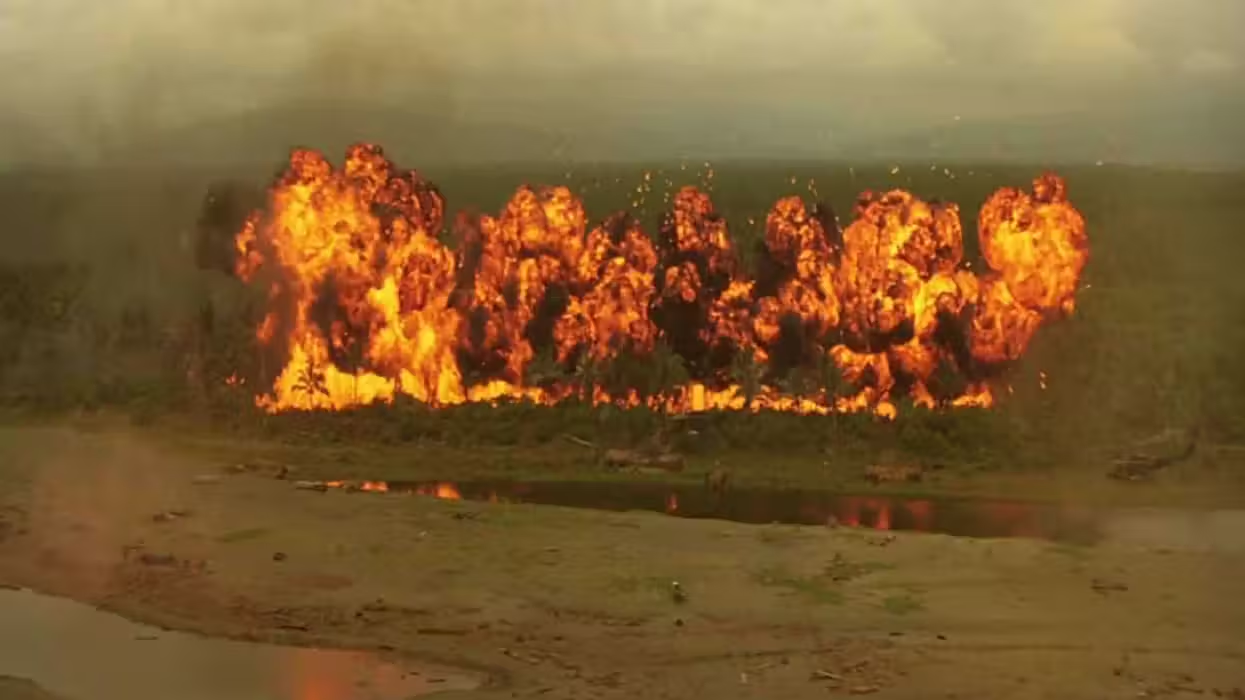
It is a war zone. Dust and the smell of gunpowder have taken over. Kilgore is on the field, leading the troop. He orders a full-fledged napalm strike on the field, then evacuates his men to safety, as he waits for the order to be carried out.
Moments after the strike, Kilgore sits with his fellow soldiers, telling them a story about a napalm strike in another war. He begins with the words, “I love the smell of napalm in the morning.”
Decoding: "I Love The Smell Of Napalm In The Morning"
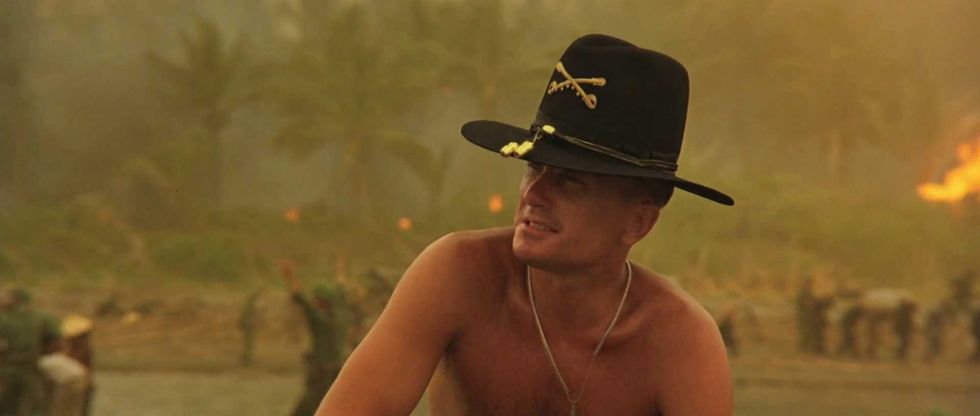 Apocalypse Now (1979)Source: Paramount Pictures, Starz Entertainment, Miramax, Studio Canal, United Artists, Studio Canal UK
Napalm is a dangerous explosive. It usually explodes in a series and thus is capable of significant destruction.
When the commander of a troop romanticizes the destruction caused by a war explosive, it is indeed a matter of grave concern. While Kilgore is one of the more competent and dependable soldiers of the army, his nonchalance towards war and the fatality it brings along paints him in different shades of gray. On one side, his outlook is suggestive of a long career in the army, owing to which, he’s now extremely accustomed to the horrors of war, while on the other, it’s a reflection of a man’s ambition, who has lost too much to care for anything anymore.
The description of the other war zone after the napalm attack by Kilgore is also nightmarish, especially when he says, “We didn’t find one of them. Not one stinking dink.” The rest of the story only gets darker, as Kilgore states how the smell of burnt gasoline, after an explosion like a napalm attack, smells like victory to him.
Kilgore represents those people who romanticize war. They associate it with bravado and patriotism, turning it into a vicious cycle to feed into their own sense of glory. The way he fills up with glee, excitement, and pride, narrating a story where he was responsible for the death of innumerable people (even if it was war), shows how war influences morality and conscience.
Reportedly, Apocalypse Now’s script-to-screen journey was a literal apocalypse. For the longest time, the studios didn’t agree to fund the film, fearing political controversy that a film set in Vietnam during the Vietnam War would attract, until United Artists took up the project. A lot of the crew was on drugs during the entirety of the schedule, and Coppola (also a co-producer) was on the brink of losing his house because of production failures. The crew got arrested, and production was shut down as a police investigation began around the corpses that were a part of the set design. Even the lead, Martin Sheen, had a near-death experience as he suffered a serious cardiac arrest during the filming in the Philippines. But all’s well that ends well, and Apocalypse Now continues to top the list of “the best war movies of all time.”
Which is your favorite moment from the movie?
- Putting Sanity At Stake: Coppola Interviews John Milius About Writing 'Apocalypse Now' ›
- Watch: Why 'Silence' and 'Apocalypse Now' Are Two Sides of the Same Coin ›
- Why 'Apocalypse Now' Might Be Dangerously Overrated ›
- “Charlie Don’t Surf!”: The Absurdity of War in ‘Apocalypse Now’ ›
- 'Apocalypse Now' Cut Breakdown: 1979 Theatrical vs. Redux vs. Final Cut | No Film School ›