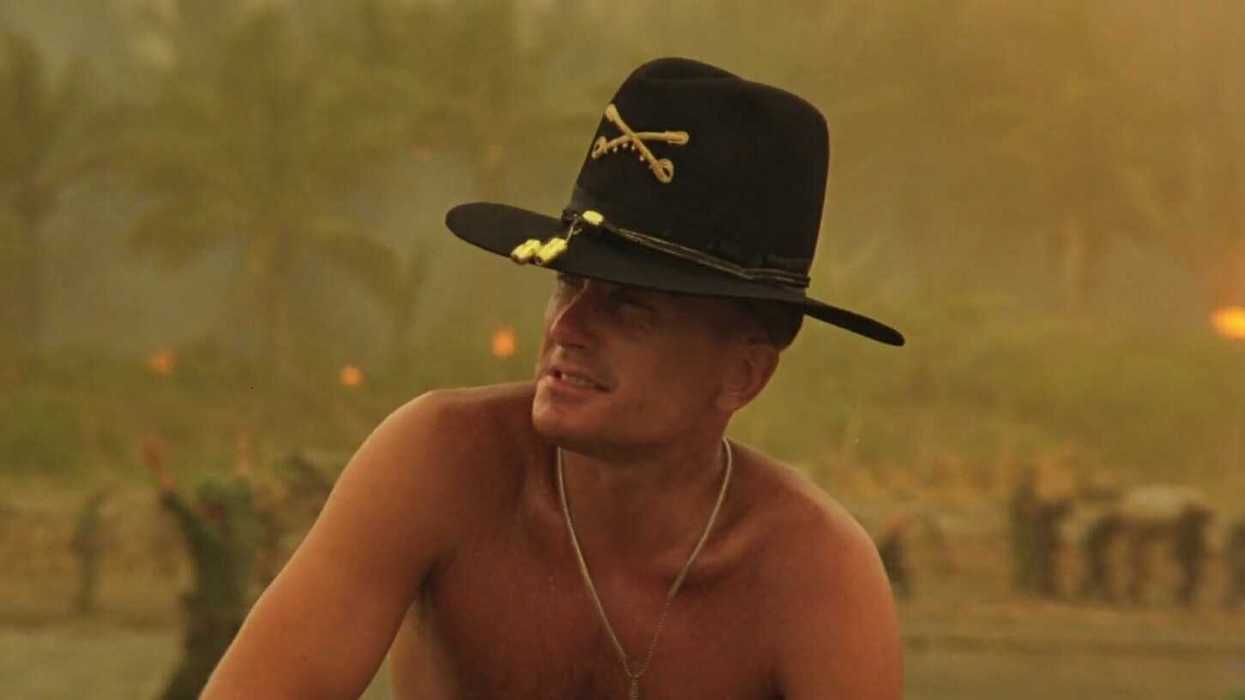
While war movies chase big speeches and war cries, Apocalypse Now (1979), a legitimate anti-war movie, goes in the opposite direction. Its special field of focus is America’s misguided and hypocritical approach toward the Vietnam War. And to put that point across, Coppola brings the breezy, carefree spirit of California cool and the gloomy darkness of a jungle war together and condenses them into a single, crisp remark: “Charlie don’t surf!”
The phrase, if you dig deep enough, reveals America’s selective moral logic about “cultural dominance.” While it fights a two-decade-long war to stop the spread of an ideology it considers oppressive, it casually assumes its own culture belongs everywhere, even as the people who live there are dismissed with nicknames like “Charlie.”
It also points to the indifference and disillusionment of American soldiers who remain spiritually separated from the conflict’s soul. The scene quietly captures a specific brand of madness in which the horrors of combat are treated like a “background extra” in a West Coast lifestyle reel.
The scene is understated, yet it’s a brilliant critique of the wartime detachment ever filmed.
The Scene That Birthed the Line
In 1969, in the midst of the Vietnam War, a high-ranking military officer, Colonel Walter E. Kurtz (Marlon Brando), went rogue and committed war crimes and atrocities against the opposing side. Since he is deemed “insane,” a threat to the military hierarchy, and a political embarrassment, a U.S. Army captain, Benjamin Willard (Martin Sheen), is sent on a secret mission to kill him.
Kurtz and his “followers” are based at a remote jungle outpost in Cambodia. To get there, Willard joins a patrol boat, where he befriends Lance Johnson (Sam Bottoms), among others. On their way to Kurtz’s outpost, they come across a helicopter-borne air assault unit, which is commanded by Lt. Col. Bill Kilgore (Robert Duvall) to execute a destructive, full-scale raid on a Viet Cong-controlled coastal village and a nearby tree line at the mouth of the Nùng River. His objective: to secure the area and use it for a surfing excursion.
In this nightly scene, Willard and his comrades are on Kilgore’s base. Kilgore is chilling with his troops, playing guitar, singing, and having T-bones and beer. He agrees to help Willard only after finding out that Lance, a well-known professional surfer, is with him. At this moment, he is preoccupied with the thought of surfing. He instructs Lance to go with one of his soldiers and bring his Yater Spoon and also pick out a surfboard for himself. When the soldier points out that the situation there is very “hairy” (risky) because “It’s Charlie’s Point,” a.k.a. controlled by the Viet Cong, Kilgore snaps: “Charlie don’t surf!”—as in, the beautiful spot is wasted on the Vietnamese who don’t use it for surfing.
What’s Behind “Charlie Don’t Surf!”
War Zone That Looks Like a Surf Spot
This whole moment mirrors Kilgore’s, and, by extension, the American army’s subconscious outlook toward the war. The gravity and the tragedy of the war are lost on him. That’s why he is able to see sunny California’s vibrant, bustling coastline in the war-torn, blood-soaked scene of carnage in Vietnam. He engages in procuring surfboards when soldiers are moving through active combat in real time.
While the active war zone is burning, he is delighting in the plans of a dynamic recreational activity. This casual attitude shows his detachment from not only his mission but also the grim cost of the whole war.
Dehumanizing the Enemy
NATO has a special phonetic alphabet system that is commonly used in radio communication. It is used to distinguish letters when spelling out words to avoid letters being misheard. For example, "A" as in "Alfa," "B" as in "Bravo," "C" as in "Charlie," and so on.
The word “Cong” in Viet Cong is an abbreviation for “Cộng sản," which means “Communist.” So, during the Vietnam War, the U.S. troops reduced their enemy’s identity to their ideology and referred to them as “C,” as in Charlie. It’s the same as calling them “Commies.”
Here, Kilgore represented those Americans who believed that their “faceless, emotionless, mirthless, non-surfing” opponent could only be identified by their rulebook socio-political principles. The whole anti-communist paranoia of McCarthyism condensed into one single word.
War Seen Through a Californian Lens
Kilgore behaves as if Vietnam is just another location for West Coast culture. So, wherever he goes (Vietnam) or whatever the occasion may be (the war), he brings with him surfboards, music, steak (he orders, “Make my meat rare. Rare, but not cold”), and beach talk.
This is a broader theme in the film: the war through the eyes and mindset of those Americans who carry their own lifestyle and belief system into a foreign environment, while not bothering to understand theirs.
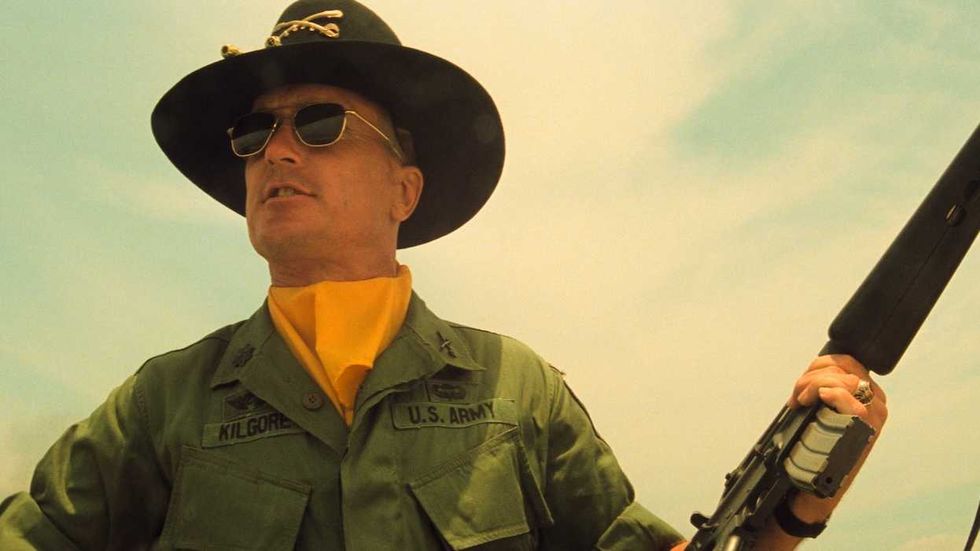 'Apocalypse Now' Credit: United Artists
How the Line was Created and Why It Lasted
John Milius and the Origin of the Quote
Screenwriter John Milius commented that the inspiration for this line came from an Israeli general, Ariel Sharon. After Israel won its Six-Day War with the Arab states, Sharon went skinny-diving and spearfishing in the newly captured enemy territory. When he ate those fish with his troops, he commented, “We blew them out of here, and now we’re eating their fish.”
Milius loved (from an artistic point of view) the blunt arrogance in Sharon’s comment, and he translated that into the surfing culture. Both Sharon's and Kilgore’s statements carry the same underlying message: We claimed what was theirs. Now we will make it our own.
Why It Works
Sharon devastated the enemy territory and the enemy waters and then fished into them. In the movie, Kilgore orders a napalm strike to clear a Vietnamese beach so he and his men can surf. The real-life parallel of the “We destroyed their place, now we get to enjoy it” attitude is exactly what makes the moment both absurd and revealing about the war. And considering the wars that keep sprouting one after another, such lines (sadly) never go out of fashion.
Conclusion
The relatability and longevity of “Charlie don’t surf!” lie in its potential to capture the entire worldview in a single moment. Kilgore says it casually (how else will he say it, anyway), but it reveals his disturbing detachment from the war and from what it has become for the people (on both sides) fighting for it.
Ultimately, the thought that lingers in your mind is that the world is burning, and someone is still thinking about the fantastic, six-foot peak.
- Watch: Why 'Silence' and 'Apocalypse Now' Are Two Sides of the Same Coin ›
- Putting Sanity At Stake: Coppola Interviews John Milius About Writing 'Apocalypse Now' | No Film School ›
- The Hidden Irony in “I Love the Smell of Napalm in the Morning” | No Film School ›
- How Coppola Uses Absurdism and Contrast in ‘Apocalypse Now’ to Condemn War | No Film School ›
- Why 'Apocalypse Now' Might Be Dangerously Overrated | No Film School ›