“Attica! Attica!”: The Improvised Shout That Shook Audiences
Pacino’s famous chant was more than acting—it was a reflection of America’s rage in the 1970s.
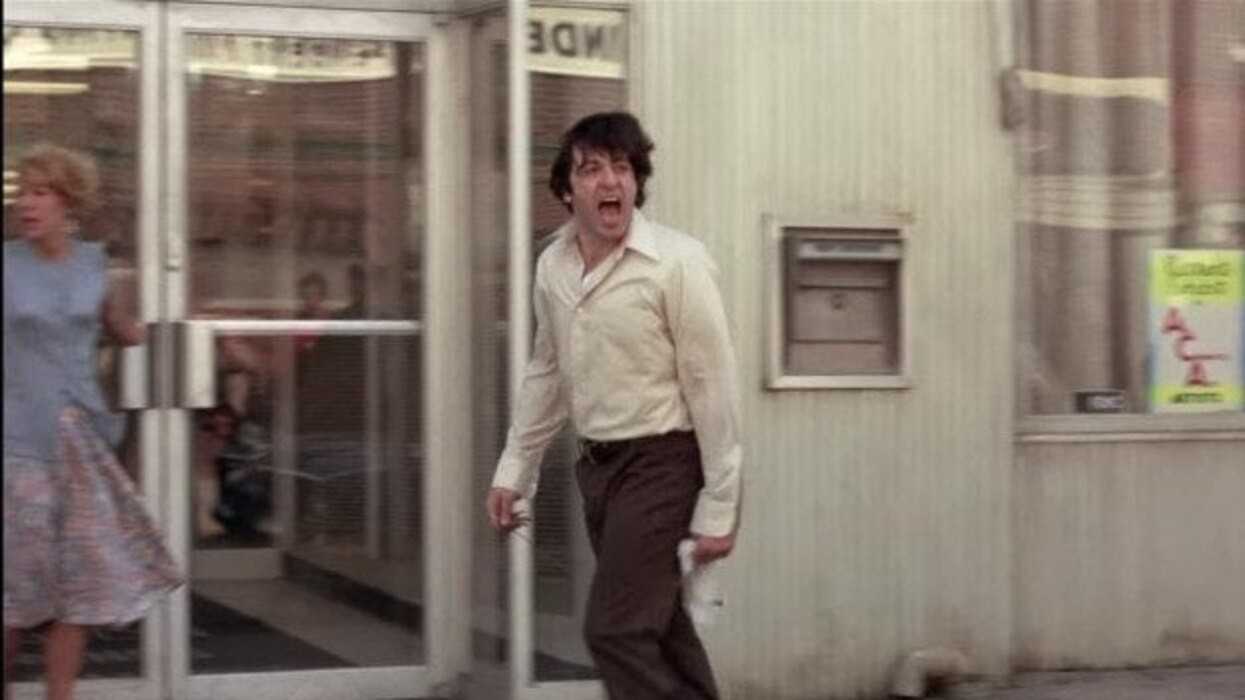
Dog Day Afternoon (1975)
The sun beats down on a Brooklyn street. A swelling crowd gathers, restless and loud, as cops line the perimeter with rifles and sweat-soaked uniforms.
Out of the bank steps Sonny Wortzik (Al Pacino), eyes wild, body trembling with both fear and adrenaline. He raises his arms, unleashing a cry that slices through the air: “Attica! Attica!”
The crowd roars back, echoing him, chanting like it’s no longer a movie but a real protest erupting in real time. For a fleeting moment, Sonny stops being a cornered robber and becomes a voice of the people.
But why did this improvised outburst—a two-word chant—become one of the most electrifying moments in film history? Why does it still resound decades later, surfacing not just in movie lore but on protest lines across America?
The answer lies in the perfect storm of performance, direction, politics, and cultural timing. Pacino may have shouted it, but the world heard it as its own.
The power of “Attica! Attica!” rests in more than just a character’s desperation. It crystallized America’s wounds, captured a generation’s distrust, and redefined what political cinema could be.
To understand its weight, we have to rewind to where it came from—the real Attica, and the rage it left simmering in the nation’s bloodstream.
Setting the Stage
The Attica Prison Uprising: The Real-Life Tragedy
In September 1971, nearly 1,300 inmates at Attica Correctional Facility in New York staged a rebellion, demanding basic rights: decent food, medical care, religious freedom, and protection from abuse. For four tense days, they held hostages while negotiating with officials.
The standoff ended brutally when state police stormed the prison in a hail of gunfire. Forty-three people were killed—33 inmates and 10 correctional officers.
What made Attica unforgettable was—obviously the scale of the massacre—but also the fact that it was televised. Americans watched in horror as images of blood-soaked bodies and chaos flickered across their screens. The rebellion became an instant symbol of state violence, systemic neglect, and betrayal. By the mid-1970s, the very word “Attica” was shorthand for injustice, and it carried the raw power of an open wound.
This wound hadn’t healed when Dog Day Afternoon (1975) hit theaters. The public hadn’t forgotten, and when Pacino summoned that word, it was like pulling the scab off in front of millions.
A Nation Losing Faith in the Anxious 60s and 70s
The 1970s were steeped in unease. Watergate had shattered trust in government. The Vietnam War dragged on to a humiliating close, leaving Americans skeptical of authority and weary of lies. Economic stagnation bred cynicism, while urban centers like New York were decaying under crime and poverty.
This distrust was mirrored in the 70s cinema. The New Hollywood era thrived on moral ambiguity and realism. Directors were not interested in happy endings but in exposing the rot.
Dog Day Afternoon is a child of this movement. It doesn’t frame its protagonist as a hero or villain but as a desperate man caught in a society crumbling around him.
That environment made Pacino’s shout resonate even louder. Audiences watching the robbery were actually watching the reflection of their own mistrust, their own exhaustion with a system that had failed them.
Sidney Lumet’s Cinema of Social Conscience
Sidney Lumet was the perfect director for this story. Already known for 12 Angry Men (1957) and Serpico (1973), he had built a reputation as a filmmaker unafraid to tackle systemic injustice head-on. His lens was sharp, unflinching, and rooted in New York grit.
Lumet’s style was deceptively simple: favoring natural light, documentary-like camerawork, and raw performances over flashy aesthetics. He believed in exposing truth through cinema, often spotlighting flawed individuals pushed against oppressive systems. In Dog Day Afternoon, that philosophy was alive in every frame—chaotic crowds, claustrophobic interiors, sweat-stained closeups.
So when Pacino unleashed “Attica,” Lumet amplified it. He let the camera linger, capturing both the chant and the crowd’s transformation. In this scene, when the character was acting, cinema was colliding with reality.
Deconstructing the Scene
The Improvisation: Pacino’s Lightning Strike of Genius
Here’s the kicker: the chant wasn’t in Frank Pierson’s Oscar-winning script. It was improvised.
Just before the filming of the scene started—where Pacino exits the bank to negotiate with the police—one of the assistant directors, Burtt Harris, in a whisper, asked Pacino to use “Attica” in his dialogue.
Pacino then instinctively connected Attica, as a symbol, with his character—a working-class New Yorker—who would have it on the tip of his tongue, and drew into Sonny’s desperation.
Lumet, immediately recognizing its authenticity, leaned into it and let the cameras roll. That choice transformed a tense hostage scene into an eruption of lived history.
Pacino was suddenly channeling a cultural wound that was still bleeding.
Improvisation is based on instincts, and instincts can go wrong. However, in this case, it turned into cinematic lightning. One scream, and a bank robbery became a protest rally.
Sonny Wortzik: The Unlikely Folk Hero
Sonny Wortzik isn’t your usual antihero. A bumbling, desperate man, he stages the robbery to fund his partner Leon’s (Chris Sarandon) gender-affirming surgery. He’s nervous, clumsy, and even sympathetic. By the time he shouts “Attica,” the crowd sees not a criminal, but a man standing against the same police they distrust.
The shift is subtle but seismic. That chant flips Sonny’s role in the public eye—inside the story and for the audience watching in theaters. He becomes less of a robber and more of a folk hero, rallying people against a shared adversary: authority.
The brilliance here is how one line blurs morality. Viewers can’t quite cheer him as a hero, but they can’t dismiss him as a villain either. He embodies the confusion of the era: flawed, human, yet defiant.
Directorial Craft: How Lumet Framed the Protest
Pacino is not the sole reason why this moment works. It’s also Lumet’s framing. He used long lenses to give the sequence a documentary texture, as if captured by a news crew on the ground. Instead of using the crowd just as a background, he choreographed it to swell and respond like a living organism.
Sound design also played a crucial role. Pacino’s chant reverberates, then catches fire as the crowd repeats it, amplifying it into a protest chorus. Lumet holds the shot long enough to let viewers feel swept up in the rally themselves.
It’s not staged like a movie standoff. It’s shot like history unfolding. That authenticity is why the moment still feels urgent, not cinematic artifice.
Blurring the Line Between Cinema and Reality
The Immediate Impact: From Screen to Cultural Lexicon
When Dog Day Afternoon premiered in 1975, audiences were stunned. The shout was instantly recognizable, instantly political; it didn’t take much for the audience to register it. For those who had lived through the Attica coverage, it was like an electric jolt—familiar trauma reframed through fiction.
The phrase leapt out of the movie theater and into the streets. “Attica! Attica!” became cultural shorthand for resistance, shouted in protests and parodied in comedy sketches. The line was alive, moving freely between art and life.
It’s rare for a fictional line to achieve that. But Pacino’s cry wasn’t fictional. It came straight from the real world.
Critical Reception and Legacy
The “Attica!” chant went beyond being just a crowd-pleaser. It was the moment critics kept circling back to. Vincent Canby of The New York Times praised Dog Day Afternoon as “Lumet’s most accurate, most flamboyant New York movie,” noting how his films are as much about the city’s life as they are stories of it. That sense of immediacy is exactly why Pacino’s improvised outburst felt so authentic. It was more than acting and more than improvisation. It was New York itself spilling onto the screen.
The Academy certainly noticed. The film earned six nominations, including Best Picture and Best Actor, with Frank Pierson winning for Best Screenplay. The recognition confirmed that this wasn’t a routine crime drama. By letting a moment like “Attica!” breathe, the movie elevated itself into something braver—a thriller that doubled as political commentary.
What lingers today isn’t the hardware but the proof of concept. Pacino’s raw cry showed that a heist film could do more than entertain—it could grab a headline from yesterday’s news, infuse it with urgency, and give it back to audiences as art. That scene clearly punctuates the movie, redefining what the genre is capable of.
The Ultimate Testament: Endurance as a Protest Cry
The staying power of “Attica!” is almost eerie. The chant reappeared in countless places—films like Saturday Night Fever (1977), comedy sketches, and even music.
But its truest afterlife was on protest lines. During the George Floyd protests of 2020, marchers revived “Attica!” as a rallying cry against police brutality. That a moment improvised in 1975 could still rally voices nearly half a century later says everything about both America’s unfinished struggles and cinema’s uncanny ability to keep wounds open.
It’s ironic but telling: the real Attica uprising is often footnoted in history, but Pacino’s fictional scream kept it alive. Art doesn’t have to just reflect reality; it can preserve it and amplify it as well.
The Echo That Never Fades
The “Attica! Attica!” moment was no accident. It was the convergence of artistic and creative instincts, the director’s vision, a sharp script, and a nation teetering on disillusionment. That two-word outburst became a bridge between cinema and protest, between artifice and truth.
More than just a cinematic flourish, it proved that movies could channel collective anger and give it a voice louder than any news broadcast. Pacino screamed it as Sonny, but audiences heard it as their own, and generations since have carried it forward.
That’s why the moment endures. It is not a line in a film, but a piece of history, grief, and defiance, crystallized into art. The echo hasn’t faded because it belongs to all of us now.
- Iconic One-Liner: “Say Hello to My Little Friend!” From Scarface ›
- When Pacino Met De Niro: The Scene That Stopped Time ›
- 11 Al Pacino Movies That Define Great Acting ›
- Behind Al Pacino’s Wildest Improvised Moment in ‘Heat’ ›
- 11 Best Movies by Sidney Lumet: Ranked ›
- Film Quote of the Day: The 'Dog Day Afternoon' Line That Was Funny on Screen But Tragic in Reality | No Film School ›