Legendary Flicks Born Again: 6 Best Film Reboots of All Time
These films floored the audience with their reimagination of an established concept and story.
Scarface (1983)
Film reboots are often received with a mix of excitement and skepticism. And why not? They are reimagined versions of established franchises. Leveraging nostalgia, these films have been drawing in audiences with the promise of honoring the essence of the original source material while elevating the storytelling with relevant themes that resonate with contemporary perspectives.
I am the kind of audience who is extremely intrigued anytime a reboot is announced, especially if it's for any classic stories. I’d give you all my money to watch a complete reboot of the Harry Potter franchise, or To Kill a Mockingbird.
If you’re like me, here’s a pot of gold for you. In this article, we’ve listed the best film reboots, spanning different genres, that hit the spot just like their parent films.
The 6 Best Film Reboots of All Time
With fresh narratives, casts, or modernized perspectives, these reboots have successfully upheld the pride of their cherished originals.
1. The Fly (1986)
David Cronenberg’s The Fly is a reboot of the 1958 horror classic The Fly, directed by Kurt Neumann. Following a brilliant but socially awkward scientist, Seth Brundle (Jeff Goldblum), who transforms into a hybrid fly monster after a scientific experiment goes wrong. The film taps into complex themes, including the hazards of scientific ambition and personal insecurity in relationships, as it culminates in a tragedy, where, in the end, his girlfriend, Veronica (Geena Davis), is forced to kill him to end his suffering and stop the havoc.
In Cronenberg’s version, the story is narrated linearly, mainly from Brundle’s perspective, unlike the original, which is structured like a murder mystery, unveiled through investigation. Alongside Brundle’s doomed romance with Veronica, Cronenberg focuses on body horror, capturing Brundle’s transformation step by step, through intricate visual effects and makeup. Brundle’s monstrous transformation was so realistic that Chris Walas and Stephan Dupuis won the Academy Award for Best Makeup in 1987.
2. The Thing (1982)
A reboot of the 1952 sci-fi horror The Thing From Another World (1951), based on John W. Campbell Jr.'s 1938 novella “Who Goes There?”, but John Carpenter’s The Thing reimagines the alien predator underlined with a metaphor.
Set in remote Antarctica, the story centers on a research center, where a team of American scientists encounters a shapeshifting parasitic alien organism that begins hunting them down. Since the organism can perfectly transform into anything, trust dissolves sooner than expected, as nobody can be sure who is still human. In the end, unable to contain the organism, the scientists decide to destroy the research outpost and themselves with it, to prevent the thing from escaping into civilization.
Carpenter tackles the visual challenge of creating a shapeshifting parasitic entity, with advanced practical effects by Rob Bottin. The parasite isn’t played by any single actor in a costume. Instead, it is created with special effects, as the alien is rarely seen in a stable form, unlike the alien in the original film.
In short, the original film is a straightforward story of heroism, but Carpenter’s narrative is an allegory and a social commentary on paranoia and social mistrust in the face of adversity and intrusion.
3. Mad Max: Fury Road (2015)
A grand reboot of 1979's Mad Max, George Miller embarked on a larger-scale journey full of spectacle and continuous action in Mad Max: Fury Road. While the first film was a slow-burning tale of revenge, focused on personal loss, Fury Road taps into broader and more complex themes, including female liberation, restorative justice, and collective resistance.
Set in a post-apocalyptic world, in a world that’s now nothing but a wasteland, ruled by brutal warlord Immortan Joe (Hugh Keays Byrne), Fury Road follows Max Rockatansky (Tom Hardy) and Imperator Furiosa (Charlize Theron), in their quest for liberation and freedom, for themselves and the masses. In the end, Joe’s dictatorship is overthrown with his death, and Citadel’s water resources are freed for the oppressed masses to use, while Max disappears into the crowd.
In comparison to its parent film, Mad Max: Fury Road is definitely more stylized and visually maximalist. While Mad Max is identified by its muted, washed-out tones, Fury Road is renowned for its vivid, saturated palette, such as desert landscapes in blazing oranges and deep blues. In contrast to Mad Max, Fury Road features grand sequences such as sandstorms and canyon collapses, for which it employs advanced practical effects and real stunts, seamlessly integrated with CGI for environmental augmentation, scale, and safety.
4. Ocean’s Eleven (2001)
Steven Soderbergh’s Ocean’s Eleven is a reboot of the classic heist film, Ocean’s Eleven, directed by Lewis Milestone.
Soderbergh presents the beloved heist story with few tweaks to increase the intensity. The narrative follows a charismatic con man, Danny Ocean (George Clooney), who, during his parole from prison, plans an audacious heist to simultaneously rob three Las Vegas casinos for over $150 million, to exact revenge on Terry Benedict (Andy Garcia), who owns all three of them.
Unlike the original film, Soderbergh opts for a heist that is highly technical and employs elaborate mechanics. The 2011 Ocean Eleven features polished, modern visuals, leveraging LA’s neon aura to create both suspense and style, while the 1960s film is more retro in look and feel, emphasizing Rat Pack charisma. Soderbergh tweaks the climax to culminate in a more upbeat end, in which the crew succeeds in both love and larceny, unlike the parent version.
5. Scarface (1983)
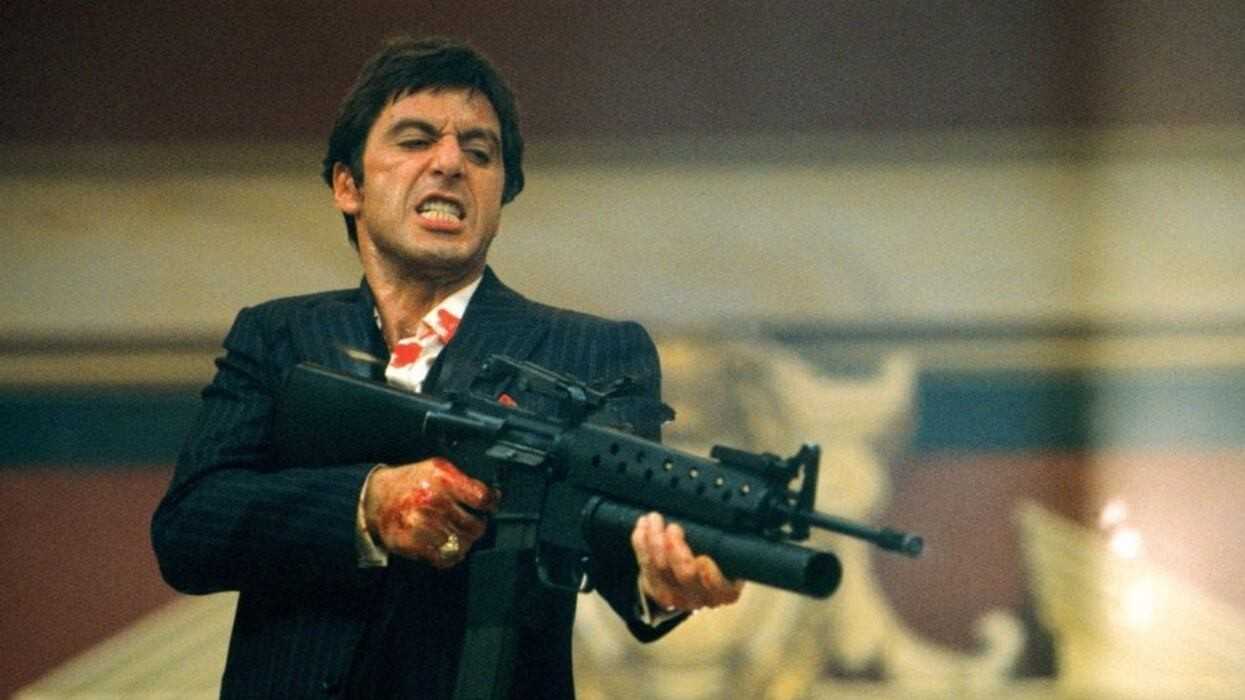
Brian De Palma’s Scarface is a reboot of the 1932 Scarface directed by Howard Hawks. Based on the parent film with certain aspects reimagined, De Palma’s narrative follows the violent rise and spectacular fall of a Cuban immigrant, Tony Montana (Al Pacino), as he works his way through the underbelly of Miami to become one of the most powerful cocaine kingpins in Florida.
The original film is raw and grimy, filmed in black and white, relying on high contrast, dynamic camera movements, and moody lighting. De Palma’s version is vibrant and neon-infused, highlighting the “excess” of the 1980s. 1983 Scarface is marked by dramatic tracking and crane shots, inventive POVs, slow motion, bold framing, and lingering focus on details. De Palma doesn’t shy away from explicit visuals of violence, drug use, and sexuality, unlike the original film, which is more censored and plays with implications
6. The Parent Trap (1998)
The 1998 version of The Parent Trap follows identical twins (Lindsay Lohan in a dual role), Annie and Hallie, who were separated at birth after their parents’ divorce, but are reunited a decade later at a summer camp by chance.
Neither is aware of the other’s existence, but soon they realize the truth and hatch a plan to switch places so each can meet the other parent and experience a life they missed. Things take a turn for the girls when Annie discovers her father’s engagement with Meredith Blake, a manipulative gold-digger, who is scheming to ship the twins off to a boarding school right after the wedding.
Nancy Meyers has tweaked little aspects of the story, such as the original is set in Boston and California, while the reboot is set in London and California, the names of the characters are different, evil stepfather vs evil stepmother, and more. Yet the narrative upholds the charming mix of slapstick and emotions. Special mention to Lindsay Lohan for seamlessly playing a dual role!
Not that film reboots never miss the mark, but it’s always worth giving them a chance. After all, film reboots mirror the newer possibilities in a story.
Did your favorite film reboot make it to the list? Do let us know which one on the list you like the most.
- 'Kingsman' Director Matthew Vaughn Explains Why He Would Reboot Star Wars ›
- An Exclusive Window Into 'Jay and Silent Bob: Reboot' (all episodes) ›
- 3 Huge (Non-Superhero) Action Flicks That Might Get Rebooted Soon ›
- Watch the Latest Trailer for Jordan Peele's Reboot of 'The Twilight Zone' ›
- Here's How Disney's Live-Action Remakes Screw Over the Original Writers ›
- Why The Entertainment Industry is Completely Starting Over ›
- The New 'Anaconda' Is So Meta, It Bites Its Own Tail | No Film School ›