30 Years Ago: Robert De Niro and Joe Pesci Returned for One Last Gangster Epic
Three decades on, Scorsese's Vegas true-crime saga still teaches plenty about voiceover, excess, and letting a wardrobe do the talking.
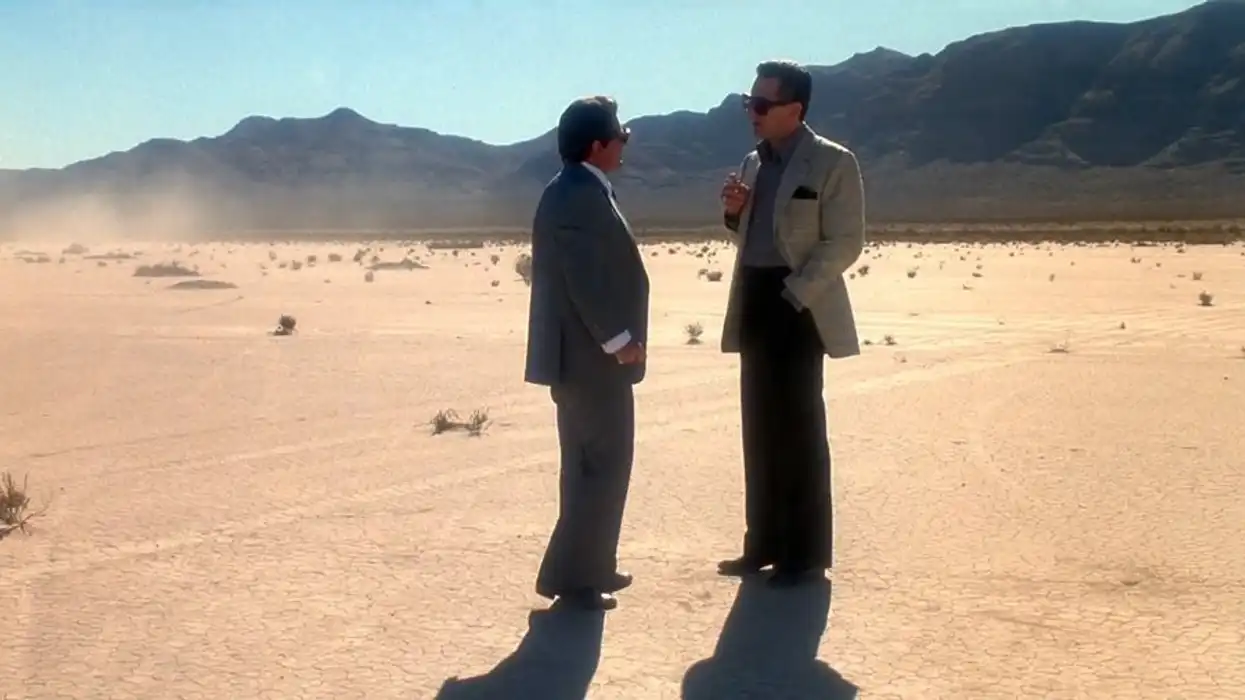
If I say "Martin Scorsese mob movie," which one do you think of?
For some movie fans, Casino still gets filed under "the other one," a slot or two below Goodfellas on everybody's list. But it still deserves some shine of its own.
In 1995, Scorsese got his Goodfellas gang back together (including Robert De Niro, Joe Pesci, writer Nicholas Pileggi, editor Thelma Schoonmaker) and put them in Las Vegas.
"There are certainly some similarities to Goodfellas in the way the story is told," Scorsese said (via American Cinematographer). "But then, Nick Pileggi and I also wrote Goodfellas, Pesci and De Niro were in that film, and Casino deals with a comparable subject matter. When you have the same writers, the same actors, and similar themes, you're quite naturally going to have some parallels in style. Because this film covers a number of years, we used the voiceover narration to carry the viewer through, and there are also a lot of quick cuts in many scenes. But this film is different than Goodfellas because we have a much larger canvas this time: it's America, it's Vegas, it's the mob out West!"
What resulted was loud and mean and oh-so-Scorsese, and it's stuffed with lessons you can lift for your own work. It also turned out to be the last time this particular crew would run a gangster picture together for a very long while. Now 30 years out from release, let's look at this classic.
- YouTube www.youtube.com
What Casino Is About
Set across the 1970s and into the '80s, Casino follows Sam "Ace" Rothstein (De Niro), a meticulous sports handicapper the Chicago mob installs to run their Tangiers casino.
Ace is brilliant at the job but hopeless at everything else in life. His childhood friend Nicky Santoro (Pesci) turns up to work as muscle and immediately starts running his own reign of terror across the desert.
Then Ace falls for Ginger (Sharon Stone), a hustler who never stops working her own angles. There's betrayal and greed, and the mob's grip on Vegas slowly collapses.
The Goodfellas Team Runs It Back
Casino was created the same way Goodfellas was five years earlier. It started with a Pileggi nonfiction book, which was then adapted by Pileggi and Scorsese, and the story is about real people whose names got a light coat of paint.
Sam "Ace" Rothstein is Frank "Lefty" Rosenthal. Nicky Santoro is Tony Spilotro. Ginger is Geri McGee. The Tangiers stands in for the Stardust.
"The Tangiers is fictional, but there were four—the Stardust, the Fremont, the Frontier, and the Marina—which the Rothstein character controlled," Scorsese told Sight and Sound (via Cinephilia & Beyond). "So we just made them one giant hotel and combined all the elements."
If you're adapting a true story or even just doing an "inspired by a true story," as they did here, find the bit of real life and shape it, compositing where you must, without sanding off what made it strange to begin with.
De Niro plays Ace as a control freak undone by the two things he can't manage, his wife and his best friend. It's one of his last great performances of that era.
- YouTube www.youtube.com
Let Two Narrators Fight for the Mic
Like Goodfellas, Casino has a voiceover, but here Scorsese gives the mic to two narrators, Ace and Nicky, and lets them talk over each other.
The film opens with Ace's car exploding, then rewinds, and the first long stretch plays almost like a documentary on how a casino exactly skims its cash and who gets how much. The narration is how Scorsese crams all that detail into your head without stopping the movie's pacing.
Some viewers find it too much, and I get it. The voiceover rarely takes a breath. But it's so smart. Nicky narrates his own story right up until two men start swinging aluminum bats at him, and the voice cuts out mid-sentence.
Narration can do more than deliver information. It can be creative. You can build a character on it.
Shoot the Excess Like a Documentary
Cinematographer Robert Richardson shot Vegas the way you'd shoot a nature film about a predator. There's a sense of realism and grit about it.
"Tremendous constraints were placed upon us in terms of the time we had to shoot," Richardson said (via American Cinematographer). "In order to use an actual working casino, we were forced to work night hours, starting at 10 or 11 p.m. and working until the same hours in the morning. The graveyard shift was the time when it was easiest on the Rivera, so we wouldn't distract the casino's clients."
The cutting is fast, and the camera keeps prowling. Saul Bass designed the fiery opening titles, his final collaboration with Scorsese before his death in 1996. Dante Ferretti built out the Tangiers, and the production shot inside the real Riviera with actual dealers and pit bosses working the tables.
Then there's the soundtrack. Scorsese drops period tracks into many scenes, and if you want a tutorial on the needle drop, this is a great one to look at.
The Wardrobe Does the Talking
Ace changes clothes constantly. He has around 70 costumes across the film, part of a wardrobe budget said to run near a million dollars.
Costume designers Rita Ryack and John Dunn used Ace's broad palette to show us a man whose entire identity is control and surface. De Niro modeled the look on the real Rosenthal, down to the tailoring.
Costume design is characterization you can see. Every detail matters because it tells you something about the wearer.
Why Casino Still Has a Winning Hand
Casino took in around $116 million worldwide and earned Sharon Stone an Oscar nomination and a Golden Globe win for her performance, which practically walks off with the movie.
Three decades later, it's the capstone of the Scorsese/De Niro/Pesci gangster run that started back in the Raging Bull days and peaked with Goodfellas.
Pesci mostly stepped away from acting afterward, and the three of them wouldn't make another gangster epic together until The Irishman in 2019, a full 24 years later.
So when we call this one last epic, it's not just hyperbole. It feels like the end of a monumental run.