How Ben Affleck’s Artists Equity Is Redefining Film Financing Models
As a creative, it's so nice to see a company built around artists make a living.
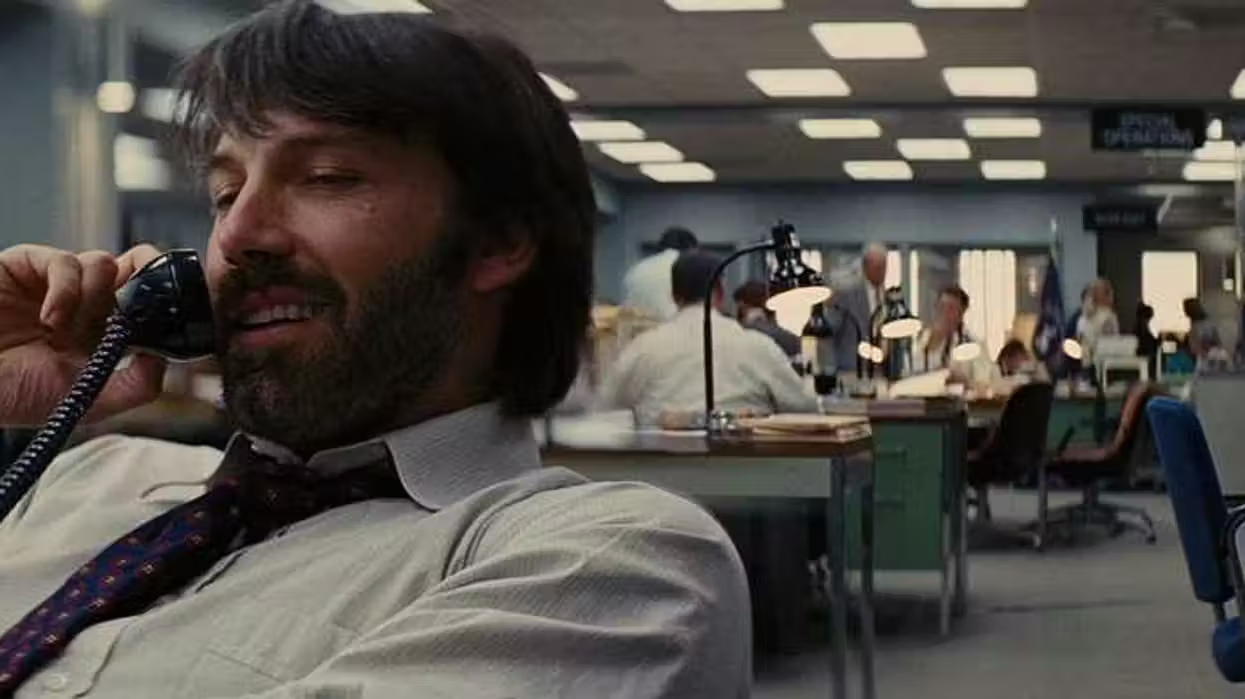
'Argo'
I respect Matt Damon and Ben Affleck so much. They have just done Hollywood in a way I find so inspirational. They wrote themselves the roles they weren't getting in Good Will Hunting, and now, with all the power and status they have achieved, they have a company, Artists Equity, focused on paying people fairly.
You can't get much better than that.
Four years into that endeavor, Affleck opened up in a conversation with Variety about how the company works.
Here are the key takeaways for filmmakers from that interview.
1. Replacing "Arcane" Backend Pools with True Equity
Unless you're a movie and TV nerd like me, you may not know how filmmakers and crew get paid in the traditional Hollywood sense. Basically, writers, directors, actors, and producers are treated as line-item costs rather than partners.
You get paid for a job and then get told to go away while a giant corporation takes it for granted. Their excuse is that they also take in the risk.
Fine.
But there's a better way to do this stuff.
Artists Equity flips this dynamic by treating creative talent as direct investors in the overall product they're going to sell together.
"We seek to compensate old-school above-the-line talent—directors, writers, actors, producers—as if they were investors in a film," Affleck explained. "It works on the clean, evident construction that those parties are compensated exactly as equity financiers would be. Not in some kind of arcane, separate bonus pool that’s distant from where the revenue comes in."
We saw this model in action with movies like Air (Amazon) and The Rip (Netflix), and as Affleck noted, "People got bonuses."
2. Leveraged Transparency in the Streaming Era
One thing I bemoan all the time is that we have no idea whether a streaming movie is successful, because we never see the numbers. Once in a while, the major successes get published, but if you're looking for the backend, it's always going to be a fight.
Without clear performance metrics, performance-based compensation becomes almost impossible to calculate, and it takes away from what people get paid to participate in these projects.
Artists Equity took this head-on.
"A big part of that was around streaming and how are people being compensated. We did work to facilitate conversations about this, and it ended up that Netflix was willing to share some information about what’s successful on their platform. It’s in their interest to create a united incentive with the people they work with."
3. Scaling the Model
One of the reasons I wanted to talk about this today was that a big studio run by Damon and Affleck may feel out of reach for our readers. But they kind of thought of that too and now have an indie model of their own studio that will function as an arm for people like our readers and me.
The company recently closed a deal to launch Artists Equity Independent Pictures, a theatrical film fund designed specifically for the next generation of directors and writers.
"I understand the studio’s point of view... But we’re trying to create a template that can be widely adopted," Affleck said. "To that end, we just closed a deal to start Artists Equity Independent Pictures, an indie theatrical film fund... That’s specifically for next-generation filmmakers."
4. Keeping Production Local and Supporting L.A. Crews
I am dying for production to return to Los Angeles and to help us all out. And so are the people at Affleck's company. And they have the power to do something about it.
"The best crews in the world are in L.A.," Affleck stated, pointing out the human cost of runaway production. "I don’t want to have to be in Shreveport or New Mexico in order to work... My kids are here, and their life is flying by."
The Takeaway for Filmmakers
I really think Matt and Ben (can I call you Matt and Ben?) are onto something with this company. It's a great way to make sure everyone gets paid fairly and becomes genuine financial partners in the project they devote their lives to making.
That's the kind of Hollywood I think we all want.