Why Does 'Digger' Look Like Someone Bleached It?
Iñárritu, Lubezki, and colorist Peter Doyle made 'Digger' look deliberately gray.
Tom Cruise as Digger Rockwell in 'Digger'
You've probably seen the trailer for Digger and have a few questions. Or maybe a lot of questions. Such as, "What is this? Why does it look like that? Is that Tom Cruise?"
Digger is Alejandro G. Iñárritu's first feature since Bardo. Tom Cruise stars as Digger Rockwell, an oil baron who has to avert an environmental catastrophe he caused himself. Riz Ahmed, John Goodman, Sandra Hüller, Michael Stuhlbarg, and Jesse Plemons co-star.
Iñárritu wrote the script with his Birdman collaborators Alexander Dinelaris and Nicolás Giacobone, plus Sabina Berman. Iñárritu started developing the idea right after The Revenant.
The comp most viewers keep bringing up is Dr. Strangelove, a similarly wacky movie about men in a disaster scenario that feels like a farce.
As Iñárritu said at one Warner Bros. event, "Ladies and gentlemen, prepare yourself, because Mother Nature loves motherf*ckers" (via Deadline).
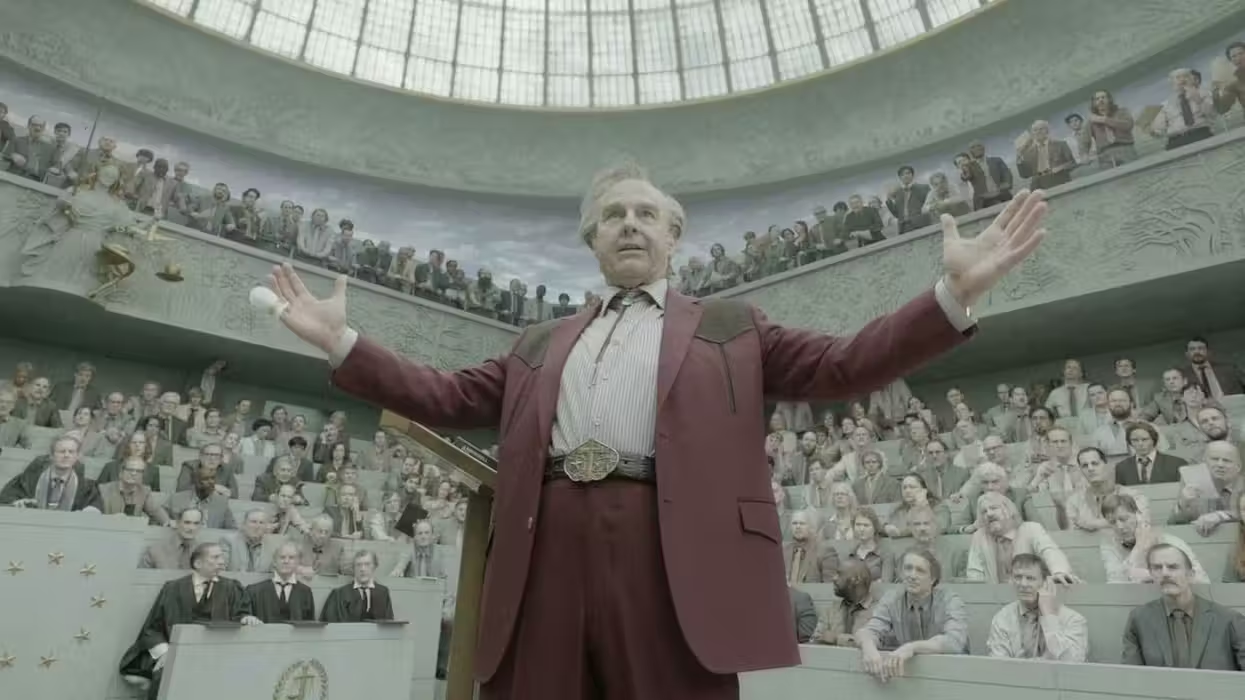
But back to that question about how it looks. Based on what we see in the trailers, it's got a washed-out appearance that's almost like raw S-log footage. Reviews are starting to come out this week, and the palette is one of the most-argued craft elements. Variety calls it "a showy monochromatic color scheme just this side of black-and-white."
The film reunites Iñárritu with cinematographer Emmanuel Lubezki, their first collaboration since The Revenant. Lubezki shot on VistaVision 35mm film with vintage Leica lenses. Today, we want to dig (yes) further into the film's look.
We're going to avoid spoilers this time around, but if you do some digging (yes) in any reviews, you're going to get spoiled. So, fair warning.
- YouTube www.youtube.com
A Gray, Gray World Is a Choice
Look, the color is an intentional choice, right? The filmmakers did this on purpose, which means it's a storytelling choice, too. Color, or the lack thereof, is telling us something about this world and these characters.
And what we're supposed to feel in this case is likely that this character, despite all the wealth and opulence around him, is living a dreary existence.
As Den of Geek writes, Digger Rockwell is a "tycoon so blue-blooded that his austere, Yosemite-chic mansion is lit in a perpetual dreary morning-gray overcast by cinematographer Emmanuel Lubezki. Still, it doesn't make all the dead animal heads and guns on the walls, floors, and even ceilings look any less garish."
It's worth pointing out here that even when the grade pulls saturation down, whatever color survives carries extra weight. So your production design will need to be extremely intentional too. And texture, clutter, and silhouette will carry the visual interest when color can't.
Everyone around this character is similarly dreary. The President of the United States (John Goodman) is physically ill. Everybody is pale and wan under the weight of impending doom. The color reflects the doom. All this to say, there is an in-world story reason for this look.
How to Achieve a Look
Tom Cruise said in a recent interview that the grade and cinematography weren't the only things adding to the look. He actually wore makeup to make himself appear paler.
"That's how you make a movie look like a movie," he said. "You make intentional choices like that. Like the makeup, the wardrobe, the set design all is a color palette that matches, right?"
Critics keep crediting Lubezki, but supervising colorist Peter Doyle graded the film and helped it land on its final look. According to his Picture Shop bio, he's known for "pioneering bespoke techniques that expanded creative possibilities for filmmakers," and his credits include The Tragedy of Macbeth, a film so theatrical and brutalist and unique in its visuals that it needed a similar level of collaboration between everyone on the filmmaking team.
The look comes out of a team. The DP lights it, the production designer builds it, costume designer Jacqueline West dresses it, and the colorist finishes it.
"You have to understand the tools," Cruise said (via The Credits). "It's not one-size-fits-all. You have to find the communication, the lenses, the color of the makeup, and the color of the cowboy boots. What are my shorts like? Even the color of the sets. They're beautiful on every single level. You look at the taste of this man. It's very special."
Cruise's concern is communicating the character, and Iñárritu's is, too, but he also has to convey the world around him.
"I had an idea, not a script, not a film, just a relentless recurring obsession that has endured through all these wild years," he said (via The Credits). "I knew who this character was. I knew how he spoke, how he survived, how he seduced reality into agreeing with him. It took me 10 years to do this film, because I wasn't looking for a story. I was looking for the right way of saying it."
Iñárritu Has Pushed Color Before
According to Criterion, Iñárritu and cinematographer Rodrigo Prieto first experimented with bleach bypass on commercials, and got more contrasty color and crisper texture. They carried the process into Amores Perros.
Looking back on the restoration with IndieWire, Iñárritu described the process' chemistry. "The film was shot in a bleach-bypass process, or silver retain, which is a very corrosive thing, because the silver stays in the negative."
Criterion points out that plenty of films imitated Amores Perros' worn, bluish look, but Iñárritu and Prieto used the process only once more, on 21 Grams. Today, Iñárritu compares that aesthetic to Instagram, "like a phone filter."
On The Revenant, Lubezki planned to shoot film. He switched to the digital ARRI Alexa 65 after tests showed film couldn't handle the low light at dawn and dusk, according to Variety. The shoot relied almost entirely on sunlight and firelight.
"It also allowed us to [work] without any noise or grain between the audience and the actor," Lubezki told Variety. "It's a little like watching everything through a window; it's clean, and there's no texture between you and the character. I felt this was my divorce from film—finally."
Nope. Digger marks their return to celluloid.
If you see the film, let us know what you think of its use of color.
- An Eye for an Ojo: Iñárritu, Aronofsky and How To Tell A Story Through the Eyes of Your Protagonist ›
- Alejandro González Iñárritu on Filming a Difficult Scene in 'The Revenant' ›
- 3 Lessons on Magical Realism from Iñárritu's 'Bardo' ›
- 4 Cinematic Techniques Iñárritu Emboldens Us To Try ›
- The 'Digger' Twist Is Actually 90 Years Old | No Film School ›
- Digger Ending Explained | No Film School ›