"Digger here got us into this mess, and Digger's gonna dig us out again."
Tom Cruise's new movie, written and directed by Alejandro Iñárritu, released last week, to some acclaim, some confusion, and maybe a few walkouts from audience members who had no idea what they were getting into—at least at my local theater.
In this farcical comedy, Cruise stars as Digger Rockwell, an oil baron who must avert an environmental catastrophe his drills caused. Riz Ahmed, John Goodman, Sandra Hüller, Michael Stuhlbarg, and Jesse Plemons also star.
To talk about the film's most unique storytelling elements, we're going to have to get into spoilers today. A lot of spoilers.
So this is your spoiler warning.
Are you ready?
Come with us on a journey through the maze-like mind of Bertolt Brecht.
- YouTube www.youtube.com
What's the Twist in Digger?
It takes perhaps 30 minutes to reach a point in the story where Digger has learned everything about the disaster taking place at one of his Greenland drill sites. He's learned that methane gas has led to an explosion, breaking off a huge iceberg on its way to Europe, which will set off a tsunami and kill thousands.
What to do? He hears from his scientists. He meets with the president and his cabinet in secret. They decide... to do nothing. It's not their responsibility anyway.
The president pulls Digger aside. He has cancer, he says. As the two men confer, the light changes. Outside—
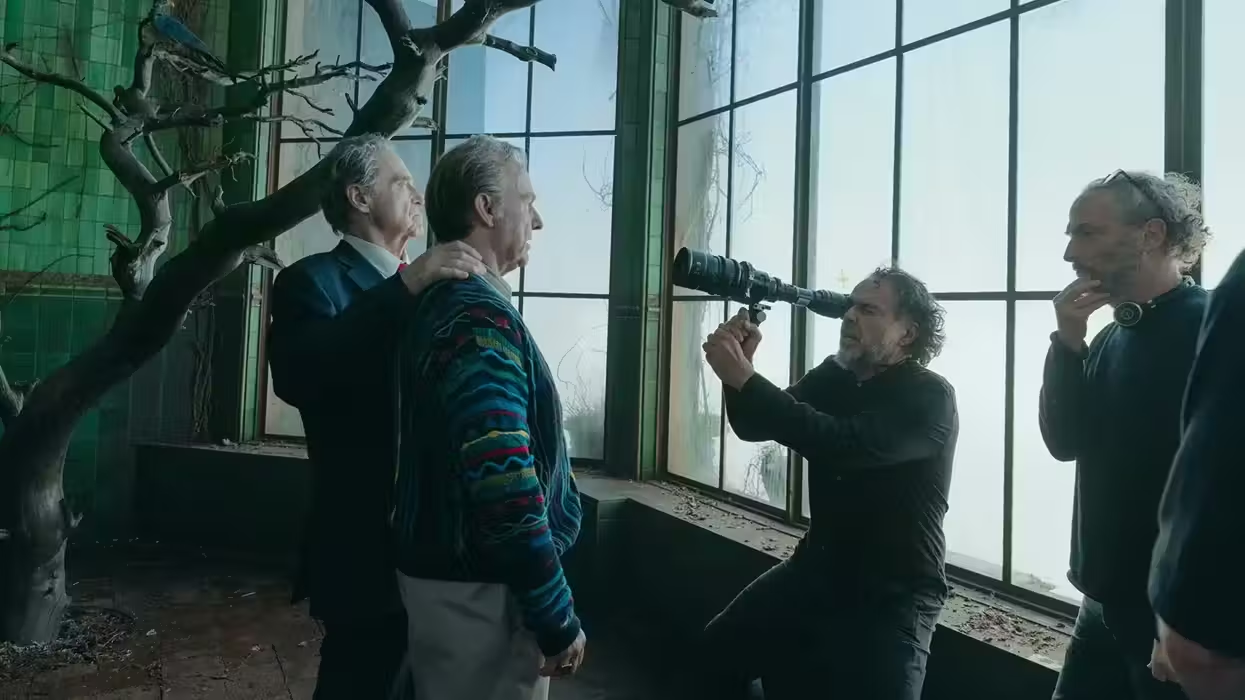
A tree suddenly falls over. A seemingly enormous man emerges from the horizon to reset the scene. A director somewhere shouts instructions. The "actor" playing the president (in-world, an actor being played by John Goodman) saunters off for a break.
Digger is also being played by an actor—Curtis Markson.
So Cruise is playing Markson playing Digger.
The whole thing is a high-tech play about an environmental disaster. In this version of the near future, the iceberg really did cause mass death, and the world really is one of floods and terrible air quality. Plemons plays Digger's real-life nephew, who is financing the expensive revival of this play (which is aptly called Fossil Fools).
Markson is conflicted about his portrayal of Digger and the point of all the comedy and stagecraft. He's upset about things like the vice president character (Michael Stuhlbarg) and the president being on the same plane, which would never happen in "real life." The actor questions choices that the writers and directors make to tell this story, which he feels should be more serious out of respect for the events and the man.
These doubts come to the forefront at the end of Fossil Fools' tech rehearsal, which is when Kenny Rockwell reveals he's the play's producer and Digger's nephew. He's close enough to the material to be an authority on it. He also understands why the play needs to exist—for the gratification of a massacred public who has to live in the version of the world his uncle created.
You might wonder why Iñárritu chose to tell the story this way, in layers that some might find confusing or unnecessary. It's one reason the movie has been so divisive. The Los Angeles Times called it "a climate change satire that's a self-conscious hybrid of Stanley Kubrick and Bertolt Brecht." IndieWire said it was a "Brechtian funhouse."
But who is Brecht, and why do critics keep referencing him?
Who Was Bertolt Brecht?
Brecht was a German playwright and poet, born in Augsburg in 1898. He wrote The Threepenny Opera with Kurt Weill, became a Marxist, and developed a particular theory of epic theater. He broke from theatrical illusion (meaning the idea that everything on stage had to feel real) and turned drama into a political stage.
Brecht fled Nazi Germany in 1933. He landed in Santa Monica in 1941, hoping to write for Hollywood, but his only credit came from co-writing the story for Fritz Lang's Hangmen Also Die! He fought for a screenplay credit, never got it, and left distrustful of how Hollywood did business. (The studio even billed him as "Bert Brecht" to sound less German, per TCM.)
As a revolutionary playwright, he came up with Verfremdungseffekt, or the alienation effect, and that's what matters to Digger.
What Is the Alienation Effect?
Brecht didn't buy into the whole realism thing. He never wanted audiences to lose themselves in a play's emotional fiction. He wanted people to remember they were watching something being put on for them. That it was all fake.
Brecht didn't use the term "Verfremdungseffekt" formally until he watched Beijing Opera star Mei Lanfang demonstrate traditional Chinese theater in Moscow in 1935, then in a 1936 essay ("Alienation Effects in Chinese Acting").
To create a sense of distance between the audience and the story, he would have his actors break the fourth wall. They would stop what they were doing to address the audience or sing or dance. The production design mechanisms would be exposed to the audience. There was little attempt at artifice.
He also drew from Viktor Shklovsky's idea of "making it strange" (Russian, ostranenie). Brecht wanted audiences leaving the theater arguing about the world. He believed theater shouldn't be about feelings, but intellect.
 'Digger' Credit: Warner Bros.
The Alienation Effect in Digger
We talked obliquely about the color in Digger already. The washed-out color palette most obviously shows up in the play, where everyone is pale, and the production design is a wash of sick greens and grays. It's fake, so the color looks fake.
When you think about the alienation effect, that is the film signaling clearly that we're in a story. The "real world" gets a little more color and realism, not to mention futuristic touches.
Markson, the actor, doesn't want to make Digger a joke, and his fights with the play's director might even echo the film's own critics. That's Brecht's actor-as-commentator built right into the plot.
Once you know the Digger plot is a play, you start to see the machinery even more obviously. Backdrops are LED volumes. Clouds and planes pass the set, held up on sticks. In Digger's big speech in Europe, he stands on a spinning platform. The film makes no attempt to hide that it's a play production.
"I've never seen a character like this ever. I've never seen it onscreen, let alone from [Alejandro's] imagination," Cruise said at one screening (via Gold Derby).
At the end of the film, the opening-night crowd cheers when Digger dies, and then an announcement tells them to turn their air-filtration masks up before heading back out into dystopian New York. Iñárritu shows us an in-world audience getting exactly the emotional release Brecht wanted to deny them through alienation.
The movie shows us catharsis and then refuses it, forcing us to reckon with our world, which might feel on the brink of a similar disaster.
What did you think of Digger?
- Why Does 'Digger' Look Like Someone Bleached It? ›
- 3 Lessons on Magical Realism from Iñárritu's 'Bardo' ›
- Check out The THR Director Roundtable With Alejandro Iñárritu, Gina Prince-Bythewood, Todd Field and More! ›
- 4 Cinematic Techniques Iñárritu Emboldens Us To Try ›
- Digger Ending Explained | No Film School ›