We never need an excuse to revisit David Fincher, but it just so happens that Criterion recently posted an excerpt from the 1997 commentary track of The Game. So, of course, we materialized out of the fog like a mysterious organization ready to ensnare an unsuspecting film fan in a web of lies.
Fincher is joined on the commentary by the film's writing team, screenwriters John Brancato and Michael Ferris, and the excerpt covers everything from how the project came together to why a particular scene got shot three times and still didn't survive the cut.
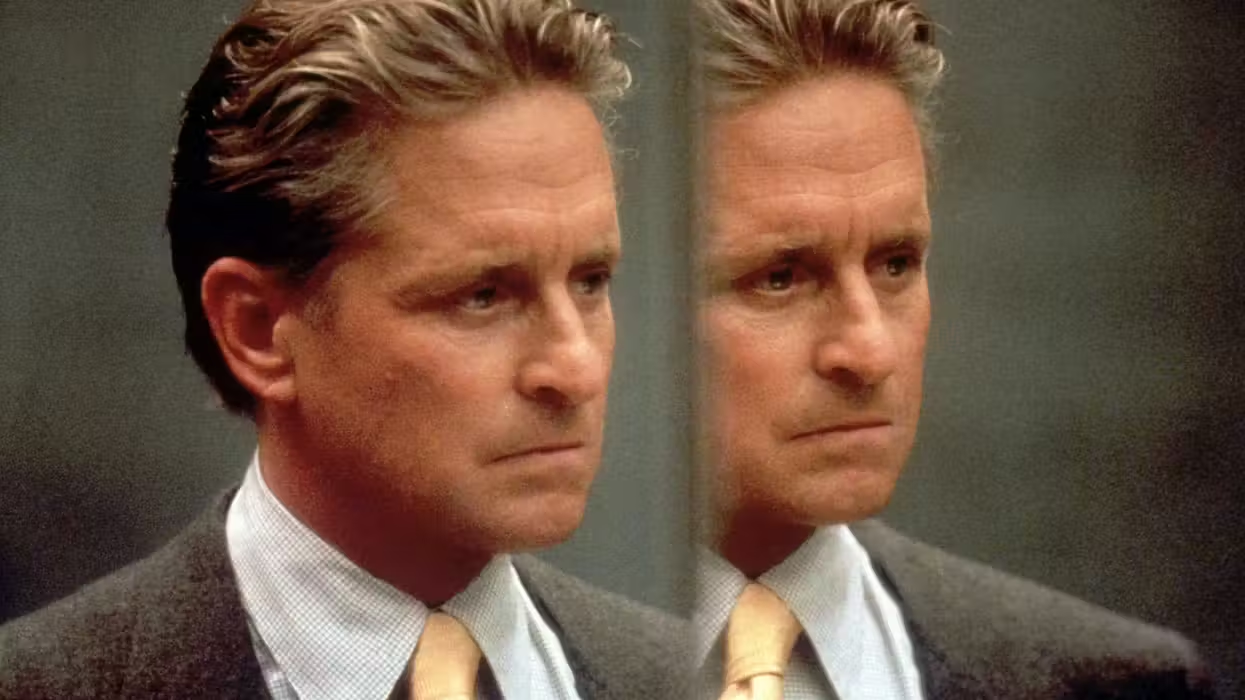
The Game, Fincher's third feature, follows Nicholas Van Orton (Michael Douglas), a sickeningly wealthy, emotionally sealed-off investment banker who receives a mysterious birthday gift from his brother (Sean Penn). It's a voucher for a consumer recreation service that promises to change his life.
And that's "the game," a paranoid spiral that has the character questioning everything and everyone around him. It's the film where Fincher's obsessive control of every visual element first fully clicked into place, and hearing him describe the logic behind it is super interesting.
If you haven't heard Fincher talk about this film, check it out below.
- YouTube www.youtube.com
Manipulation Has Layers, and They Have to Move Together
Fincher opens with what amounts to his theory of the whole film.
"You're aware of manipulation, and the movie's about manipulation," he said. "And you can't be aware of the movie's manipulation as a separate lane to the story's manipulation as a separate lane to Nicholas Van Orton's manipulation."
Just some light philosophy to start, very Fincher. He's aware the character is being manipulated within the story, but the film itself is meant to manipulate us, the audience. But how do you do that?
"Eliminate the distracting and get to the essential. What do you essentially have to tell?" he said.
What he's describing is a structural demand unique to The Game. The character being manipulated, the story doing the manipulating, and the filmmaking reinforcing it all have to function as one.
The moment the audience perceives any of those as operating separately, the illusion breaks. We've covered how Fincher put it to Bong Joon-ho recently, that more than half the job is making sure nothing is distracting the audience from what they're supposed to be looking at.
This commentary is where that philosophy has the highest stakes, because The Game is uniquely vulnerable to it.
What Fincher Loved, and What He Didn't Buy
Fincher describes being brought the script by producer Steve Golin. He loved certain sequences immediately, including the drugging scene and the relentless middle section. But there were certain things he wasn't so keen on.
"I didn't quite buy the setup or the ending," he said. He wanted to make some changes.
His solution was structural and borrowed from something much older.
"What if we have a guy who's Scrooge who's just dead, who doesn't have anybody in his life," Fincher said, "and back into his life comes somebody who should mean something to him, but he's holding off at a distance, and that person gives him this experience."
Giving the film a Christmas Carol skeleton gave the "game" a moral logic it was missing. The elaborate manipulation stops being a prank and becomes an intervention.
The screenwriters acknowledged the courage it took to push the protagonist further in that direction. Their original draft had Nicholas as a softer, more conventionally sympathetic figure.
"Fincher's decision to move it much more in a Scrooge direction, make this A Christmas Carol-type story, was a smart one," Ferris said. "It was a gutsy one, and I don't think, you know, every director could have gotten away with it or could have, you know, been given the freedom to do it that way."
Typically, writing advice will direct you to make your protagonist someone to root for. Make him "good," or sympathetic. That's not the hard-and-fast rule. Fincher bet against that and won.
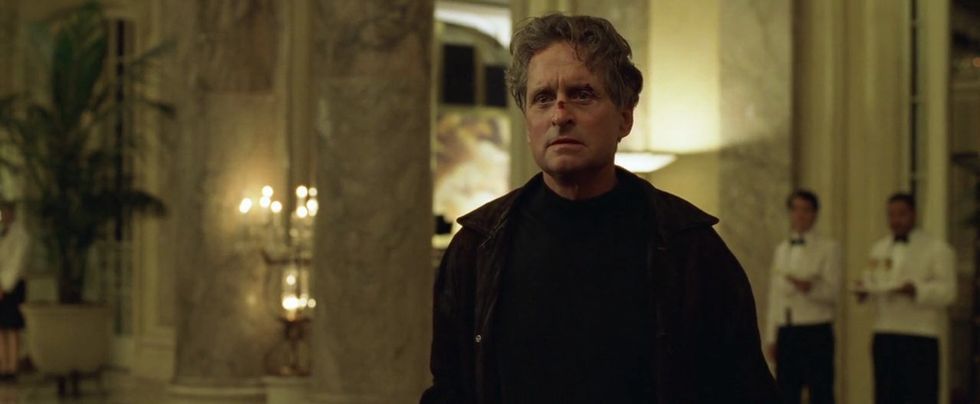 'The Game' Credit: PolyGram Filmed Entertainment
Cut the Scene That Stops to Smell the Roses
This is the one I need to remind myself of as a writer.
The most immediately applicable lesson in the commentary involves the red bra scene, which Fincher says he shot three times and still couldn't make work. In earlier, longer versions, Christine (Deborah Kara Unger) had a conversation with Nicholas about the view from his office windows, what she'd do if she had an office like that. There were layers. It was character-revealing.
It was also, uh, wrong. Too long. Bad, even.
"It seemed like a big windup," Fincher said. "It seemed like it drew way too much attention to her, and you sort of went, 'She's setting him up for something.'"
But the issue wasn't that the scene was clumsy. It was that it dragged the pacing down at the wrong moment.
"It wasn't what they were saying," Fincher said. "It's that they were stopping to talk about that, they were stopping to smell the roses at all at that moment, made you—made the audience go on alert."
In a film built entirely on sustained misdirection, any scene that invites the audience to slow down and assess is a scene where they might figure something out. Scenes that linger in the wrong place don't just bring the pacing to a halt. In the wrong kind of film, they might actively damage the con.
What Does an Audience Need from a Film?
The writing team described a development meeting where they got the question every screenwriter dreads. What's the theme?
Their first answer was that "life's a joke." And that didn't fly with the studio. Yes, you could debate this as a concept, but it's not really a strong theme.
They kept going. Why is the tragedy of life a comedy?
"Because it has a happy ending," Brancato and Ferris supposed. They landed there.
And for Fincher, the project was ultimately about something more specific than character psychology.
"This film for me was an interesting study not in human behavior and how people relate to each other or what people want from life or a career or any of that," he said. "It was, what does an audience want or expect or need from a film?"
The answer he built was a movie that takes every expectation a viewer brings to a thriller (escalation, revelation, catharsis) and turns them against the viewer.
The manipulation is really everywhere. The trick here was making sure none of it was distracting.
Have you seen this one?