Butch Cassidy and the Sundance Kid is one of the best classic Westerns we've ever experienced, chock-full of lines we love, with wisdom and humor woven throughout the character banter.
Early in the film, when Butch Cassidy turns to the Sundance Kid and says, "Boy, I got vision, and the rest of the world wears bifocals," you learn more in a few words about this character than you sometimes see in a full feature.
It's cocky, it's funny, it's honest and earnest and a little bit sad once you know where these two are riding. Let's take apart how one lighthearted boast in Butch Cassidy and the Sundance Kid does that much.
The Scene
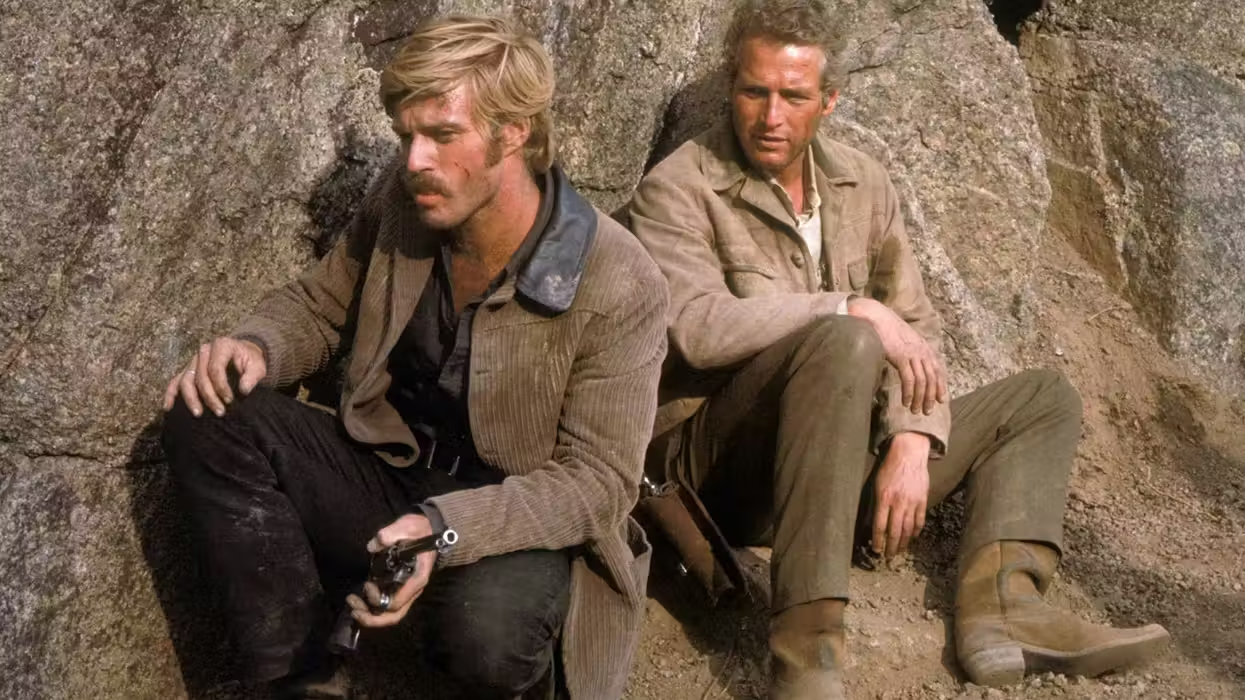
Butch and the Kid ride back toward Hole in the Wall, the gang's hideout, and Butch gets that look.
"Boy, every time I see Hole in the Wall again, it's like seein' it fresh for the first time. And every time that happens I keep askin' myself the same question. How can I be so damn stupid as to keep comin' back here?"
Then he does the thing Butch always does. He starts selling a plan.
The plan is Bolivia. Sundance has never heard of it, and Butch can barely place it himself—Central or South America, one or the other, he isn't fussy about which. When the Kid floats Mexico instead, Butch swats it away and pitches Bolivia like a land man working a mark. It has silver mines, gold mines, tin mines, payrolls so fat they'd hurt themselves hauling the money out. When he says Bolivia, he tells the Kid, just think California, gold rush, the ground floor of something huge.
Sundance isn't sold on the geography, but he's enjoying the show.
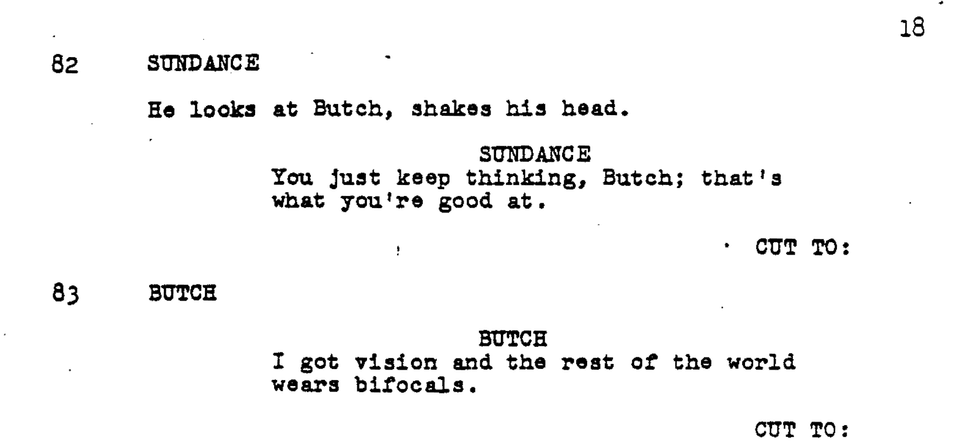
"You just keep thinkin', Butch. That's what you're good at!" he says.
Butch rides on with confidence. "Boy, I got vision, and the rest of the world wears bifocals," he says.
The scene is just outlaws on horseback, one dreaming, the other keeping him tethered to the ground. But it shows us so much, like why they work so well together.
What the Line Tells Us About Butch
Look at how much that boast carries. In this partnership, Butch is the schemer and the Kid is the trigger. Butch dreams up the jobs, and Sundance makes them work.
So when Sundance jokes that he does nothing but think, Butch doesn't see it as an insult. He takes the joke and makes it into something he's proud of. He casts himself as the one guy who can see while everyone else squints through glasses, because they have no vision or foresight.
That's Butch, running on optimism and bravado that borders on a con, although mostly it's a con he's running on himself. He's charming because he believes his own pitch, and he leads because he inspires that belief in others. We would all follow him to a country none of these characters could find on a map.
Paul Newman plays it with a grin. The line works because we've already watched Butch talk his way through every jam with the same easy nerve, the unmistakable way of speaking that belongs to him and no one else. It's how the man is built, and William Goldman lets this line show it.
 Credit: 20th Century Studios
How One Line Carries a Character
There's a lesson in here for your own projects. One character line can do several jobs at once, and Butch's pulls off all of them.
Start with voice. The word choice, the rhythm, the pure nerve of it are unmistakably Butch, and that kind of specificity that makes a character sound like a person instead of a plot function is the goal. Nobody else in the movie would say this in this particular way
It also moves the scene. The best screen dialogue behaves like action, not information, and this boast is Butch pushing the Bolivia plan forward using his charm. It's also a nice button and a clean way to end the sequence.
Then there's everything he leaves out. The frontier is closing in on these two, and the subtext humming under the joke is a man who would rather die than turn ordinary. A man who wears glasses is aging, handicapped almost in Butch's eyes. He doesn't want to be saddled with that life. He wants adventure.
And it fits in a dozen words. Goldman was an excellent, economical writer, and here he keeps the surface small and lets the weight sit underneath it all, trusting us to supply the interpretation. Remember, we don't want to be on-the-nose, and this line isn't, although on a surface level you might just think Butch is bragging about himself.
Try testing your own dialogue the same way. Read it aloud and ask whether it sounds like one particular human being or a writer. Every character will talk about themselves differently, react to situations uniquely,
The Sadness Under the Swagger
What elevates the line is the dramatic irony. Dramatic irony is a storytelling element that occurs when the audience knows an important piece of information that the characters do not.
Butch's vision is real. He's confident, but his dreams are aimed in a fatal direction; he just doesn't know it yet. The same gift for seeing something bigger is what walks him and the Kid out of a country that's finished with outlaws and into one that will bury them. The bifocals crowd, the cautious people who buy the farm and lock the door at night, are the ones who get to grow old.
If you watch the movie again knowing the ending, the boast starts to feel like a setup for downfall. Every plan Butch sees so clearly lands a little worse than the one before, until the two of them are pinned in a Bolivian courtyard, still grimly arguing about where to go next.
It's really a great character line. It lands as funny the first time and hits heavier the second, because by then you know the man well enough to hear what he can't. Butch does have vision. But it was always going to cost him.