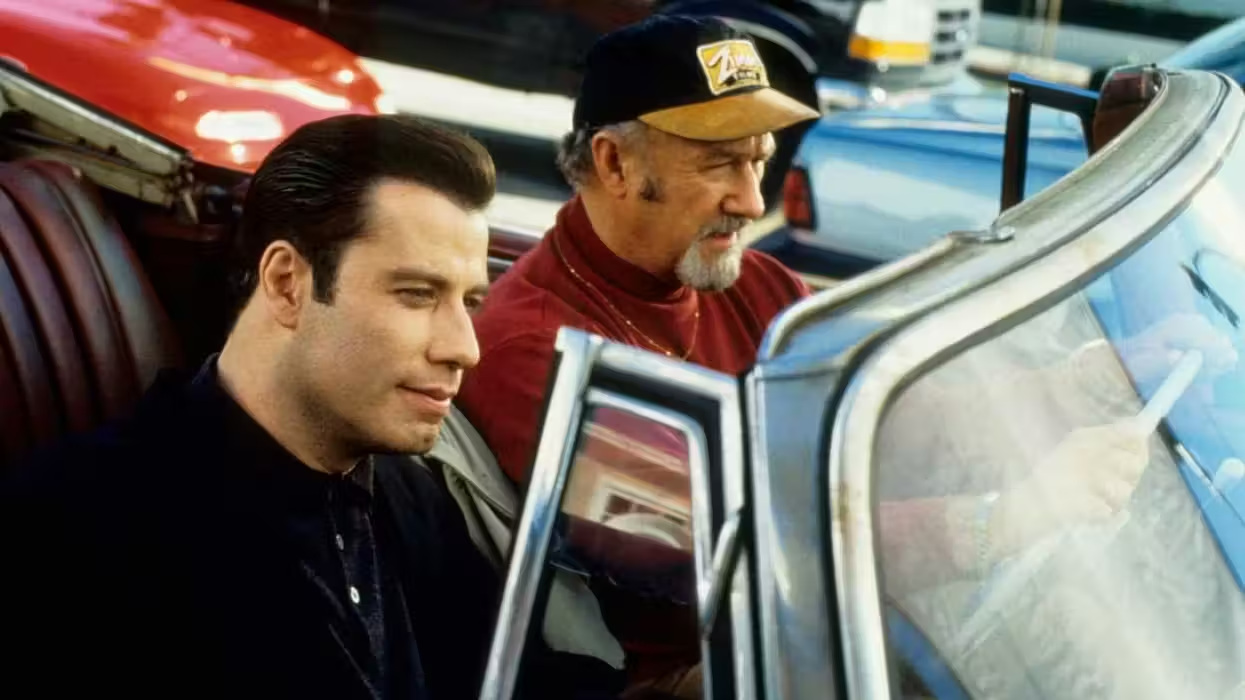
Get Shorty is still a great example of tone, adaptation, and casting the right actor at the exact right moment.
Hollywood loves to make fun of itself, and some movies capture the ridiculousness of the industry in a way that feels like a time capsule of a bonkers time. I'd put Get Shorty in that pile for sure.
Released October 20, 1995 (a year after Pulp Fiction put John Travolta back on the A-list), Barry Sonnenfeld's adaptation of Elmore Leonard's Hollywood novel took a Miami loan shark, dropped him into the movie business, and made him cooler than everyone around him.
Thirty-one years later, the film still stands as a sharp, funny crime story set in Hollywood, and one of the more fun entries in Gene Hackman's filmography. It's also a working tutorial in a few things filmmakers still get wrong.
- YouTube youtu.be
What Get Shorty Is About
Chili Palmer (Travolta) is a Miami loan shark chasing a deadbeat named Leo who faked his own death for an insurance payout.
The pursuit sends Chili to Las Vegas and then to Los Angeles, where he stops in to shake down a broke B-movie producer named Harry Zimm (Hackman). Instead of collecting, Chili pitches Harry an idea for a movie based on his own life and gets pulled into producing it, alongside a scream queen (Rene Russo), a vain star everyone calls Shorty (Danny DeVito), and a rival crew of Los Angeles crooks (Delroy Lindo, James Gandolfini) trying to get in on the action.
How Tarantino Helped
Getting Travolta in the lead wasn't easy. Sonnenfeld has said Travolta passed on the script twice before the producers got creative.
Quentin Tarantino, who worked with him on Pulp Fiction, phoned him personally. Sonnenfeld told The Guardian:
“It didn’t work out with Danny playing Chili. Thank God he played the role he was born to play, which was Shorty. John Travolta [who played Chili Palmer] turned the movie down twice until Quentin Tarantino intervened. Tarantino had dated one of Get Shorty’s producers, who gave him the script. He called John and said: ‘This is not the movie you pass on. Travolta said he didn’t get it, but Quentin said: ‘Trust me and do it.’ John was perfect as Chili Palmer. He is one of the greatest actors with a walk. Whether it’s Saturday Night Fever or Pulp Fiction, his walk exudes confidence.”
Travolta went on to win the Golden Globe for Best Actor in a Musical or Comedy for this one.
In terms of casting, Travolta's Chili reads as cool because Travolta was suddenly cool again. Anyone drafting a role for a specific actor should study his '90s run and how each of these movies built on the last.
Trusting the Novelist
Scott Frank's screenplay is the reason people still quote this movie back and forth. He didn't try to improve on Elmore Leonard. How could you?
Leonard said of the film (via CBS News):
"I told [Get Shorty director] Barry Sonnenfeld a couple years before they started shooting that I hoped when somebody delivers a funny line, you don't cut to get a reaction from another character, grinning or winking or laughing, because these guys aren't being funny.
"They're serious. It's kind of flat and deadpan, the whole thing. This is how I see my material. If the audience thinks it's funny, fine. ... There's a certain rhythm that runs through it."
That rule might seem like something small, but it isn't. It's a specific note on tone.
Frank also lifted big chunks of Leonard's dialogue straight from the page, understanding that when your source is that good, your job is transcription and compression, not embellishment.
If you want a model for adapting a novel, check out Frank's script and read it next to the book.
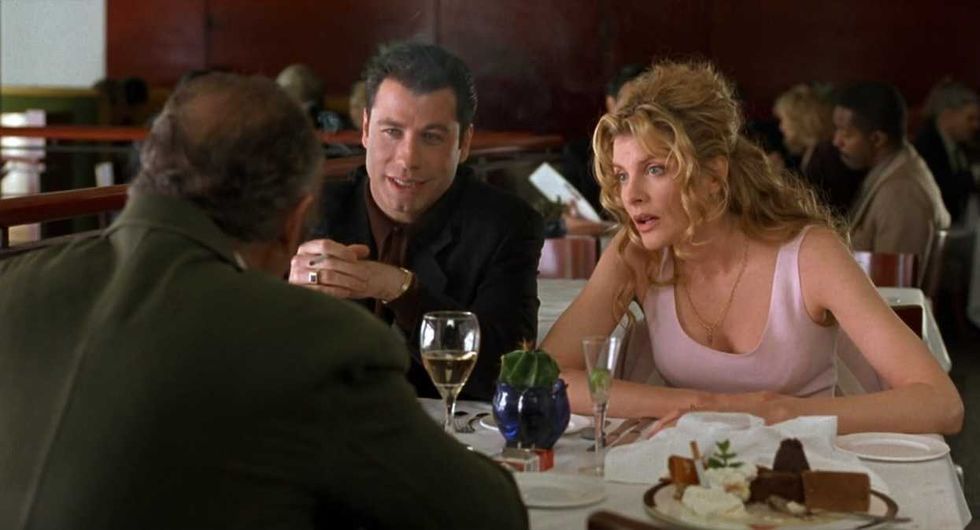 'Get Shorty'Credit: MGM
Comedy That Doesn't Know It's Funny
Sonnenfeld (a former cinematographer for the Coen brothers on Raising Arizona and Miller's Crossing) shot Get Shorty the way you'd shoot a straight-up crime thriller. There are no goosing camera moves telling the audience to laugh, and, as we've already seen, no cutaways to make sure you caught the joke.
Everyone plays it dead straight, which is precisely why it lands.
"Gene Hackman [as Harry Zimm] never tried to be funny," Sonnenfeld told The Guardian. "He was scary as hell to work with—he's very intimidating and suffers no fools."
In the film, Hackman's Harry Zimm believes his terrible movies are art. DeVito's Martin Weir believes he's a genius. Dennis Farina's Ray "Bones" Barboni believes he's terrifying instead of ridiculous.
Comedy is sometimes funny because it isn't trying too hard. It can be borderline serious, and the seriousness becomes its own hilarity. The tone comes from the performances and can be bolstered in the edit. Trust the writing, and trust that the audience will come to the joke.
A Hollywood Satire Made by Hollywood
Part of what makes Get Shorty so sharp is that everyone making it knew the terrain so well. It's the same reason 30 Rock was so fun, why Barry felt so biting, why Hail, Caesar! was hilarious.
Danny DeVito's production company, Jersey Films, optioned Leonard's novel. DeVito was originally lined up to play Chili before he committed to directing Matilda, at which point the studio required him to stay involved by taking the smaller role of Shorty.
Sonnenfeld had spent years as a cinematographer before graduating to directing, so he'd sat through his share of terrible producer meetings and knew the type Hackman was playing.
Frank was already an insider. Adapting Leonard well meant thinking like a filmmaker, not a novelist, and Frank knew the difference. The film's contempt for producers, agents, and stars works because it's not punching down, and the contempt is affectionate, from people who've survived them.
Why It Still Holds Up After 31 Years
Get Shorty pulled in about $115 million on an approximate $30 million budget and helped give Travolta a second act. (It also, just FYI, spawned a middling sequel called Be Cool and a three-season TV series.)
Now, 31 years later, the sequel and the show have faded, but the original is still looked on fondly. And there are a few reasons why. The dialogue trusts the audience, the casting is inspired, and its tone never breaks character.
If you're writing or directing a comedy right now, watch Get Shorty and pay attention to how little the movie strains to sell any of its jokes. The smartest crime comedy of its era happens to be the least anxious about being one. It just is one.