Why "I'll Be Back" Is the Ultimate Lesson in Screenwriting Foreshadowing
How James Cameron used a mundane line of transitional dialogue to subtly forecast one of the most destructive action sequences in cinema history.
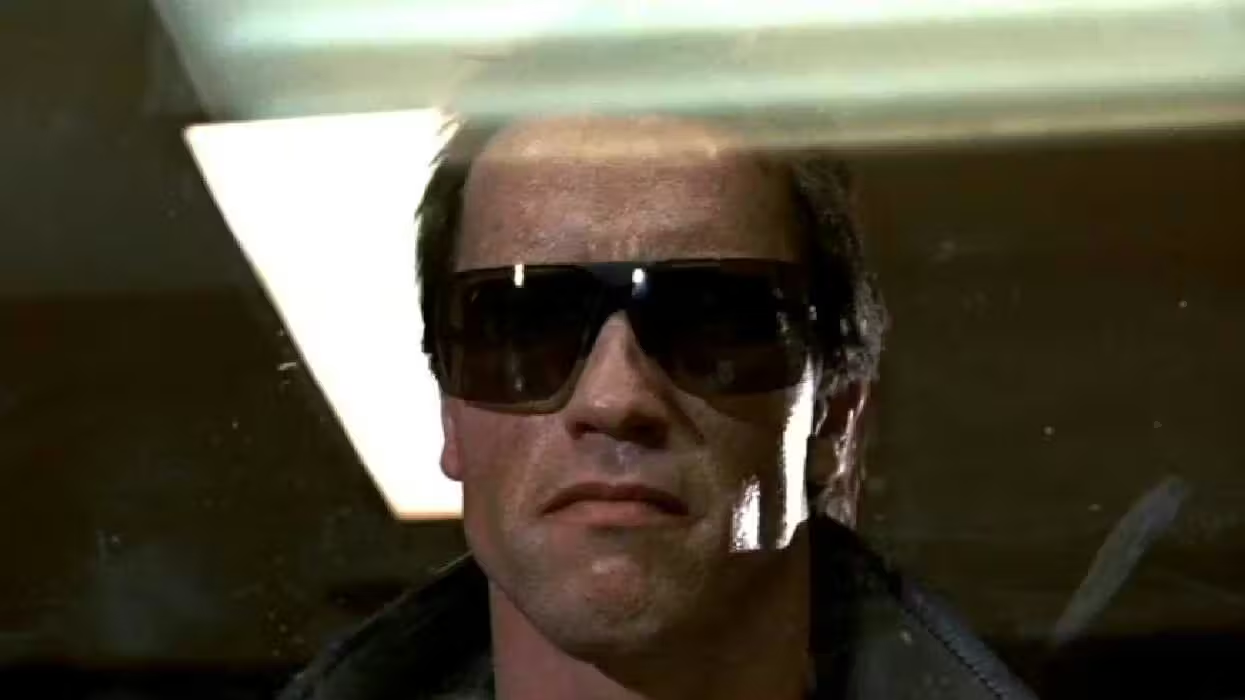
'The Terminator'
It's kind of crazy that a simple line became the most memorable quote from Arnold Schwarzenegger's career, but here we are 40+ years later, and we're still talking about "I'll be back."
But The Terminator is one of those movies that started from such humble beginnings; it's cool to see how a vision came together. It all started with a dream Cameron had while working on Piranha 2: The Spawning, of a metallic torso coming to get him.
And then he used that to write the movie with Gale Anne Hurd, originally intending it to be a low-budget slasher they would let him direct, so he could get his career off the ground. Somewhere in it becoming one of the biggest movies and franchises of all time, "I'll be back" became a masterclass in screenwriting foreshadowing.
Today, I want to break down how all that happened.
Let's dive in.
Setting up the Narrative Trap
Okay, so this is sort of a wild scene because the line is a button to a car driving him, and then an action set piece. The shooting of the scene is very legendary.
Apparently, it was originally written as "I'll come back," but Arnold Schwarzenegger struggled with the phrasing thanks to his accent. He argued with Cameron and said that a cold, precise machine would say "I will be back" instead.
That didn't make Cameron happy. He told Schwarzenegger to stick to the script and deliver it flatly.
Somewhere, along the way, we got "I'll be back."
And that flat delivery is precisely what makes the foreshadowing work.
You get this sort of hair sticking up on the back of your arm when you hear it. You realize this guy doesn't lie, so he is coming back with a strategy to kill Sarah Connor no matter what.
How to Hide the Threat in the Mundane
To me, this is the absolute gold standard of screenwriting foreshadowing. We have a total sense of wonder as to what's about to happen next, juxtaposed against fear, and briefly, the cop has his boring answer to the question.
We even pause so the T-800 can assess the room and how to breach its security. It does this silently with some eye movement and computer analysis; we don't know what's coming, but we know something is coming.
The Explosive Payoff
All writing is plants and payoffs. This is like an immediate growth of action out of the line. The brilliance of "I'll be back" is how rapidly and violently that contract is fulfilled.
Our Terminator returns second after his promise by driving a full-sized sedan directly through the front doors.
The line acts as a narrative trigger. We hear it, and we clench. Even though it doesn't take long to respond, it's just this perfect edge-of-your-seat moment.
Summing It All Up
If you want to master foreshadowing in your own scripts, look at your transitional dialogue and see if it's leading the audience toward an emotion or a feeling.
You can do a lot even with a boring line; if we know the way a character delivers it, it can be forboding or challenging.
Add some subtext if you need to hammer it home.
The best setups aren't the ones that sound profound on the page; they are the ones that make the audience hold their breath for the inevitable explosion.
What do you think?
Let me know in the comments.