Forget the Algorithm: How 'El Tonto Por Cristo' is Finding Success Through Roadshows
From the backwoods of America to the Kennedy Center, the director discusses the black-and-white beauty of El Tonto Por Cristo, the power of Texas-made art, and the family-fueled roadshow bringing audiences back to the theater.
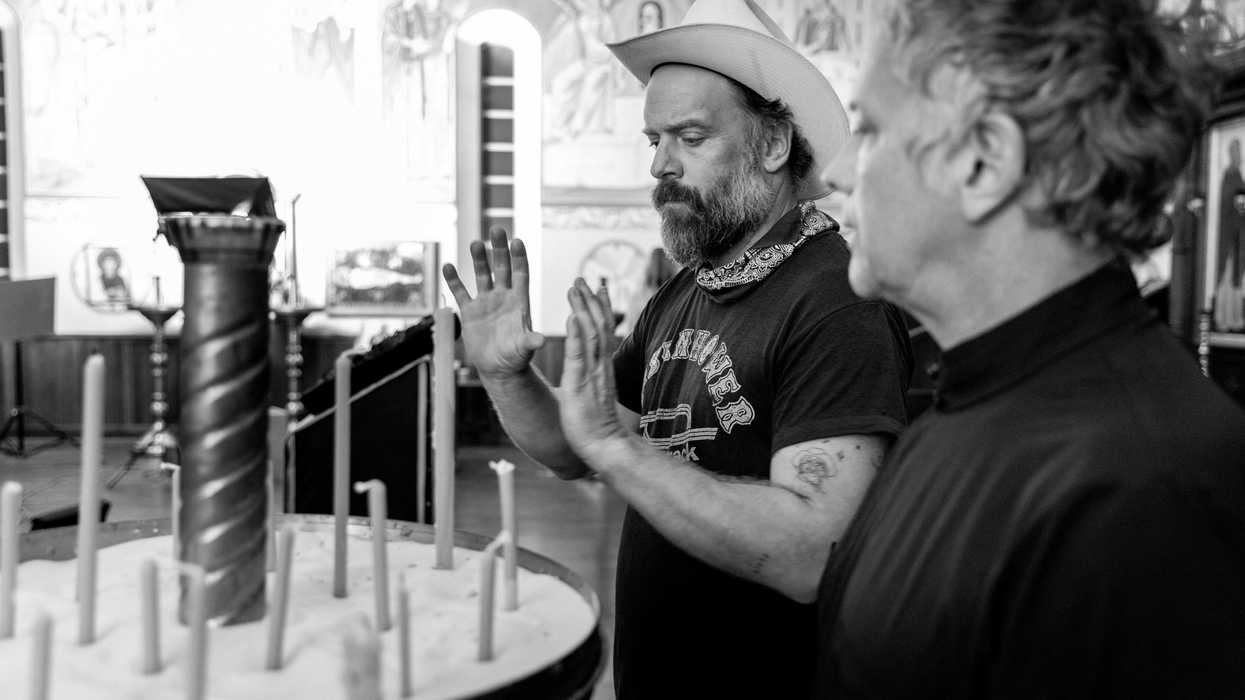
'El Tonto Por Cristo'
Let’s be honest: the current indie film landscape can feel like a bit of a graveyard. Between the shrinking middle-budget market and the soul-crushing void of the "content" treadmill, it’s easy for filmmakers to feel like they need a permission slip from a streamer just to pick up a camera.
Then you meet someone like Josh David Jordan. His film has this special screening at the Kennedy Center in February, but I got to see it early.
Jordan isn't waiting for a green light; he’s building his own traffic patterns. His latest feature, El Tonto Por Cristo, is a gorgeous, meditative, black-and-white journey that manages to bridge the gap between deep Texas roots and the high-art sensibilities of Andrei Tarkovsky. It’s a film that trusts its audience to sit in the stillness, proving that "patience" isn't a dirty word in cinema—it's a superpower.
As the film prepares to take the stage at the Kennedy Center for the 2026 Films Across Faith Traditions series, we caught up with Josh to talk about his unconventional path from Walker, Texas Ranger to the director’s chair, the technical reasons behind his monochrome palette, and why the best production office is often just your own living room.
Let's dive in.
- YouTubewww.youtube.com
NFS: Hi Josh! Can you begin by telling us about your filmmaking career and what led you to direct your latest movie, El Tonto Por Cristo?
Josh David Jordan: I didn’t come up through a traditional filmmaking path. I’m the son of a traveling evangelist, so I spent the 1980s moving from town to town across the backwoods of America. Wherever we landed, I would find a library and read about directors and filmmakers. At that time, L.A. and NYC felt like the only places where filmmaking was possible, so theater became my entry point. Acting was the closest thing I could reach without a real home base.
In the late 1990s in Dallas, I started booking commercial work and small roles on local shows like Barney and Walker, Texas Ranger. My first feature was The Prodigy. Later, my friend Tim DeLaughter’s band, The Polyphonic Spree, was hired for Scrubs, and he gave me a speaking role. That experience clarified something important for me. I realized I didn’t want to be in front of the camera anymore. I wanted to be the person shaping the story from beginning to end.
That realization led me to music videos, short films, and eventually writing and directing my first feature, This World Won’t Break. Once I finished that film, I knew I had found my place.
NFS: What compelled you to shoot the film in black and white, particularly in churches that are often known for their vibrant colors?
JJ: From the very beginning, the film was always going to be black and white. That’s simply how I saw it. Orthodox churches are incredibly beautiful, filled with iconography, vestments, and color. I knew that if we shot in color, we would constantly be chasing visual beauty instead of focusing on the story.
There is so much happening during a liturgy beyond color. There is the smell of incense, beeswax candles, the movement of the service, and the act of participation itself. What surprised me most was how the monks visually emerged on screen. Their black cassocks against white walls, ocean, and sand created a contrast that would disappear in color. They would blend in.
At screenings, people often tell us they forgot they were watching a black and white film and imagined it in color the entire time, confirming the choice was working.
NFS: David Lowery described your film as “Texas by way of Tarkovsky.” Can you tell us a bit more about some of your key influences for El Tonto Por Cristo?
JJ: Tarkovsky’s Andrei Rublev is an undeniable influence, especially in its Orthodox themes and use of black and white. But Dreyer’s Ordet, Jarmusch’s Dead Man, Wenders’s Wings of Desire, and Pawlikowski’s Ida were all present throughout the process, from writing to production.
Those films trust the audience. They allow stillness. They are not afraid of restraint. That stylistically stayed with us the entire time.
NFS: I am struck by the extent to which this film is a family affair, with your wife Jessica serving as a producer on the project, and your son Julian serving as editor. How does making the film with your loved ones help shape the final product, and can you tell us more about collaborating with Julian on the film’s final cut?
JJ: Working with family is not for the faint of heart, but I cannot imagine working any other way. Everything begins and ends with honesty and full commitment. I trust their instincts because I know they are living with the film just as deeply as I am.
Our home becomes a production office, a merchandise warehouse, and a pre-production space for the next project. Not many people could manage that kind of overlap. Julian understands my process better than anyone. He is also getting very good at cutting moments I’m emotionally attached to, which I think he enjoys more than he admits.
That trust and speed in post-production allowed us to move quickly and get the film into the hands of our composer, Michael Paraskevas, without losing momentum.
NFS: The film’s grassroots nature seems to extend beyond your own family, featuring performances from members of local groups like The Polyphonic Spree, as well as a hypnotic score from composer and Texas native Michael Paraskevas. What role does Texas play in this film, and why were these local connections so essential?
JJ: Texas plays a central role in everything I do. Many filmmakers leave for LA or NYC, and that makes sense, but we never stopped creating here. Being somewhat isolated has created a tight-knit community of artists who consistently show up for each other’s work.
There is an honesty here that is difficult to replicate elsewhere. Texas also offers an incredible range of landscapes. El Tonto Por Cristo has peaks, valleys, and beaches, all within our own backyard. This film could not exist anywhere else.
We have also been supported by Stetson, Tecovas, Topo Chico, and Lonestar Beer, to name a few, on all of my projects. Doesn't get more Texan than that.
NFS: You and your team also adopted an innovative distribution model by taking the film on the road over the past several months. Tell us more about the film’s roadshow, as well as how it compares to your previous experiences sharing your films with the world.
JJ: That model was led by my wife, Jessica Jordan. She spent 24 years touring with The Polyphonic Spree and translated that experience directly into a film roadshow. We screen in historic theaters across the country, with live Q&A sessions, merch tables, and VIP meet-and-greets.
Audience members receive a gold paper crown as they enter. The shows sell out. People stay after the screenings and talk with strangers about the film in theater bars and lounges. Honestly, when was the last time you went to a movie where every seat was full and no one left before the final question was answered?
It has been exhausting, but it has also been the most rewarding way I have ever shared a film.
NFS: The film is now headed for a special screening at the prestigious Kennedy Center. Congratulations! What do you hope this added exposure does for your film and the community it represents?
JJ: Thank you. Back in August, the Kennedy Center reached out and invited us to kick off their 2026 Films Across Faith Traditions Series in Washington, DC. It’s rare for independent art, especially work made outside the system, to be given a national stage like that.
For us, it’s confirmation, a signal that there is an audience for sacramental cinema and for films that move at a patient pace without compromise. Practically, I hope the film meets people in that room who understand the work and want to help give it a wider life beyond the road, and talk about what's next. The success of the roadshow has already shown us that the audience exists.
And on February 9th, we are bringing the same roadshow experience that night: the gold crowns, a VIP meet and greet, and our merch table. The scale changes, but the spirit stays the same.
NFS: Is there anything else you would like to share about El Tonto Por Cristo or any future projects?
JJ: You don’t need permission to make meaningful work. You need clarity, commitment, and a willingness to meet your audience where they are. Sometimes that means putting the film in your car and driving it to them.
As for what’s next, that’s still under wraps while we look for the right investors to join us. What I can say is that it will be made the same way, deep in the heart of Texas.