How 'The Odyssey' Pulled Off Those Practical Effects
The sword and sandal movie was a staggering sight to behold on the big screen.
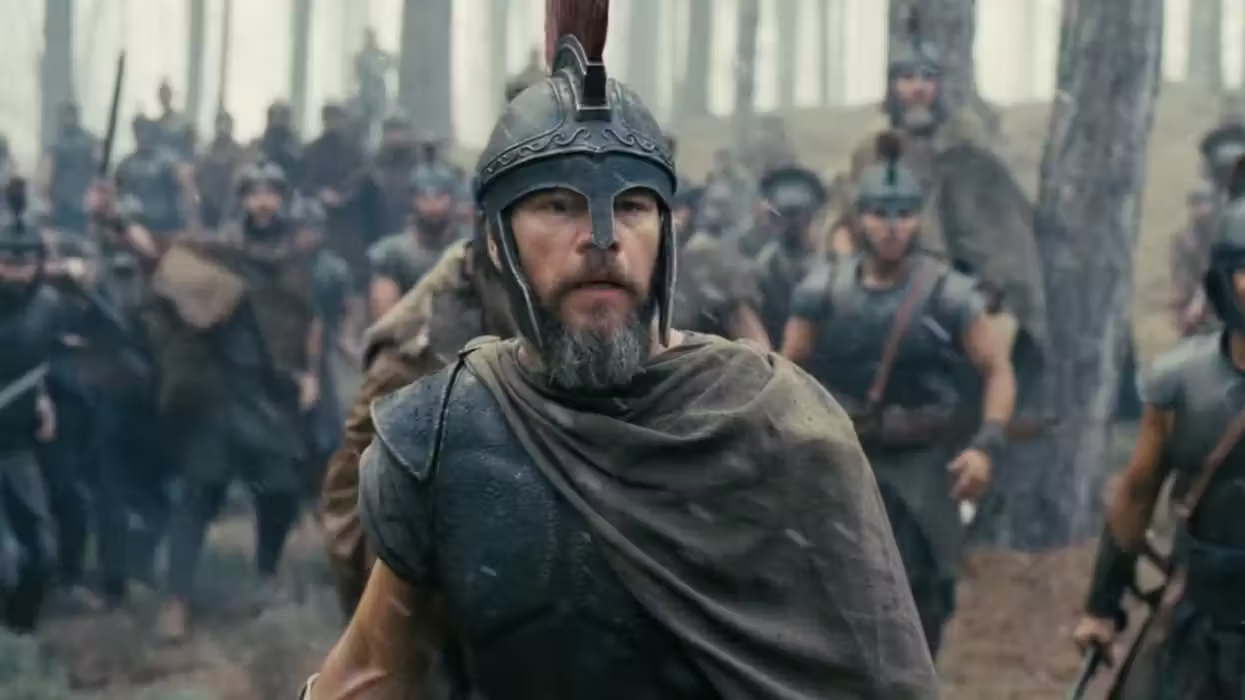
'The Odyssey'
It's a Monday morning, and everyone is talking about going to see the big blockbuster movie over the weekend. If you thought The Odyssey was big before, the box office numbers and chatter show that it could wind up being the movie with the most cultural impact this year, in a field that's already pretty crowded.
One of the reasons I think The Odyssey connected with wide audiences is that it felt so very real. Everything was grounded in natural emotions and ideas that were both relatable and singular.
And its visuals matched. But how? How did Nolan and company make a movie that starts with an admission of magic and then work so hard to make sure everything on screen was shot with mostly practical effects and ideas that dug into those themes?
Let's dive in.
Make It All Real, And It'll Feel Reel
One of the many behind-the-scenes marvels of The Odyssey is that they traveled all over the globe to find actual locations for cities, landscapes, and caves to shoot the real thing.
For example, the location for Troy covered more than 110,000 square feet and was large enough to hold over 2,000 extras.
It was a tiered city on a hill that had more than 60 structures. They recreated the temple of Athena inside it.
When it came to the actual Trojan Horse, multiple 35-foot-tall horses were built for the movie. They even submerged one on the beach and really had men pull it from the sand and roll it and then filmed that to feel as authentic as possible.
For the Ithaca castle where Odysseus ruled, and then Penelope and Telemachus entertained suitors, they used a real 15th-century castle that was over 1,000 feet above sea level on the Italian island of Favignana.
The cast and crew had to hike up to it every day together, and the equipment was dropped off by helicopter or funicular.
Their boats were actual boats on the open ocean that led to happy accidents, like getting Dolphins in a shot because they were out there swimming.
Even though shooting on location is not easy, it feels like it was nothing compared to what else Nolan did to preserve the reality for the actors.
Like building a real Cyclops.
The Cyclops Puppet
In order to give Matt Damon’s Odysseus and his men a genuine sense of scale while filming inside Nestor's Cave in Greece’s Peloponnese region, Nolan and his crew built a 60ft puppet that they used for many of the shots to give scope and scale to one of Odysseus's first stops.
"Everything about the Cyclops sequence is aimed at trying to imagine: what would this be like in real life? Not approaching it from a storybook or cartoony point-of-view, but really trying to be in there with Odysseus and his men. It’s a horrifying situation." — Christopher Nolan, in Empire's August 2026 issue
To make the puppet come alive, Nolan recruited actor Bill Irwin, the guy who previously voiced and operated TARS in Interstellar, to make the Cyclops into a real humanoid.
- YouTubewww.youtube.com
Irwin stayed on set inside the cave with the cast, providing live dialogue, performance cues, and terrifying vocalizations.
And trust me, if you have seen the movie, you know those vocalizations stick with you forever. It's so horrifying to hear that thing yelling and suffering and attacking.
Taking inspiration from filmmaker Guillermo del Toro’s philosophy, Nolan insisted the creature shouldn't feel like a mindless killing machine.
He told the Associated Press: "A monster is never just a monster...You have to look beyond that. You have to look for what this creature is as an individual, and that's what Bill was able to bring to the soul of the Cyclops."
- YouTubewww.youtube.com
But The Whirlpool and Monster had to be CGI, Right?
I feel like the longer I wait, the more I am stunned by the enormity we're learning on the press tour of how these movies really got done.
Matt Damon recently revealed the staggering practical filmmaking behind the intense Scylla scene in The Odyssey, and somehow it was all practical, too.
Damon explained, “We took the boat through that passageway, and Chris had, on one side, jet skis doing donuts in the water... to really create a small whirlpool that the visual effects could use [as] the actual movement of water as a guide.”
Beyond churning up the sea, stunt coordinator George Cottle pushed the physical limits on set to pull off the monster's attack.
“George Cottle did six ratchets on that boat—on the actual boat,” Damon recalled. “He rigged a ratchet system and pulled stunt guys up out off the deck of the boat; it was the most incredible thing.”
Remarkably, Cottle executed the high-wire act in a single burst of efficiency: “He did six ratchets, and he did it after lunch—he did it all in an afternoon. The great George Cottle, ladies and gentlemen!”
In-Camera Visual Illusions
One of my favorite parts of the movie was just seeing what felt like natural lighting in every scene. It felt like you were there in every scene, almost like a voyeur.
But as we know, it takes a lot of effort to get that natural look right.
Nolan worked with cinematographer Hoyte van Hoytema to make sure nothing felt oversaturated or like it was lost on screen.
Remember, they're shooting everything in IMAX, which had never been done before, so it all kind of has this experimental quality to it.
When it came to the fall of Troy, they knew they wanted to shoot that via firelight. And since real open flames present massive fire hazards and low exposure, the production built over 1,000 custom 4-foot LED panels called Pyrohedrons.
They programmed them with natural flame-flicker profiles; they illuminated set pieces up to a mile away.
They worked to find analog resolutions to pretty much any camera problem they ran into.
"The moment you go with a digital effect, you have to scan your original negative, and reduce the resolution to do it. Then you refilm it back with a reduced resolution. You have a whole step where you can lose a lot of quality. The more we maintain in-camera, the more we maintain that original quality. That has always been very important to us." — Hoyte van Hoytema to The New York Times.
As I said above, The Odyssey marks the first feature film shot entirely with 15/70mm IMAX cameras.
Even that had to be practically fixed because older IMAX cameras were so loud.
"After “Oppenheimer” [2023], I called up my friends at IMAX. I couldn’t tell them what the movie was yet, but I said if ever we were going to do a film all in IMAX, this is the one. So let’s finish these new cameras, find some kind of soundproofing system. And they engineered this blimp system that we could put the camera in."
— Christopher Nolan, to The New York Times.
IMAX engineered a custom "blimp" soundproofing housing that reduced the camera's deafening roar down to a whisper.
And then they were able to shoot the whole movie that way, including all the close-ups and quiet scenes.
- YouTubewww.youtube.com
The Takeaway for Filmmakers
Nolan’s methodology isn't just about stubborn nostalgia; it’s about creating an environment where real light, physical physics, and genuine human reactions interact naturally.
I love how personal he made the movie and how his changes to the ending reflected a thematic core that had to be shot practically for it to make sense.
By opting out of heavy storyboarding and trusting real locations, the camera captures unpredictable natural moments that standard CGI environments rarely replicate.
As Nolan sums it up: "Try to create a world, and then live in it."
Summing It All Up
At this point in cinema history, Christopher Nolan using practical effects just feels right and inspiring. I hope it challenges more filmmakers to try it and studios to bet on them.
Let me know in the comments.
- 5 Lessons Filmmakers Can Learn from the 'Odyssey' Trailer ›
- Why Christopher Nolan is Turning The Mythic Epic On Its Head ›
- Christopher Nolan's 'The Odyssey' Proves Practical Filmmaking Still Wins ›
- ‘The Odyssey’ is Christopher Nolan’s Most Gargantuan Film Yet ›
- The Odyssey China ›
- Wicker trailer ›
- Emily Wilson's Scathing 'Odyssey' Review Violates Ebert's Law | No Film School ›
- Why Is Everyone Going Nuts For These Chinese Interviewers' Questions to Christopher Nolan on 'The Odyssey'? | No Film School ›
- Read 'The Odyssey' Screenplay | No Film School ›