60 Years Ago: John Ford’s 1966 Western Classic Became the Final Feature Film of His Legendary Career
Have you seen his final film, 7 Women?
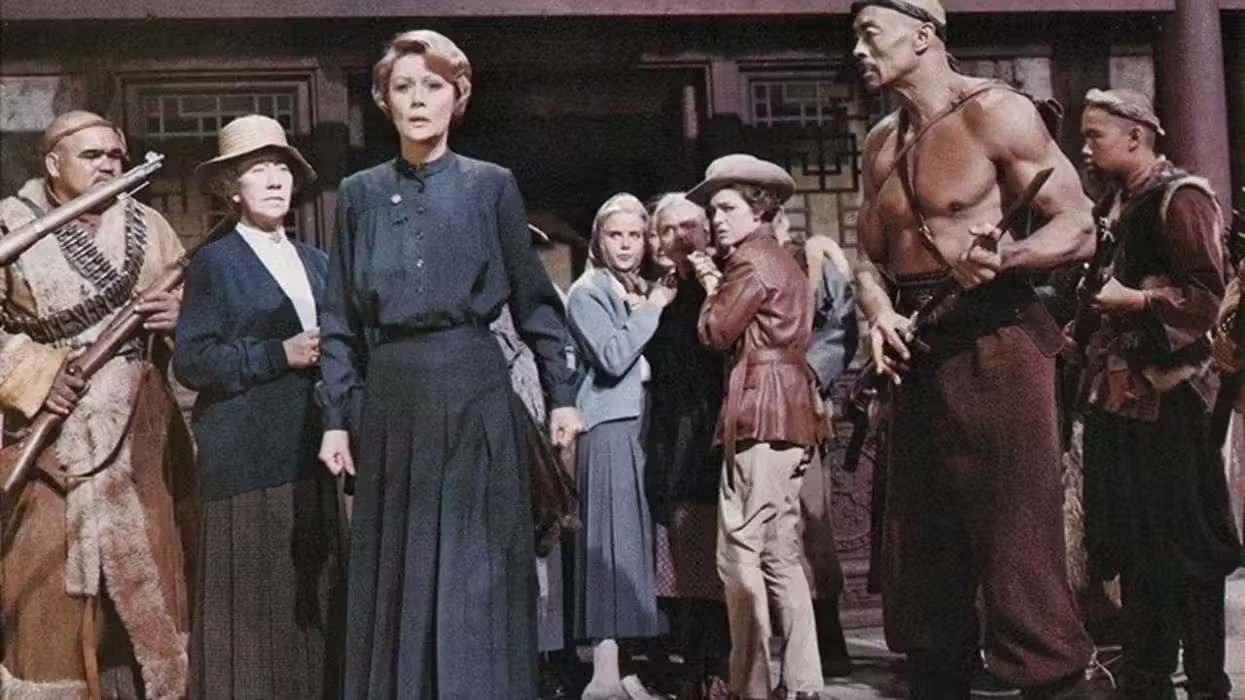
'7 Women'
When you think of the name John Ford, you probably think of rolling hills and stunning vistas. And you definitely think of Western movies. The guy directed so many of those films, most notably The Searchers, which is one of the most important and greatest American films ever made.
Yet exactly 60 years ago in 1966, the director who practically invented the American Western delivered his final feature film, and it wasn't set here and didn't star John Wayne.
It was a movie about a missionary troupe on the China-Mongolian border called 7 Women.
Many people argue that it is Ford's final Western, a movie disguised as a drama that subverted the tropes he built a career creating.
Let's dive in.
- YouTubewww.youtube.com
The Western in Sheeps' Clothing
Okay, so I wasn't too excited to watch this movie. Even though it was Ford's final film, a group of missionary women in China did not sound like a plot I would be into on a regular basis.
But I pressed play anyway and got treated to an ensemble drama about American and British missionary women trapped in their mission village during the Sino-Japanese conflict. Up against them? The bandit warlords who are coming toward them fast, and want both these women and the land where the mission stands.
Now...I was told this wasn't a Western. But it has all the makings of one, and in my opinion, it's pretty obvious this is Ford waving goodbye to the sole Americanness of the Wild West and introducing the tropes into a movie that occurs like 10,000 miles away from our frontier.
You also get Mongolian warlord Tunga Khan (Mike Mazurki) and his marauders who are effectively a gang of bandits coming in to take the woman and the land.
And then instead of a sheriff, you have Dr. Cartwright (Anne Bancroft) who arrives on a horse, wears all leather, smokes, drinks, hates religion, and takes no guff.
These all sound like your standard Western players working toward a face-off in the finale.
The movie kind of shifts into a hostage film during the face-off, and Tunga and his gang murder their way through the mission, with plans to sell the American women off for money or keep them as concubines.
Carwright convinces Tunga to let the other women go as long as she becomes his concubine, and he agrees.
But in the end, Dr. Cartwright tricks Tunga into taking her as his concubine, and then she serves him poison out of her medical bag and drinks some herself, thus allowing the women to go free and killing herself in the process.
Subverting His Own Mythology
What makes 7 Women fascinating is how Ford used his final movie to interrogate the myths he spent fifty years building.
Ford was a director who was responsible for some of the most important Western movies like Stagecoach, Fort Apache, She Wore a Yellow Ribbon, and The Searchers.
His works break down our taming of the West to make it more civilized, but here we are 66 years later in his career, seeing someone stoop lower to murder suicide her rival, thus succumbing to laws she will never understand but wants to break.
We're short on conventional heroes, like John Wayne, instead letting Anne Bancroft take center stage as a doctor there to save people, who kills. He also shows that the civilians like them are out of touch with the way the real world works.
They can't civilize anything with God because people are not actually civilized; they'll lie, cheat, and steal to get what they want, as long as they can.
No one is riding off into the sunset either.
Cartwright sacrifices herself to the warlord to save the women and children. And she delivers a parting line that rings in your ears...
"So long, ya bastard."
Summing It All Up
Six decades later, John Ford’s final curtain film remains a bold genre subversion that takes on the legends he built and shows them in a brand new light.
Have you seen the movie? Is it canonically a Western?
Let me know what you think in the comments.