How 'Leave the World Behind' Creates One of Modern Cinema's Most Unsettling Scenes
How Sam Esmail turns a doorway conversation into dread.
'Leave the World Behind'
Someone knocks at the door of your Airbnb in the middle of the night. The internet is down, the phones are dead, and an oil tanker ran itself aground a few scenes earlier. Things are weird and unsettling. Then a man and his daughter appear out of nowhere, claim the house is theirs, and talk their way inside.
That is the setup for one of the most unnerving stretches in Leave the World Behind, Sam Esmail's 2023 Netflix thriller shot by Tod Campbell.
A recent breakdown of the scene from YouTuber From the Screen argues that the real tension has almost nothing to do with whether these two are lying. It lives in the camera. Let's jump in.
- YouTubewww.youtube.com
Don't Start with Coverage, Start with Emotion
Speaking at Talks at Google about the film, he said he treats the camera as the audience's way into the experience, and that he and Campbell never take that for granted.
His warning to filmmakers is that it is easy to fall into a trap of just grabbing coverage, but then everything becomes rote. Pan up the stairs, get your over-the-shoulder and the reverse. Wide, medium, close-ups. Boring!
"No one gets involved in the movie just because you're following the beats of something," he said. "It's not about the logic or plot. … It's about the feeling and the nightmare that you're dragging the audience through."
Every camera choice is about the feeling he wants you to have in that exact moment. He described building an early shot of Amanda touring the rental, a swooping move he and Campbell kept exaggerating in previs until, he said, "the more we did that, the more sickening it started to feel. And that's when I knew that was right because, as much as Amanda's character in this moment is taking in this beautiful home, the movie is setting up the tone that something's off, that something's about to go awry."
Composition Can Go Against Dialogue
The scene has some simple over-the-shoulder coverage, but most interesting is one particular wide shot.
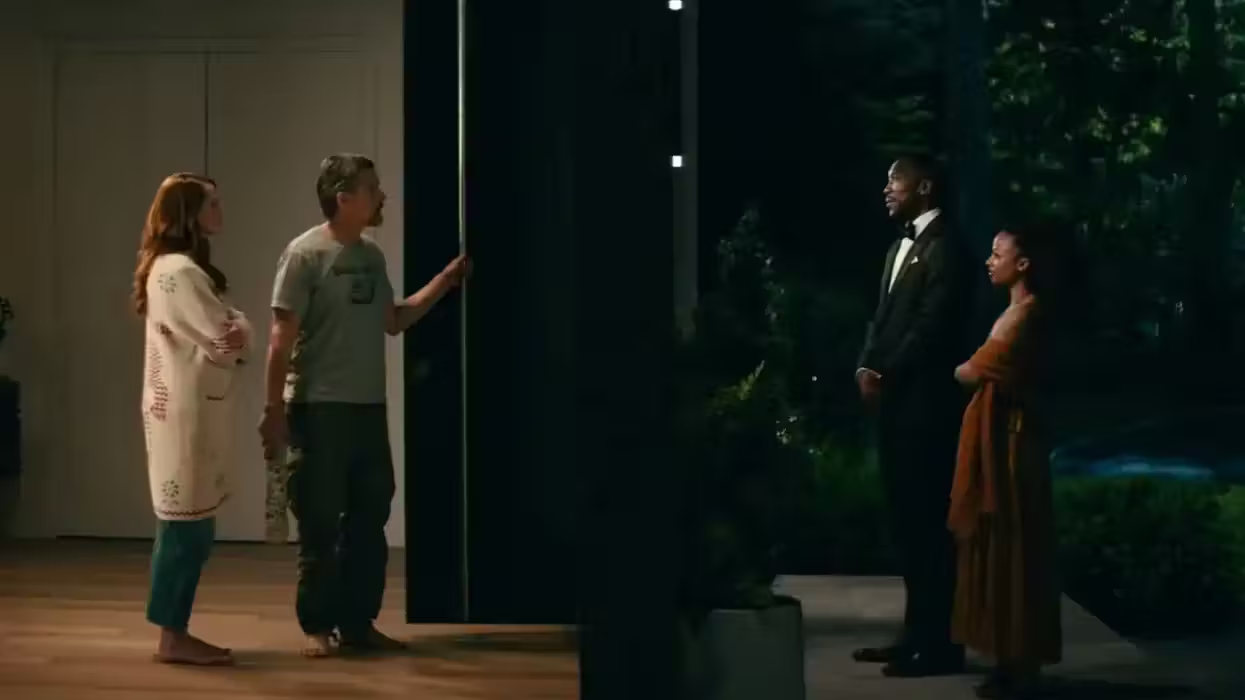
As G.H. Scott (Mahershala Ali) insists the house is his, Esmail cuts to a symmetrical frame split down the middle by the doorway. On one side sits warm light, wood floors, and Amanda and Clay (Julia Roberts and Ethan Hawke) in casual clothes and bare feet. On the other, cold blue darkness, G.H. in a tuxedo, and his daughter Ruth (Myha'la) in a formal dress.
The frame gives both families equal weight. You hear one thing in the dialogue and see another. The contradiction is the whole scene in miniature. Who do you believe? The cinematography won't give you any clues as to who's being honest.
When discussing coverage with Collider, Esmail said, "When we start thinking about how we're going to shoot it, we always go into it with a point of view of a character, and sometimes I don't know what that is until i see the actors perform it."
Camera Height and What It Means
Camera height helps the scene get sneaky. Generally, a high-angle shot looks down and shrinks its subject, while a low-angle shot looks up to someone who has perceived authority. This scene uses both.
The camera drops low to look up at Clay or to show Ruth's POV. These angles lend them power. At other points, the camera climbs to look down on G.H. and Ruth even while they try to assert themselves.
At one point, the POV pulls all the way back into a wide shot that diminishes all of them and gives them equal footing. It might suggest judgment or something larger closing in.
- YouTube www.youtube.com
Make Viewers Pick a Side
Why does the scene stay so tense? For most of the sequence, the cinematography never resolves who is telling the truth.
If you align with Amanda, the framing reads as proof she is right, isolated, the only one who's right. Pick G.H., and the same framing reads as two people uneasy in their own home. Esmail wanted the audience destabilized on purpose.
"I wanted it to feel like it was a dream that slowly turns into a nightmare. Because that's such a visceral feeling that I know I've had," he told ScreenRant.
The whole movie is about how people treat each other when no one can be sure of anything.
How to Break Coverage Rules
Once the new characters are inside, the cinematography rulebook gets basically thrown out. A four-person conversation would normally get clean, neutral, static coverage to save time. Instead, the kitchen runs about 20 complicated shots in 10 minutes, most of them breaking some rule.
The camera crosses the 180-degree line, isolates people in their own frames, and boxes the couple in behind their own kitchen island.
At the door, Clay's hand drifts off the door when he relaxes, then snaps back the instant ownership is questioned. The camera moves outside and watches the group through a window.
The aim, Esmail told ScreenRant, was to keep stretching the audience. "We always talk about tension as pulling a rubber band apart and just how long can you keep stretching it without snapping it."
These are the kind of rules a DP learns to break once they know why the rules exist.
Focus on People
This is a disaster movie that, for the most part, doesn't show you the disaster. Esmail told Google:
"Unlike most disaster films where the spectacle is the main kind of thrust of the story that you're really coming there for the action and the characters sort of tend to be secondary, we sort of inverted that process. And really this film is about these people. And the disaster elements are sort of pushed off in the distance."
The way to use this on your own project is simple. When something huge happens off-screen, the most frightening image might be the person watching it. Point the camera at the reaction, not the event, and plan your coverage accordingly. (If you're working at a low budget, it's an easy way to keep things cheap, too.)
This scene ends with an emergency broadcast. For the first time, all four characters share the frame, lit the same way. The camera finally lets them stand as equals.