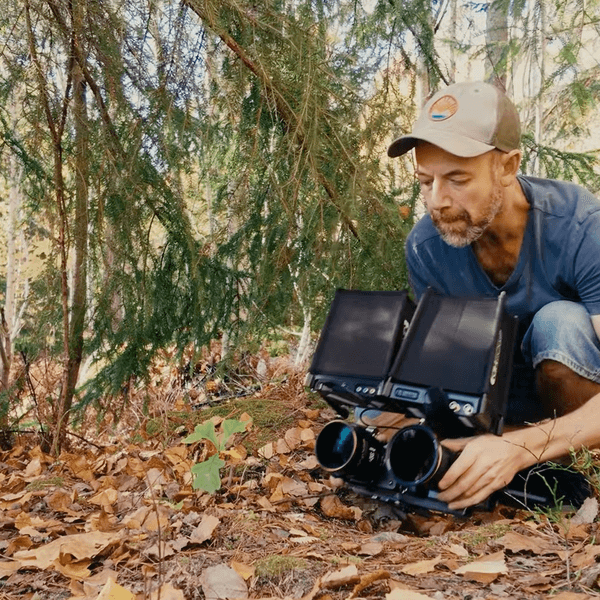
For cinematographer Powell Robinson, shooting “Coochie Coochie Coo” for V/H/S Halloween wasn’t about crafting perfect images—it was about letting go of that instinct entirely. The segment, directed by Anna Zlokovic, plunges viewers into the jittery, overexposed world of late-2000s DV camcorders, where fear feels immediate and every frame looks like it could have been captured by accident. Robinson leaned into the imperfections of found footage—embracing blown highlights, handheld chaos, and the hum of analog sensors—to make the horror feel disturbingly real.
For those not familiar with the V/H/S franchise, it is an anthology series of found-footage horror films where individuals discover disturbing VHS tapes containing various horrifying short stories, often linked by a recurring wraparound narrative.
In the Q&A below, Robinson breaks down how he and Zlokovic recreated the look of 2009-era digital video using a modern Sony FX9, a custom tapeless DV workflow, and a lighting approach built entirely from practical sources. The result is a segment that feels both nostalgic and uncomfortably present—a reminder that sometimes, the scariest thing a cinematographer can do is stop trying to make the image beautiful.
- YouTubewww.youtube.com
No Film School: How did you first get involved with the V/H/S Halloween anthology?
Powell Robinson: Anna Zlokovic, the director, and I have been working together since college! We shot a thesis together there, have since shot a bunch of music videos, and then Anna’s debut feature, Appendage, for Hulu.
NFS: What cameras did you use to achieve the found-footage aesthetic, and did you combine different formats to mimic the look of consumer gear?
PR: We’d originally looked at doing a tapeless Canon XL2 shooting workflow, using a converter cable to record directly from the XL2 to an Odyssey monitor/recorder. But the logistics and stability of the a/v connections presented a huge issue for how active and turbulent the camera motion and blocking was: I was running up stairs, hitting walls, etc., and if you even bumped the DIY connection the wrong way, it would shut down. There was also the concern of the lower resolution being too hard to work around for all of our VFX. We did also try to make a more straightforward consumer-DV cam situation work by using a Canon HV40. But it had even more limitations for monitoring, so we quickly nixed that as well. However, it did serve as a basis for our reference of what the girls would actually have been filming with, were this real. So we based a lot of our on-set decisions and the look off of what the HV40 would have been like to film with.
Bottom line, we pivoted, saving the XL2 for later for a tapeless-tape-out post-analog transfer. On set, we shot with a Sony FX9 for 90% of the segment and an A7S for the intro in the car. We really wanted the girls to be able to operate that section all on their own – they also needed to, as the car was too tight to fit all of us in there. It also really grounds you in the world and sets you up to believe that it’s truly just the two of them filming the whole time.
 Credit: Shudder
I went with an FX9 for the bulk of the shoot as I wanted robust and stable video monitoring options, a broadcast-style ENG handle to control the zoom in a way that felt like someone using the zoom rocker on an old school DV cam, and also a lightweight enough camera body I would get a good amount of jitter/shake from the handheld so the rendering of motion on screen looked like two teenagers swinging a little DV camera around.
Anna and I knew from the beginning we needed the image to have the dynamic range and texture of DV to really sell the time period, so once we finished the edit and VFX, we went through a multi-step process that we called “our tapeless tape out”.
We set up an OLED screen, which we filmed using the Canon XL2’s sensor output straight into an Odyssey recorder. That way, we could capture all the quirks and imperfections of the older CCD sensor and its color space without the headache of digitizing from tape.
Since the sensor’s dynamic range and color science behave so differently from modern cameras, we routed a live feed from DaVinci Resolve to the OLED, which let me tweak our color grade on the fly, scene by scene, so shots that weren’t translating well through the sensor could be adjusted in real time.
Once finished, we sent the output back to Jared Rosenthal, our colorist, and he applied some really specific sharpening to emulate the texture of some references from Blair Witch, as well as fixing any color clipping or artifacting from the DV transfer.
NFS: Did you restrict yourself to certain lenses or focal lengths to keep the segment grounded in a “home video” perspective?
PR: For sure, the only prime we ever used was a 24mm on our full-frame sensor that seemed to match the widest lens of the period-accurate consumer DV camera we were trying to emulate—the Canon HV40—as well as a 24-70 zoom.
NFS: Did you use practicals—flashlights, candles, household lamps—as your primary tools, or did you supplement subtly with hidden units?
PR: For the exterior trick-or-treat street, we were actually filming on a backlot with zero lighting available or built into the houses, so all of that was created by us. We used a mix of Astera bulbs, hydra panels, and tubes in and around the houses for practical sources like the prop streetlamps. And then creamsource vortex 8’s for the background trees, a Nanlux 2400 hidden on a scissor lift in the trees that felt like streetlights raking through the environment. We also had a lantern globe on an LED stashed way in the distance for some ambience on the houses in the background.
 Exterior house lighting Credit: Shudder
The Mommy house exterior was on the same backlot and needed to feel very naturalistic in the same way until all the Halloween decorations and interior lights started to pulse in a synchronized fashion. I found a set of decorative-looking string lights made by Chauvet that you can send to Blackout/Luminair through DMX, which got strung up in front of the house, as well as a bunch of Astera bulbs stashed in the pumpkins. We hid some other vortex and tube lights in and around the house, all set to very natural-looking color and brightness values. But then, once the girls notice the house, since everything was set up through DMX to the iPad, my gaffer was able to trigger an effect where the entire setup would start to rhythmically oscillate at the same time.
Once inside the house, I’d say we switched to a more traditional found footage light source, the camera’s “onboard flashlight.” However, in our case, this was an Astera pixel brick mounted directly in line with, and resting right above, the lens on the FX9. Our Production Designer, Danny Erb, fabricated some 3D-printed spotlight mount rings and diffusion that let us change the spot/flood amount as well as its quality of softness depending on the shot.
 3D-printed spotlight mount rings and diffusionCredit: Danny Erb
NFS: Each V/H/S entry feels like a mixtape of horror styles. How did you want Coochie Coochie Coo to stand out visually among the other segments?
PR: We wanted to make sure it felt accurate to its time period, as well as the characters who are supposed to be filming, and why they continue to hold the camera. It’s less about them “needing to document” the whole thing, and more that it’s incredibly practical that they need the flashlight to see in the otherwise pitch black environment. Also, the DV cam aesthetic of 2009 is quite different from a more traditional VHS-Tape-Out in terms of both look and resolution, as well as colorspace.
NFS: How would you describe the visual style of Coochie Coochie Coo?
PR: Gritty, naturalistic, and nostalgic. And I guess often quite visceral haha.
NFS: Were there special considerations in framing or lighting grotesque or surreal elements so they didn’t feel too “cinematic” for found footage?
PR: I would say the more surreal elements were actually easier to film “found footage” style than the drama and conversations. Generally, the natural instinct as a DP is to light and film coverage/dialogue in a way that’s both flattering to the actors and feels cinematic and well composed, so you can easily take in the important info from what they’re saying. In found footage land, you have to remember that when people are talking, these are supposed to be real people holding the camera and wouldn’t be paying attention to holding a good frame or actually aiming the lens at the person at all, unless unintentionally. Anna was very on top of cuing me for moments to sort of drop the camera or hold it off angle and sideways, but keep half an actor’s face in so the camera position felt more authentic during those drama beats.
NFS: Looking back, what was the biggest technical hurdle you solved on this segment?
PR: Perfecting the post-analog transfer process. At first, we tried with a consumer dv cam, the Canon HV40, because we wanted it to have such a natural, lo-fi feel, but it gave us a lot of ghosting. Also, when filming the offline footage with temp color, the black level was all over the place, and so was the shutter angle since the camera had limited manual control functions and kept auto-adjusting.
We realized early on that the most effective way to think about the process was tricking the old CCD sensor into thinking it was shooting real life. If the footage had been too lifted or too strong of a “look” from the offline LUT, it felt inauthentic. So, before our final transfer, Jared, our colorist, did an end-to-end balancing pass, normalizing the white point and all the black levels so, on an OLED screen, it was about as close to seeing the footage with your own eyes as possible.
After rounds and rounds of trial and error with the HV40 (so many 12+ hour transfer test days), we decided the tapeless recording process with the Canon XL2 would be integral to the process as the XL2 had full manual control and we wouldn’t be reliant on log and capturing from tape.
NFS: What’s one tool or trick you relied on that horror fans might not realize was shaping their experience of the film?
PR: I was in costume the entire time, often doing multiple costume changes a day when the two characters handed the camera off to each other in case we saw my feet/legs while running, or caught my reflection in a window.
Another fun one was the baby monitor in the Pink room upstairs: you see Samantha’s character holding the camera with the light in the baby monitor, but it was actually far trickier than it seems, since I was operating and we didn’t want to use VFX. The monitor had a small camera that we set up in the room about 5ft to the left of the monitor itself (off-screen), so as I entered the room, Samantha followed me, holding a tiny flashlight and matching my blocking, but from 5 feet back. When I caught the monitor, she made sure to be aiming the light exactly as I was, panning past the monitor-camera so it perfectly syncs up and appears to be showing her in the monitor screen. Very proud of that little moment.