The Don Corleone Line That Still Resonates More Than 50 Years Later
What's your favorite line from The Godfather movies?
'The Godfather'
If you held a gun to my head, or maybe a cannoli, and asked me to name what the greatest movie ever made is, I would probably pick The Godfather (1972).
It's a movie that has so much wisdom and ideas about life; you can watch it over and over and keep learning about the movie and yourself.
There’s one line I go back to that actually is the core of the entire trilogy. It happens in a quiet room when Don Vito Corleone (Marlon Brando) has just concluded a tense meeting with Sollozzo, who's trying to get him in on the narcotics game.
During the pitch on why they should sell drugs, Sonny (James Caan), made the fatal mistake of speaking up against his father's wishes. That reveals a crack in the family’s united front. And in their power.
Once the outsiders leave the room, Vito turns to his son and delivers a doctrine:
“Never tell anyone outside the family what you are thinking again.”
Decades later, this single line of dialogue still echoes through modern filmmaking.
Let's dive in.
- YouTubewww.youtube.com
Subtext is King
I feel like I am always writing about subtext on this website, but it’s the key behind every great line. The words say one thing, and the actual meaning beneath it is far deeper.
So this line is Vito calling out the subtext of Sonny's comments. His disagreement with his dad has shown an opening and a weakness.
He's telling his son that by going against the family, he's given them ammo.
When you look at Vito and Michael Corleone's 3 defining scenes, you realize that this doctrine transforms how characters interact across the entire franchise.
It forces the audience to stop listening to the dialogue at face value and start reading the frame like a chessboard.
A Generational Curse
The family in these movies is everything. It's the gravity that pulls Michael into a life of crime and also the gravity that gets both his brothers killed, along with his brother-in-law. And also his daughter and many more bodies, too.
So look at how this line of dialogue carries and shows Sonny’s fate in this movie; Michael (Al Pacino) internalizes it and not only survives but is able to exact revenge later because of it.
When you look at the brilliant Michael vs. Vincent character analysis, you see that Michael becomes the ultimate manifestation of his father’s warning. And it also changes who he is as a person.
He never gives anyone the ammo to go against him later; he hides his thoughts from his allies, his wife, and his siblings. He rules through total isolation and then tries to lock people into the family and to secure his power.
How the Camera Weaponizes Silence
Of course, a great line needs the visuals to go along with it. In this scene, the characters are actively hiding their internal thoughts.
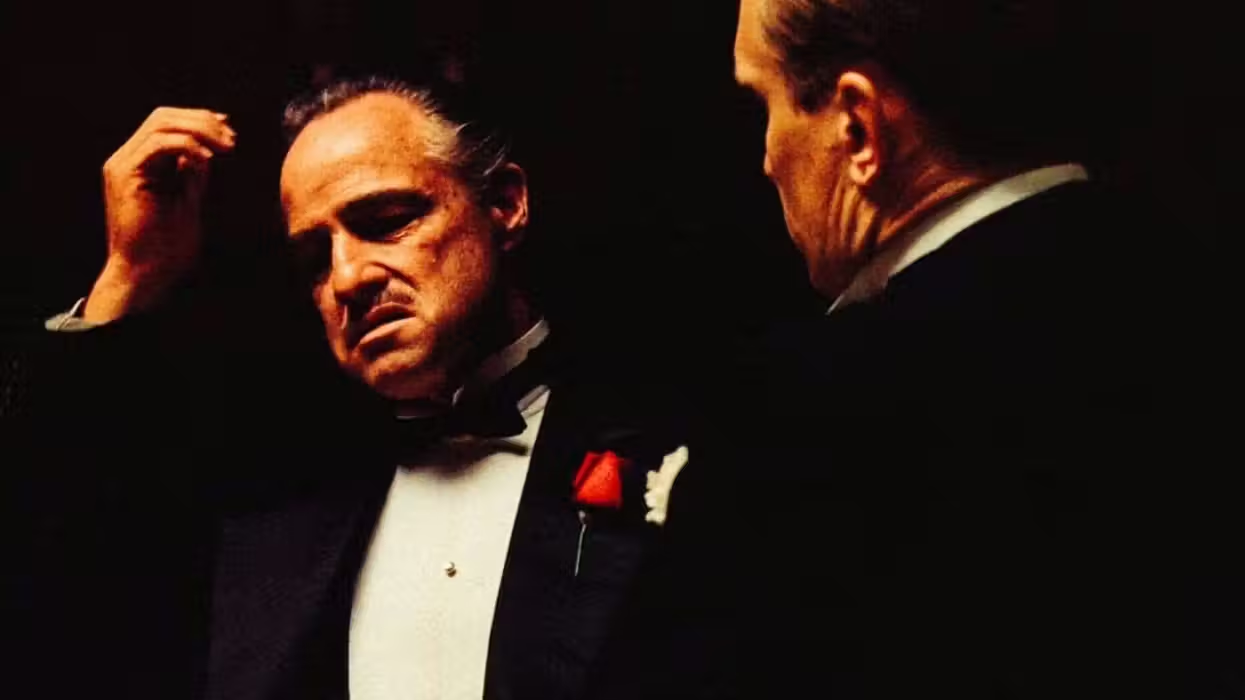
To capture that, Coppola and legendary DP Gordon Willis used darkness as a literal extension of Vito's philosophy via chiaroscuro lighting.
They used it to create stark contrasts between bright daylight and dark interiors. With it, you get characters retreating into the shadows while they plot. This visually keeps their true motives hidden from the audience and each other.
Willis famously lit Marlon Brando from directly above, casting his eyes into deep shadow so you literally cannot see what the Don is thinking.
Summing It All Up
There’s a reason that line has echoed forever, and how it's informed all three movies in the trilogy. When you strip away a character's ability to easily vent their emotions, you force them to act. That’s great for writers and filmmakers because it gives them a character who has to do things.
And it's great for audiences because we like watching people do things on the big screen.
Let me know what you think in the comments.