Jeff Kitchen is a screenwriting consultant whose work centers on what he describes as seven dramatic tools for building a story. In a Film Courage video, he works through a pitch in real time with a writer who has the bones of a thriller.
The story pitch follows Derek, a bored IT security chief at a Fortune 500 company, who falls for Skyler, a woman hired by a rival firm to seduce him and steal trade secrets.
What Kitchen does with it over 40 minutes is a clear demonstration of how to locate the dramatic engine already inside a premise, and then push it as hard as it'll go. You can find more of his work at script.kitchen, but for now, let's dive into this video.
- YouTubewww.youtube.com
What a Dilemma Is (and What It Isn't)
Kitchen's first move on any story is finding the dilemma. His definition is that a protagonist should be caught between "two equally unacceptable alternatives."
Not all dilemmas are created equal, though. They have to operate on what Kitchen calls magnitude.
"Does it hit them where they live, does it grab them, is it important?"
A technically valid dilemma with no stakes (it's equally unacceptable to wash the car, equally unacceptable to mow the lawn) will produce nothing and feel boring. The audience has to recognize the choice from somewhere in their own lives.
Training Day is his illustration. Jake (Ethan Hawke) has two things he won't surrender. The first is his ambition to make Alonzo's unit and eventually become a detective, and the second is his moral compass.
As Alonzo drags him deeper into corruption, Jake's career is being realized in direct proportion to how far his ethics are being dismantled. He can't let go of either half. Both are load-bearing.
We've written about why Alonzo Harris works as a villain. On the other side, the reason Jake works is that his dilemma hits where audiences live, and both sides are exactly matched.
Finding It in the Material
Kitchen's first question is always whether the dilemma is already in the story or needs to be built.
For the viewer, Derek's premise, he can see it immediately, "a dilemma kind of sitting on the surface."
In this premise, a corporate IT security chief's entire professional identity is built around keeping predators out of his company's systems, but he has now knowingly fallen for a woman sent by a rival firm to compromise him.
Going along with the manipulation is unacceptable. Letting go of Skyler and everything she's reawakened in the character is equally unacceptable. Kitchen calls it "a security versus adventure dilemma." Derek's professional identity is built on being the person no one gets past. He's also, for the first time, caught a glimpse of a different life, and he can't unsee it.
The dilemma typically lands around the end of Act One, after the audience has lived with the protagonist long enough to care about the stakes. From there, it builds through Act Two, tightening with every new complication. If the dilemma is already in the material, Kitchen isolates it and works to "amplify it to maximize its strength."
If it isn't, he experiments with building one, but always in service of the story.
"I'm not trying to force a dilemma onto it because the story's the most important thing," he says, "but a good, strong dilemma can amplify the dramatic power of a story."
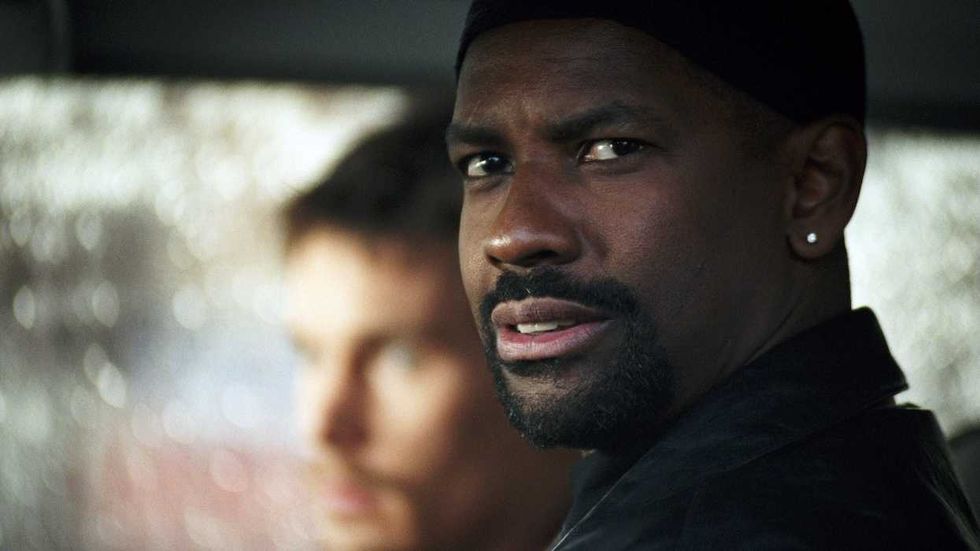 Training Day Credit: Warner Bros.
Playing "What If"
Once the dilemma is isolated, Kitchen runs what he calls "crazy what if" on each horn to make both sides as hard to escape as possible.
For Derek's guard dog side... what if there's a past failure that means he can never let it happen again?
What if protecting the company is so wired into him it's not professionalism but reflex? "My dog will die to keep you from hurting my kids," Kitchen says.
For the adventure side... what if he's so dead-ended he's flirted with suicide?
What if Skyler isn't just a complication but the thing that's made him feel alive for the first time?
"Don't settle for the easy choices," Kitchen says. "How far can you take it?"
The more impossible the dilemma, the more the audience sits forward in their seat.
The two sides can also complicate each other as the story develops. What if the company Derek has been so ferociously guarding turns out to be doing something morally reprehensible? That adds plot and makes the security side of the dilemma harder to hold, which makes the whole thing more intense.
When It Goes Critical
Around the end of Act Two, the dilemma stops being something the protagonist can sit with. It becomes a gun at their head, literal or figurative.
Kitchen calls this the crisis, with "all the worst possible stuff happening at the worst possible moment," often right as the protagonist is an inch away from a solution.
In Training Day, it's Alonzo trying to have Jake killed. The protagonist can no longer contemplate the problem from a safe distance. A decision and action are required immediately, which "breaks the paralysis of the dilemma" and drives the story into its final sequence.
The Third Path
Kitchen outlines three ways a protagonist can resolve a dilemma. They choose one horn, choose the other, or find what he calls "the third path."
"You get a chainsaw and cut a third door and go out that way."
The third path usually produces the most satisfying ending, because it represents the protagonist thinking on their feet and finding an exit that didn't previously exist.
The Firm is his example. Tom Cruise's Mitch McDeere is trapped between giving the FBI what they want (and being permanently disbarred for violating attorney-client privilege) or going down with a mob-owned law firm.
His third path is giving the FBI proof of systematic mail fraud, each instance a federal offense. Technically, what they demanded. Privilege intact.
He skated between both unacceptable alternatives through creative problem-solving under pressure.
For the video's pitch, Kitchen sketches a possible shape, and it's to find an opening to expose one problematic thing the company is hiding, without destroying the company or fully betraying it, and walking out with Skyler.
The specifics are undetermined. The goal, whatever form the resolution takes, is that you impact the audience in a way that surprises them.
Most stories don't get there. Kitchen says it's worth trying for anyway.