Film Quote of the Day: The Line From Clint Eastwood's 1976 Western Classic That Became a Timeless Life Lesson
"We endeavor to persevere." - Lone Watie, The Outlaw Josey Wales (1976)
'The Outlaw Josey Wales'
Maybe you can identify with this, but as the movie nerd in most of my circle of friends, I'm always the guy people ask for recommendations. I usually try to gauge a mood or want they have before dishing out random titles, but more and more I find myself telling people they have to sit down and watch The Outlaw Josey Wales.
This movie is peak Clint Eastwood, but I think criminally underrated by many.
It's a classic Western, but it subverts many of the tropes that made Eastwood famous, and plays as an excellent emotional prequel to Unforgiven, which kind of does a lot of the same things.
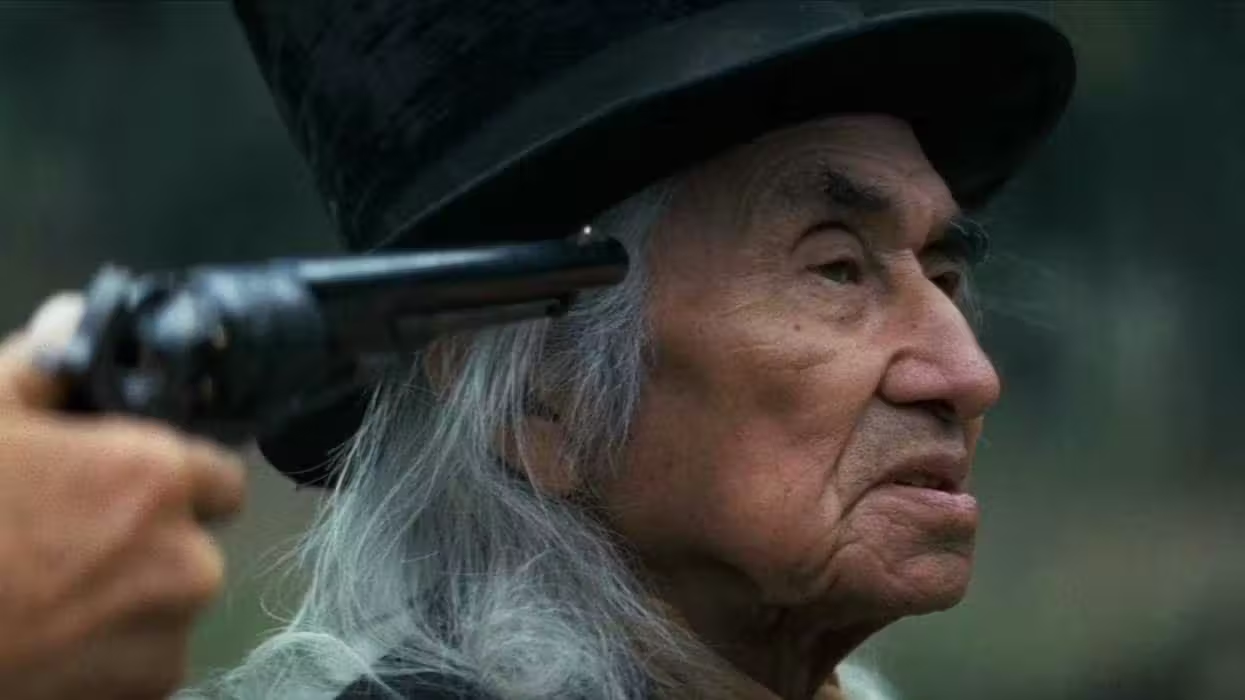
Today, I want to look past the gunsmoke and powerful vistas to talk about a line delivered not by the titular gunslinger, but by his traveling companion, Lone Watie (played brilliantly by Chief Dan George).
It's this sort of exclamation of what the old west really was for the first peoples there, and how it translated across the theme of the story.
Let's dive in.
- YouTubewww.youtube.com
The Scene In Question
Have you seen this movie? I did for the first time around a year ago, and I was sad I had put it off for so long. It's like this epic treatise on the Old West and its heroes. It picks apart what we think we know and how we think we feel and flips the whole story on its head.
The Outlaw Josey Wales was directed by Eastwood himself.
It’s a revisionist western that tracks a Missouri farmer driven to vengeance by the Civil War, who is now trying to outrun his past before it catches him and kills him.
Josey is headed toward Mexico when he meets Lone Watie, an aging Cherokee man who is a tracker out to find Josey so he can collect a bounty on his head. But after hunting around a campsite, Josey gets the drop on him.
Josey put a gun to Watie's head, and instead of blowing him away, he listened to Lone Watie talk to him about his past and the trauma he's already endured.
We hear his history with the federal government, which has betrayed him and his people, and we also learn that the Trail of Tears killed his family.
His whole speech is long, but I think it's worth listening to...especially since it contains the line I want to talk about:
"We dressed ourselves up like Abraham Lincoln. We only got to see the Secretary of the Interior, and he said: "Boy! You boys sure look civilized.!" he congratulated us and gave us medals for looking so civilized. We told him about how our land had been stolen and our people were dying. When we finished he shook our hands and said, "endeavor to persevere!" They stood us in a line: John Jumper, Chili McIntosh, Buffalo Hump, Jim Buckmark, and me - I am Lone Watie. They took our pictures. And the newspapers said, "Indians vow to endeavor to persevere."...We told him about how our land had been stolen and our people were dying. When we finished he shook our hands and said, “endeavor to persevere!” ...We thought about it for a long time, “Endeavor to persevere.” And when we had thought about it long enough, we declared war on the Union.”
- YouTubewww.youtube.com
The Irony of Bureaucracy vs. The Grit of Survival
Man, this is such a great monologue. I know we have covered a lot of quips in this series, but the writing here is phenomenal, and we totally know why Josey is letting this guy talk.
There's this ethereal quality to him; Josey wants to know how this guy got mixed up chasing him for a bounty, and if he's working with the Union men following him down there.
This line of questioning makes the audience lean on, because we also want to know who this character is and their place in the story.
It's an incredible piece of writing because it operates on two levels at the same time.
On the surface, the line is a brilliant bit of historical dark humor that kind of spins how this guy got into this predicament. Lone Watie is mocking the empty jargon used by governmental oppressors to sanitize a tragedy like the Trail of Tears and the eradication of the First Peoples.
"We endeavor to persevere" is exactly the kind of sterile phrase designed to say absolutely nothing when describing something horrific.
It's meaningless when you're standing over the dead bodies of your people.
In this moment, we get that Lone Watie also completely understands that his same government is trying to kill Josey, which means the enemy of his enemy is his friend.
These are kindred spirits, even if they are very different people.
Josey Wales is a man who should be dead. He fought for the South and then killed a bunch of Union officers trying to escape post-surrender and attempted execution.
His motivations in the movie are clear; he wants revenge for the union coming to his farm and mercilessly killing his family. But that cycle of violence has chased him far away from everything he's ever known, and he knows it's set to take his life with it.
Lone Watie is a man who the government has also sentenced to death, just for being who he is as well. One who also saw his family needlessly slaughtered thanks to settlers continuing a cycle of violence over the land from which Watie and his people were driven.
The cool thing about this movie is that this becomes the theme, as the guys decide to ride together and build up a surrogate family of similar people left behind, and that becomes the throughline of the rest of the film.
That cycle of violence is still changing them to the very last frame, where old gunfighters have to choose pace in order to move forward and have a shot at living.
They build the very thing denied to them by the government, a place where they belong and are free. They are quite literally endeavoring to persevere...
...as long as their path doesn't catch up to them.
The Takeaway for Screenwriters
This entire film operates in a moral grey area. People have written in and asked me how they're supposed ot feel about a Dixie Figher teaming up with a Native American to thwart the corrupt union.
I don't have that answer for you -- this movie wants to know what you think of it and of the ideas and questions its characters ask.
It's up to you to decide, and that's what great art is supposed to do. We're supposed to look at it and to decide how we feel and then state our case.
For me, I think we're supposed to understand that Josey's only in this mess fighting for one side because the other killed his entire family. He's not at war with deals; he's at war with vengeance. One that will inevitably kill him, because he just can't let that hate go. This is the warning that "endeavor to persevere" also bodes.
If you can't move on, you might be snuffed out.
As filmmakers and writers tracking our own screenplay development, we often fall into the trap of having big themes we want to explore, so we make them totally overt, which the audience finds boring or even on the nose.
Subtlety and subtext are an art you usually find while rewriting. And this movie, I think, is what allows it to elevate over other films in the game genre.
This is a story about coming together in the face of oppression, and it's people of different walks of life doing it.
This scene and line we pulled apart are excellent, as both have character introductions, a reason not to kill this guy, and then a distillation of what these two guys believe.
- Weaponize the Refrain: A great line can mean one thing when a character first says it, and something different by the time the film reaches its climax. Your story needs to evolve in tandem so we can see these things come to fruition.
- Find the Humor in Tragedy: Lone Watie's delivery works because it doesn't beg for the audience to react; it takes us on a journey by itself. One that, if we're astute, we can see mirror the main character, too.
Summing It All Up
There is a distinct reason The Outlaw Josey Wales has aged so gracefully. That's because it seemedl ike it understood a lot about the Old West, alliances, and the general malaise people were feeling.
The movie came out right as the Vietnam War ended, so it also capitalized on how people felt about America at the time. It took these vibes and used them to draw audiences in, and to talk about a world that felt corrupt in the face of people just trying to get by.
Again, in a moral grey area that makes you choose if we're good because we're on one side, or if our actions are what matter the most.
We endeavor to persevere.
Let me know your favorite lines from the film in the comments.
- George R.R. Martin's Advice on How to Make It as a Writer ›
- Get Writing Advice From Best-Selling Author Colleen Hoover ›
- The 'Shawshank Redemption' Line That Changed How We Think About Hope ›
- Hud Quote ›
- Film Quote of the Day: This Clint Eastwood Line in 'Gran Torino' Reveals More Than He Ever Says Out Loud | No Film School ›