Film Quote of the Day: The Line From Paul Newman's 1963 Western Classic That Warned Us to Choose Our Heroes Carefully
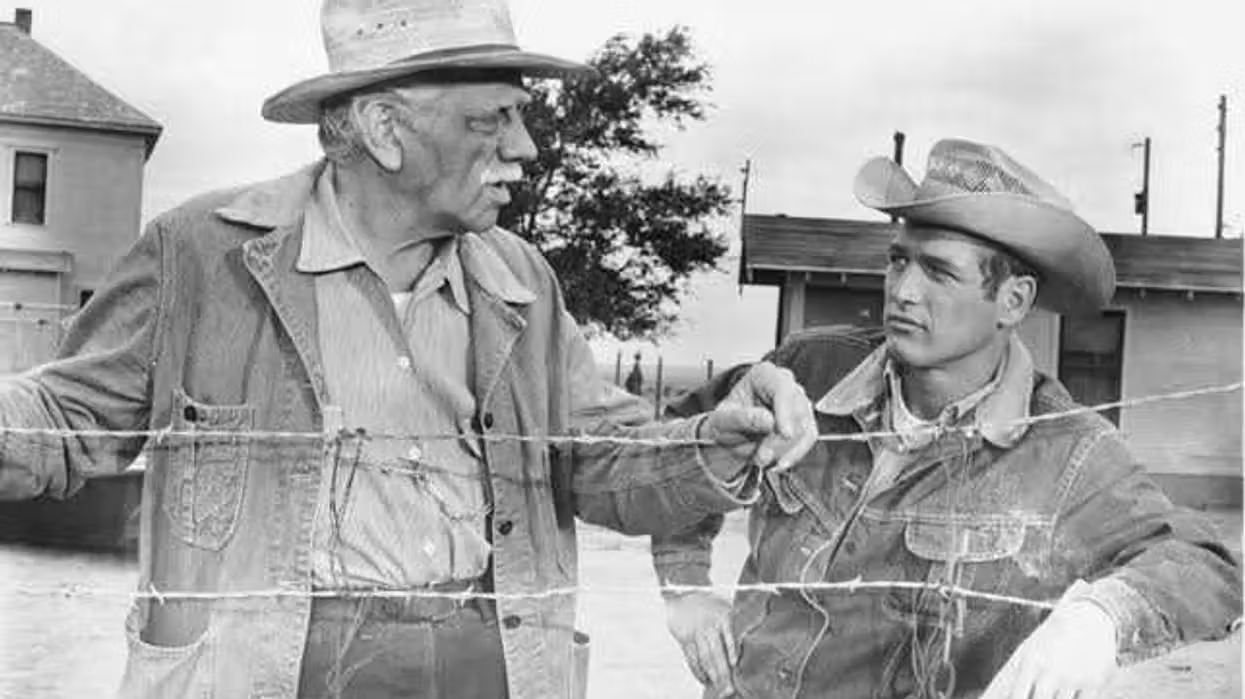
'Hud'
Paul Newman just has one of those faces you look at and instantly think: movie star. The guy just oozed charisma, and you wanted to watch him do anything and be anyone on the big screen. There are so many wonderful instances of him just taking over scenes and delivering.
But today, I wanted to talk about a movie he's in, where he's not given the most powerful line of dialogue. In fact, the line is used to direct another character back to the light, who idolizes Paul Newman's character.
I'm talking about the great classic movie, Hud.
Let's dive in.
- YouTubewww.youtube.com
The Scene In Question
Hud follows the bitter feud on a modern Texas ranch between the principled, old-school patriarch Homer Bannon (Melvyn Douglas).
Homer has a particular way of doing things; maybe we'd call them the old ways, but his son, Hud (Newman), is more of a new-school guy. He's selfish, a little nihilistic, and a bit wayward in his thinking.
They have beef, and Hud wants to take over his Dad's ranch. His dad was possibly mean to Hud when he was a kid but thinks he's rotten now.
These two are fighting over the soul of the next generation, Hud's nephew and Homer’s teenage grandson, Lonnie (Brandon deWilde).
Lonnie idolizes his uncle’s swagger and rebellious lifestyle, and thinks his grandpa is a little boring.
But his grandpa knows a little about life and about principles.
In one of the film’s quietest chilling moments, Homer sits across from Lonnie and delivers a line that cuts through the romance of the Wild West and exposes the danger of worshipping charming scoundrels, even if they're your uncle.
Sooner or later, they're going to leave you wanting, because they don't believe in anything.
Homer looks at his grandson and says:
"Little by little, the look of the country changes because of the men we admire. You're just going to have to make up your own mind one day about what's right and what's wrong." — Homer Bannon (Melvyn Douglas), Hud (1963)
The Danger of the Charismatic Scoundrel
The Wild West was built on myths of rugged individualism, but Hud tears that down to look at what happens when a family gets torn apart by what an individual wants over what's good for the entire farm.
This is the ultimate movie about self-interest and how easy it is to see Paul Newman as a cool movie star or daring cowboy...and in this movie he's actually kind of ruining the lives of everyone around him by being selfish.
Homer’s line serves as an intentional wake-up call to both Lonnie and the audience to cut through the charm and to really look at life. Examine what you actually believe and stand on those values.
It might seem old school and a little boring, especially in the Old West, but when a society begins to value charm over integrity, and swagger over substance, morality completely falls apart and so does the fabric of what keeps a ranch intact.
What Screenwriters Can Learn from Hud
This movie is an adaptation of Larry McMurtry’s novel Horseman, Pass By. Legendary screenwriting team Irving Ravetch and Harriet Frank Jr. crafted this beautiful character deconstruction of both seiness and valor.
When I watch this movie, I reallyl ike to study how they are able to skew preconceived notions about the star power of Newman and subvert it to then teach the audience a lesson.
Here are a few other takeaways that I think ring true:
- Use a Moral Observer: Lonnie acts as the audience's point-of-view character. He is pulled between two opposing philosophies, and we're along for the ride. Placing an impressionable character in the middle of a thematic debate raises the stakes for the story's soul.
- Never Save the Antihero Just to Please the Audience: Test audiences originally wanted Hud to have a redemptive arc, but Ritt and the writers stood firm. Hud remains unrepentant to the very end, and that's what makes this a classic. That refusal to give him a cheap Hollywood softening makes the film's tragic finale more memorable.
- Make Theme the Engine of Character Conflict: Homer and Hud don't just fight over the ranch or a herd of diseased cattle; their conflict is an ideological battle over what kind of men should inherit the future. It makes the story timeless.
The Takeaway for Filmmakers
As storytellers, we often fall into the trap of making our antiheroes so cool that the audience forgets to look at the destruction left in their wake. But Hud shows us how to harness movie-star charisma to deliver a deeper, sharper cultural critique.
And it subverts those antihero ideas that we've been served over and over.
More than six decades later, Homer's warning remains a timeless quote on the power of taking a stand for what you actually believe in, even if it makes you feel less cool.
Let us know your favorite lines from classic Westerns in the comments below!
- Film Quote of the Day: The Line From Clint Eastwood's 1976 Western Classic That Became a Timeless Life Lesson ›
- Film Quote of the Day: Jim Carrey’s 'Eternal Sunshine' Line That Offered a Timeless Lesson on Understanding Each Other ›
- Film Quote of the Day: The 'Shawshank Redemption' Line That Gave Us One of Cinema's Most Beautiful Metaphors ›
- Film Quote of the Day: The 'Tombstone' Line That Became Timeless Wisdom About Life's Uncertainty ›