It's hard enough to break into acting, and it's only going to be harder if you don't know the terminology associated with the profession.
That's why we created this actors' glossary.
The idea is to just put all the terms in one place so you can access them and learn them, in case this stuff ever comes up.
Let's dive in.
Acting Terminology
This glossary is designed to be a comprehensive resource for actors at all levels. We divided it into sections to make things a little easier.
General Terms
- Actor: A person who portrays a character in a performance.
- Ad-lib: To improvise lines or actions not in the script.
- Antagonist: The character who opposes the protagonist.
- Audition: A tryout for a role in a performance.
- Beat: A pause or a moment of silence in dialogue or action.
- Blocking: The planned movement of actors on a stage or set.
- Callback: A second, more specific audition for a role.
- Casting: The process of selecting actors for a production.
- Character: A person or being portrayed by an actor.
- Character Arc: The transformation or inner journey of a character over the course of a story.
- Cheating Out: Angling the body slightly towards the audience or camera to be seen better.
- Cold Reading: Auditioning with a script that the actor has not had the opportunity to read beforehand.
- Conflict: The central struggle between opposing forces in a story.
- Costume: The clothing worn by an actor to portray a character.
- Critique: Feedback on a performance.
- Cue: A signal for an actor to begin their line or action.
- Dialogue: The spoken words between characters.
- Director: The person who oversees the artistic and dramatic aspects of a production.
- Downstage: The area of the stage closest to the audience.
- Emotion: The feeling a character is experiencing.
- Emotional Recall/Memory: A technique where an actor uses their own past experiences to evoke a genuine emotional response for their character.
- Ensemble: A group of actors who work together in a production.
- Fourth Wall: The imaginary wall that separates the actors from the audience.
- Gesture: A movement of the body to express an idea or emotion.
- Given Circumstances: The who, what, where, when, why of a scene or play that the actor must consider.
- Headshot: A professional photograph of an actor used for auditions.
- Improvisation (Improv): Creating a scene or dialogue on the spot without a script.
- Impulse: A sudden, strong urge or desire to act.
- Inner Monologue: The unspoken thoughts of a character.
- Intention: What a character wants in a scene.
- Meisner Technique: An acting technique that emphasizes reacting truthfully to the present moment.
- Method Acting: A technique where actors try to experience the emotional and psychological life of their character as much as possible.
- Monologue: A long speech by one character.
- Motivation: The reason behind a character's actions.
- Objective: A character's specific goal in a scene.
- Obstacle: Something that stands in the way of a character achieving their objective.
- Pacing: The speed and rhythm of a performance.
- Props: Objects used by actors on stage or on set.
- Protagonist: The main character of a story.
- Rehearsal: The practice of a performance.
- Résumé: A document listing an actor's experience and training.
- Role: The character an actor portrays.
- Scene: A division of a play or film.
- Scene Partner: The actor with whom one is performing a scene.
- Script: The written text of a play, film, or television show.
- Soliloquy: A speech in which a character speaks their thoughts aloud, usually when they are alone.
- Stage Business: Small, detailed actions that a character performs, like fiddling with a pen or adjusting their glasses.
- Stage Fright: Anxiety or fear experienced when performing in front of an audience.
- Stage Presence: The charisma and command an actor has on stage.
- Stakes: What is at risk for a character; the consequences of success or failure.
- Stanislavski System: A systematic approach to training actors, developed by Konstantin Stanislavski, which is the foundation for many modern acting techniques.
- Subtext: The unspoken thoughts, feelings, and intentions behind the lines.
- Super-Objective: The character's main goal throughout the entire story.
- Table Read: An initial rehearsal where the cast sits around a table and reads the script aloud.
- Tactics: The strategies a character uses to achieve their objective.
- Typecasting: When an actor is repeatedly cast in similar roles based on their appearance or previous performances.
- Upstage: The area of the stage farthest from the audience.
- Upstaging: To draw the audience's attention away from the main action or another actor.
- Vulnerability: The willingness to be open and emotionally exposed.
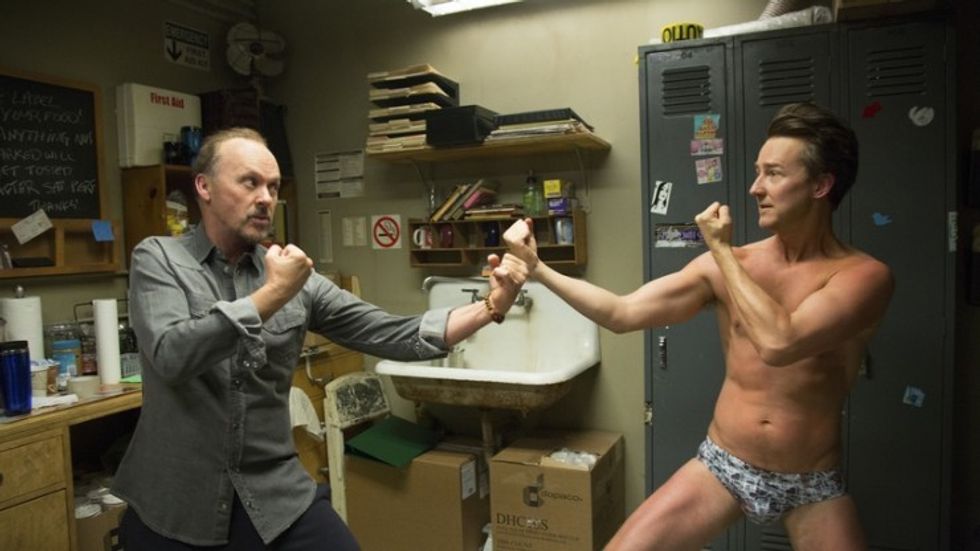 'Birdman'Credit: Fox Searchlight Pictures
On Set/On Stage
- "Action!": The director's command to begin the scene.
- AD (Assistant Director): The person who assists the director and manages the set.
- Background (or Extra): A performer in a scene who does not have any lines.
- Blocking Rehearsal: A rehearsal focused on working out the actors' movements.
- Boom Mic: A microphone on a long pole, held over the actors' heads.
- Call Sheet: A daily schedule for a film or television shoot.
- Call Time: The time an actor is required to be on set.
- Camera Left/Right: The direction from the camera's perspective.
- Cinematographer (or Director of Photography/DP): The person responsible for the camera and lighting.
- Close-Up (CU): A shot that tightly frames a person or object.
- Continuity: The consistency of characters, props, and action from one shot to the next.
- Costume Fitting: A session to try on and adjust costumes.
- Craft Services ("Crafty"): The food and beverage station on a film set.
- "Cut!": The director's command to stop the scene.
- Dailies (or Rushes): The raw, unedited footage from a day's shoot.
- Dress Rehearsal: A full rehearsal of a play with costumes, props, and technical elements.
- Dry Rehearsal (or Dry Tech): A rehearsal without technical elements, focusing on lines and blocking.
- Feature Film: A full-length movie.
- First AD: The First Assistant Director, responsible for running the set.
- Gaffer: The head of the electrical department.
- Green Room: A waiting room for actors when they are not on stage or on set.
- Grip: A technician responsible for moving and setting up equipment on set.
- Hot Set: A set that is currently being used for filming and should not be disturbed.
- Lavalier Mic (or Lav Mic): A small microphone that can be clipped onto clothing.
- Location: A place outside of a studio where filming takes place.
- Long Shot (LS): A shot that shows the entire subject from a distance.
- Mark: A specific spot on the floor where an actor must stand.
- Master Shot: A wide shot that covers all the action in a scene.
- Medium Shot (MS): A shot from the waist up.
- On Book: Rehearsing with the script in hand.
- Off Book: Rehearsing without the script.
- Pan: A camera movement that swivels horizontally.
- Pilot: The first episode of a potential television series.
- Principal Photography: The main period of filming for a production.
- Props Master: The person in charge of all the props.
- Reader: An actor who reads the other characters' lines during an audition.
- Screen Test: A filmed audition to see how an actor looks on camera.
- Script Supervisor: The person who ensures continuity during filming.
- Second AD: The Second Assistant Director, who helps the First AD.
- Set: The location where a scene is filmed.
- Sides: Pages from a script used for an audition.
- Slate: A board with scene information that is filmed at the beginning of each take.
- Soundstage: A large, soundproof building used for filming.
- Spike: A mark on the stage floor, usually tape, to indicate the position of a set piece or an actor.
- Stand-In: A person who takes the actor's place for lighting and camera setup.
- Strike: To dismantle the set after a production.
- Stunt Double: A trained professional who performs dangerous stunts in place of an actor.
- Take: A single, continuous recording of a scene.
- Tech Rehearsal: A rehearsal that focuses on the technical elements of a show, such as lighting and sound.
- Teleprompter: A device that displays a script for the actor to read.
- Tilt: A camera movement that swivels vertically.
- Two-Shot: A shot with two characters in the frame.
- Understudy: An actor who learns a role and is prepared to perform it if the regular actor is unable.
- Voice-Over (VO): Narration or dialogue that is not accompanied by an image of the speaker.
- Wardrobe: The department responsible for costumes.
- Wrap: The end of a day's shoot or the end of the entire production.
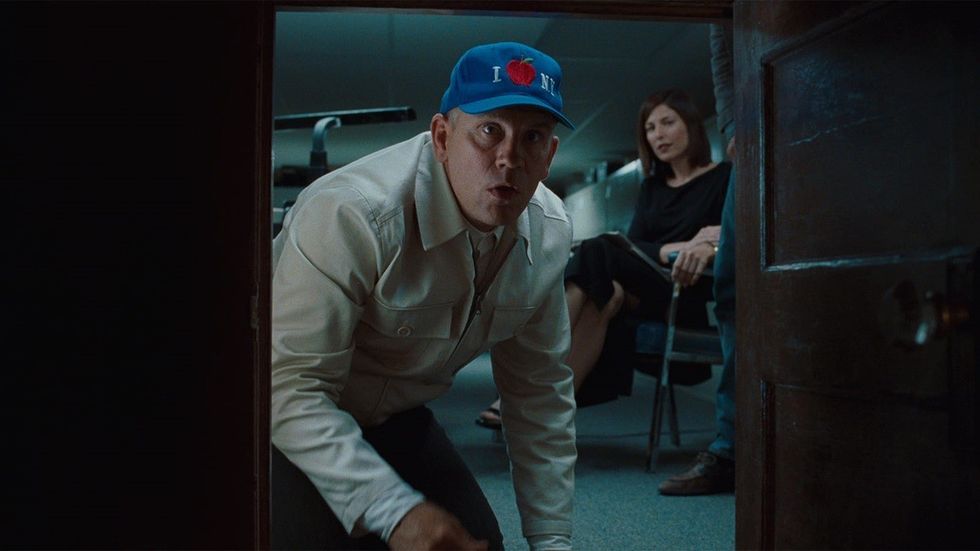 'Being John Malkovich' Credit: USA Films
Technical Terms
- ADR (Automated Dialogue Replacement): The process of re-recording dialogue in a studio after filming.
- CGI (Computer-Generated Imagery): Visual effects created using computer software.
- Color Correction: The process of adjusting the colors in a film or video.
- Composition: The arrangement of elements within a frame.
- Depth of Field: The range of distance in front of and behind the subject that appears in focus.
- Diaphragm: The muscle below the lungs that is crucial for breath support in acting and singing.
- Diction: The clarity and distinctness of speech.
- Foley: The art of creating sound effects for a film in post-production.
- Framing: The way a shot is composed.
- Green Screen (or Chroma Key): A technique where a green background is replaced with another image.
- Key Light: The main source of light in a shot.
- Mise-en-scène: The arrangement of everything that appears in the frame – actors, lighting, décor, props, costume.
- MOS (Mit Out Sound/Motor Only Shot): A scene filmed without sound.
- Pitch: The highness or lowness of a voice.
- Post-Production: The work done on a film or television show after filming is complete, including editing, sound mixing, and visual effects.
- Pre-Production: The planning and preparation phase of a production before filming begins.
- Projection: The ability to make one's voice heard clearly throughout a theater.
- Rate: The speed at which a person speaks.
- Resonance: The quality of a voice that is full and deep.
- Room Tone: The subtle, low-volume sound of a room when it is quiet.
- Scoring: The music composed for a film.
- Sound Mixing: The process of combining all the different sound elements of a film.
- Storyboard: A sequence of drawings representing the shots planned for a film.
- Tempo: The speed or pace of a scene or performance.
- Timbre: The unique quality or character of a voice.
- Vocal Fry: A low, creaky sound in the voice.
- Volume: The loudness or softness of a voice.
- Walla: The sound of a crowd murmuring in the background.
Let me know what you think in the comments.