The Tree of Life: How Andrei Tarkovsky Began and Ended His Film Career With the Same Image
A deep dive into what connects Ivan’s Childhood and The Sacrifice.
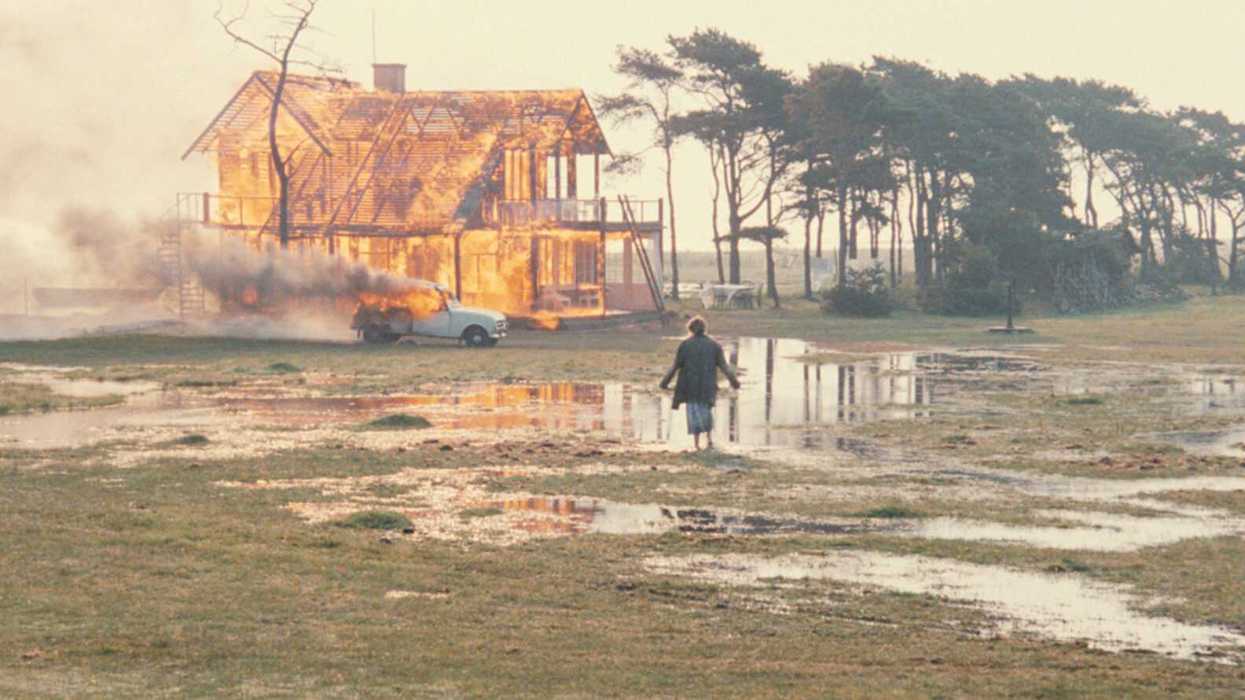
'The Sacrifice' (1986)
When Andrei Tarkovsky made his first film, Ivan’s Childhood (1962), few were expecting him to be one of the most towering voices in film history. Frame by frame and film by film, Tarkovsky stunned global audiences with his enigmatic yet undeniably awe-inspiring movies.
What is perhaps a lesser-known fact is that Tarkovsky connected the opening image of his debut film and the closing image of his final film in the most quintessential “Tarkovsky way” possible. Released more than two decades after his first movie, The Sacrifice, his final feature, ended Andrei Tarkovsky’s career with another child beneath a tree.
From a career introducing a shot of a child standing below a tree full of life to a closing shot of a child lying under a tree, softly looking toward its body without leaves, Tarkovsky ended his career with absolute stylistic and symbolic consistency that few would dare to imagine.
Let’s jump right in and take a deeper look at these two shots and what we can learn from them.
When An Opening Image & A Closing Image Meet
The opening shot of Ivan’s Childhood immediately establishes Andrei Tarkovsky’s fascination with memory, nature, spirituality, and innocence, told through dreamlike compositions. For what would follow him through the rest of his career, these themes, and more, manifest themselves in almost all his films.
The recurring imagery of Ivan among trees is starkly in contrast to wartime trauma, uncertainty, and suffering. Tarkovsky draws our attention to the most nascent form of innocence and to what happens when the world loses all of it. While it may be simpler to assert such differentiation through dialogue, Tarkovsky does it through vibrant visuals that are often ambiguous yet always suggestive of the contrast he tries to establish.
Fast forward to his final film, The Sacrifice. The closing shot of the movie is more contemplative than introductory. This may seem obvious because it is the end of the film. But Tarkovsky’s thinking goes a lot, lot deeper than that. While the viewer is primarily thinking about the movie’s last shot, it is framed to perfection, with not only this in mind, but also the opening of his debut film, Ivan’s Childhood.
This parallel feels defiant yet deliberate, a paradoxical approach to movie symbolism that encourages debates and dissections. In both shots, the camera movement is eerily identical and suggestive of Tarkovsky’s parallel-drawing motive. The interpretations of this, like much of Tarkovsky’s films, are extremely open-ended and subjective.
Let’s try our best to break them down.
Thematic Consistency Within Stylistic Evolution
When we examine the careers of some of the greatest filmmakers to have lived, we can see certain themes they repeatedly revisit, often in very different ways. To put things into perspective, take Quentin Tarantino, for example. Kill Bill (2003 & 2004) and Django Unchained (2012) both heavily rely on hardcore vengeance themes, in totally different ways.
While Andrei Tarkovsky’s frequently depicted themes are less on the surface and more in the depths of his storytelling, he maintained impeccable thematic consistency even while his films continuously evolved stylistically. The latter makes the thematic relevance of his movies all the more powerful.
From the stark black-and-white urgency of Ivan’s Childhood to the slower rhythms of Stalker and The Sacrifice, Tarkovsky’s films continued to evolve, yet their core themes never wavered.
Perhaps the most striking “objective” similarity between the opening shot of his debut film and the final shot of his last film, apart from the actual composition itself, is the presence of the tree. Tarkovsky’s films have often depicted nature as a spiritual force, and both these films comfortably sit within that notion.
While it’s always safe to say that movies themselves are open to interpretation, the early crane movement of Tarkovsky’s debut film feels more fluid and hopeful. The ending of his final film, however, feels more contemplative, heavier, and a little more tense. Perhaps Tarkovsky was asking a question more than providing us with an answer in the form of: where do we go from here?
- YouTube www.youtube.com
What Filmmakers Can Learn From This Visual Symmetry
Let’s acknowledge, once again, that Andrei Tarkovsky’s movies can bear different meanings to different people. Any interpretations we make from the visual symmetry between these two shots must be considered as subjective viewpoints and not “the only answer.”
Now, we’ve already discussed the basic symmetrical parallels, and they are obvious to just about anyone. When we try to look deeper, perhaps the first, most obvious difference we see is about the trees in both shots. In Ivan’s Childhood, the tree is filled with life, symbolizing hope and youthful innocence. In the closing shot of The Sacrifice, the tree looks dry and not too far from death. While both these motifs tie well into their respective films, they also symbolize the beginning and the end of a filmmaker’s career. Tarkovsky began his career with innocence shadowed by destruction and ended his career with the fragility of a child’s hope.
What I personally find to be the biggest lesson from this visual symmetry is how it fully utilizes the visual power of cinema without dialogue or any kind of overemphasis. It tears movie-making down to its bare bones. Two silent shots with everything implied through only their visual language.
As filmmakers, we tend to find motifs and symbols in our work. Oftentimes, we forget that one of the greatest techniques of bringing these ideas to life is through sheer visual strength. Two undeniably powerful images, not much “going on” in either of them, yet they convey everything there is to convey about what happens to our hope as we age as human beings.
Summing It Up
The child and the tree in Ivan’s Childhood and The Sacrifice are more than just a coincidence. They are deliberate motifs with incredibly deep thought engineered into their conceptualization.
Both shots ask crucial questions about sustaining hope during times of universal uncertainty. If there’s any way of clinging onto it, it is through the power of faith.
Which is your favorite Tarkovsky movie? Tell us in the comments below.
- The Top 10 Favorite Films of Legendary Director Andrei Tarkovsky ›
- Filmmaking Insights from Andrei Tarkovsky's Message for Young People ›
- Andrei Tarkovsky on Directing: 'Sacrifice Yourself for Cinema' ›
- Cinema as Art: The Philosophy of Andrei Tarkovsky ›
- Watch: 'The More We Know, The Less We Know,' The Films of Andrei Tarkovsky ›
- 7 Best Andrei Tarkovsky Movies, Ranked ›
- The Artistic Philosophy of Andrei Tarkovsky's Poetic Filmmaking ›