Film Quote of the Day: How 'Shane' Relies on the Innocence of a Child
This is one of the most influential movies of all time with the line, "Shane! Shane, come back!"
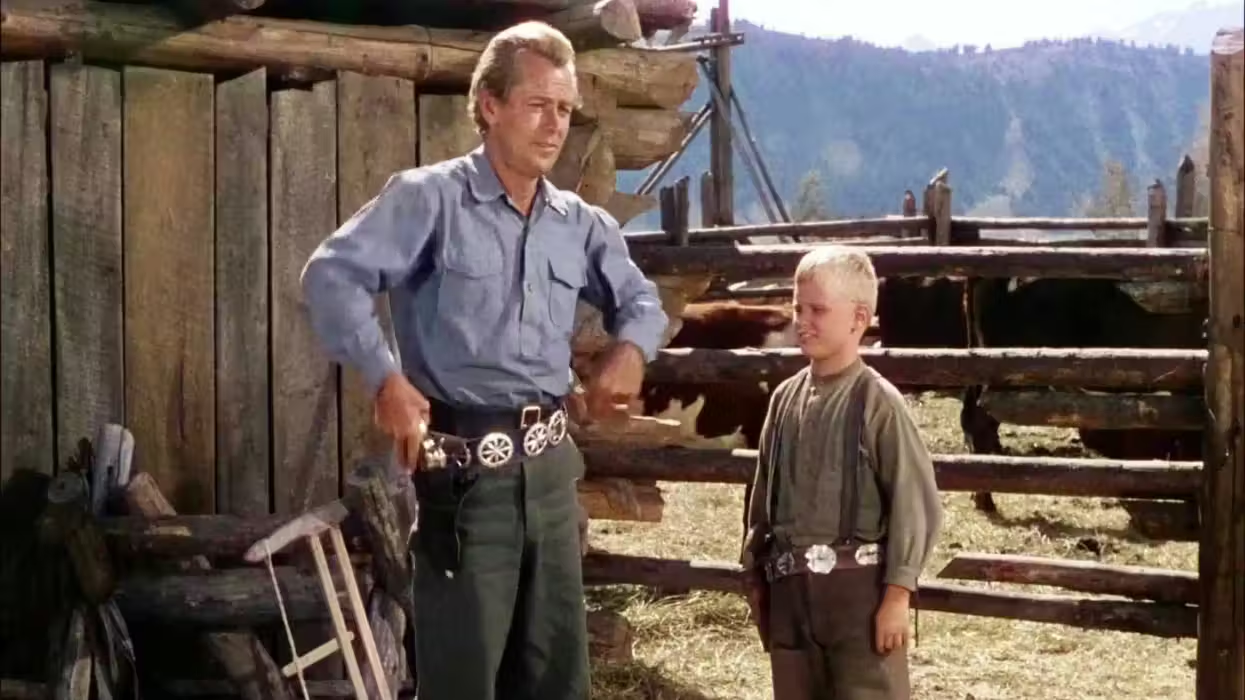
'Shane'
Last year, I went to the Academy Museum and saw Shane, introduced by Christopher Nolan. It was a great conversation about how the movie influenced Nolan's Batman.
I left that screening sure that this was one of the most important movies ever made, and I am surprised by the number of people who haven't seen the movie and don't know the emphatic cry of young Joey Starrett’s "Shane! Shane, come back!"
This quote seems innocuous enough, but it's ranked #47 on the American Film Institute’s 100 Years...100 Movie Quotes, and it serves as the denouement of George Stevens’ 1953 classic Shane.
Today, I want to unpack it and its meaning.
Let's dive in.
- YouTubewww.youtube.com
The Scene in Question
For my money, this should stand with the greatest Westerns of all time, because the movie is steeped in subtext and depth.
To understand why the line resonates, you have to trace how the film builds Joey Starrett’s (Brandon deWilde) relationship with violence throughout the narrative and what he sees when he sees our titular character, Shane.
For Joey, fighting and shooting are things he does in the barnyard and with his friends. There are np real consequences to violence in his world, because he's so young and innocent.
Sure, he's been raised in the Wild West, but that stuff hasn't come home to roost… yet.
When Joey first meets Shane (Alan Ladd), he doesn't see what his family sees. He just sees a handsome man with a gun who is sort of the ideal he's imagined. But his father and mother know you don't become Shane without seeing some truly awful things, and if you lived to tell the tale, it means other people died.
But Shane’s presence in the town draws out the dark underbelly of the local range war. This all gets personified by Jack Wilson (Jack Palance).
He's the traditional black hat who shoots down homesteaders in cold blood.
Juxtaposed against Shane, Joey sees them as good versus evil. But the more we learn about Shane, the more we realize he's just a survivor.
We get this proved to us when Joey sneaks out at the climax to watch the final saloon showdown.
In that moment, he sees how Shane easily kills Jack Wilson and all the rest of the men in the saloon. He finally sees real violence, not play violence. And he also sees Shane mortally wounded, while sticking up for his family.
After Shane dispatches Wilson and his men, he turns to the boy and delivers the film's moral center:
"Joey, there's no living with... with a killing. There's no going back from one. Right or wrong, it's a brand... A brand sticks."
As Shane rides away into the misty dawn, slumping slightly in his saddle, probably bleeding to death, leaving Joey calling out into the empty valley: "Shane! Shane, come back!"
We know he won't, and we know Joey's innocence has left with Shane, too.
- YouTubewww.youtube.com
What It Means
This is one of those tragic movies with a very strict point of view. Killing and the Old West go hand in hand. It's a life that you can't shake, and even if you like to pretend and play, once you introduce it to your character, you're a killer forever.
So how does this duality play out on screen?
We have a heartbroken boy begging his hero to return home to the farm that simultaneously functions as a hopeless attempt to call back the mythic era of gunfighters before a more civilized world takes over.
Joey does not yet fully grasp why Shane must leave. Shane knows that a killer, even a heroic one who kills for the right reasons, has no place in a peaceful society.
And he knows that if he stays there, other killers will come looking for him too.
Joey knows this, but he wants to believe that it can change, even if Shane himself has told him it won't.
Filmmaking Lessons
Again, this movie rocks. You should check it out, and I think the visual lessons in it extend beyond the Western genre to anything you're currently writing or directing.
Director George Stevens offers a masterclass in subjective point of view and plants and payoffs in that final sequence.
We see the battle in the bar through low-angle shots beneath the saloon door. That's Joey's vantage point. Then he cuts back to tight close-ups, showing he's watching without blinking.
The whole thing is anchored to a child, and when he cries later as Shane leaves, we see that as the tears of a boy becoming a man.
These visuals convey the subtext we discussed earlier and support the movie's theme of innocence.
The golden age of the West leaves with Shane and may never come back.
Summing It All Up
I wish you all could have been there when Nolan did the talk. He highlighted how "Shane, come back!" endures as one of cinema's greatest quotes because it captures a universal turning point: the exact moment a child realizes their hero is human.
And that humans are defined not by singular things, but by all the things that make them who they are. Once you understand that, the world gets a little more complicated.
Let me know what you think in the comments,