In order to get noticed in Hollywood, you have to be a little noisy. And with all the stacks of films people are thinking about financing, one way to stand out is to write something totally unique that no one has even seen before.
That's where I think every filmmaker can learn from Ari Aster.
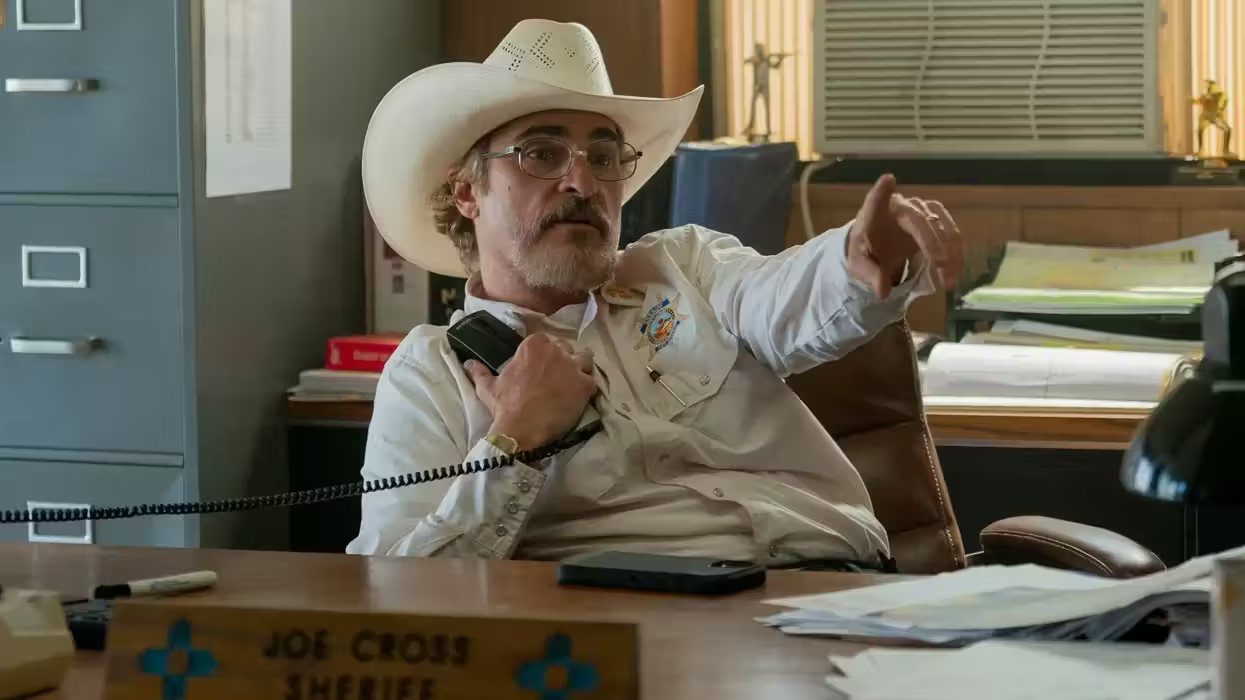
One of my favorite movies this year was Eddington. I thought it was a poignant and hilarious portrayal of humanity's struggles during COVID. It was also such a fun challenge to preconceived notions on westerns and brought toxic social media to the forefront.
And it was a movie no one could say they had ever seen before.
So today, we're going to unpack Eddington and Aster's way into that wholly unique movie, and see what filmmakers can learn from this stuff.
Sound good?
Let's dive in!
- YouTube www.youtube.com
How Originality Made Ari Aster's Career
When you think about an Ari Aster movie, you probably think about the deconstruction of a genre or of expectations. I mean, he's now made a horror movie that takes place during the day, a horrifying dream movie where the characters are all awake, and a familial horror about what we pass down to our kids.
Aster is always coming up with these stories from interesting angles. He recently sat down with Deadline, where he talked about his process and about finding ways to juxtapose modernity with Western classics.
When asked how you even build a movie like that, Aster said:
"It’s hard to say where it began and how it evolved, but I would say I was kind of trying to look unblinkingly at the culture, which is hard because I really don’t like this culture. I have a hard time living in it. But I was trying to look at it, and then also trying to think like an architect — like, OK, how do I build a house out of these things? And I was also feeling the rhetoric getting so much more dangerous, and so much more aggressive, and seeing the antipathy grow between people, and feeling that we were moving towards something combustible."
So where can filmmakers take these ideas?
Well, once Aster has them flowing, he comes at it the same way the rest of us do, with his directorial brain.
And that means organizing all these disparate thoughts and interests into one cohesive story.
Aster explained:
I’m a filmmaker, and I’m a storyteller, so I was like, OK, how do I organize this and build a narrative out of it without having it move into fantasy or coming to any easy answers. That wouldn’t have been honest, because I don’t have any answers. I’m looking for them. And so, in that sense, I wanted to make a film that was more diagnostic than prescriptive, because I see us talking about the problem, but getting lost in the weeds over and over again. And if anything, I think the film’s thesis lies in its final image…"'
I love hearing about these kinds of processes because they're so intricate. When you talk about this movie out loud, it feels like it shouldn't work. But reading how Aster did it, I can see the method in the madness.
As filmmakers, we can learn a lot from these words.
 'Eddington' Credit: A24
Sometimes we have a bunch of ideas and don't know how they'll all whittle down into one movie. Well, you need to take your time and follow them all.
As Aster said, sometimes it's just sitting down and seeing where these ideas connect, whether that's in the plot or themes, and then begin to draw the outline of what will be the movie.
I find way too many people dive right into writing the screenplay too quickly without spending time even writing a treatment or sorting out the story beats.
The key takeaway here is to take your time and work out the kinks before you jump into the script.
What About Researching Ideas?
In order to write Eddington, Aster spent time researching how social media feeds affect people. To do this, he basically followed what method actors do.
He told Deadline:
"Well, yeah, I did go down a lot of rabbit holes, and I created a bunch of burner Twitter accounts and got myself into different algorithms. For me, it was important to know when to stop, as far as making something clear, and just being clever about what you’re intimating. The jet there is designed to function as a bit of a Rorschach test, so what one person sees may be contradicted by another person. And that comes down to tone as well. One person might see that scene as satire and somebody else might see it as a dramatization of something that was happening. That is happening."
As a writer, I feel like many of us get so caught up in making things up that we miss out on how the stories we tell actually reflect real life.
By making those social accounts, Aster was able to see firsthand the mentality of the people in his movie and then write to that. It's why the satire he presented felt so real and so lived-in.
The thing I admire most about Aster is his willingness to try all these things. It's a really brave idea to tackle these tasks, like making social accounts and then figuring out where they go.
Writing the Unexpected
When Aster burst onto the scene, all of Hollywood assumed he was purely a horror movie director, thanks to his work on Hereditary and Midsommar. But Aster liked to remain genre-agnostic.
We often talk about getting pigeonholed after breaking in. People can only see what you've done lately. So if you want to remain nimble, you have to be okay with bucking their expectations and delivering something else.
That's also a big risk. Because people usually like knowing what yo expect from an artist.
Here's how Aster dealt with those expectations, especially when surfacing with a Western like Eddington.
"Well, in some ways, I feel that all my films are linked in tone and a sort of attitude, and in a way, I want to upend that now too. I don’t want to get stuck in anything. That’s not useful for any artists. But yeah, I would say with the first two films, when people would refer to me as a horror filmmaker, that felt reductive, but only because I had other movies in mind that might not satisfy that expectation. It wasn’t that I have any problem with horror — I love horror films — but I saw that as, OK, I’m starting here and then I’m going to go over there, and then I might come back, and I might go over there."
Summing It All Up
It's easy to attribute his success to luck, but what I think this interview unpacked was all the hard work he's done to not only set himself up as an original voice, but to continue to work out ideas until they're ready, and then to film them.
Aster's constant challenging of himself and genres is something I think we can all learn from and aspire to achieve in our own right.
Let me know what you think in the comments.