8 Haunted House Movies That Will Haunt You Forever
Explore cinema’s scariest houses, where walls whisper and shadows never leave.
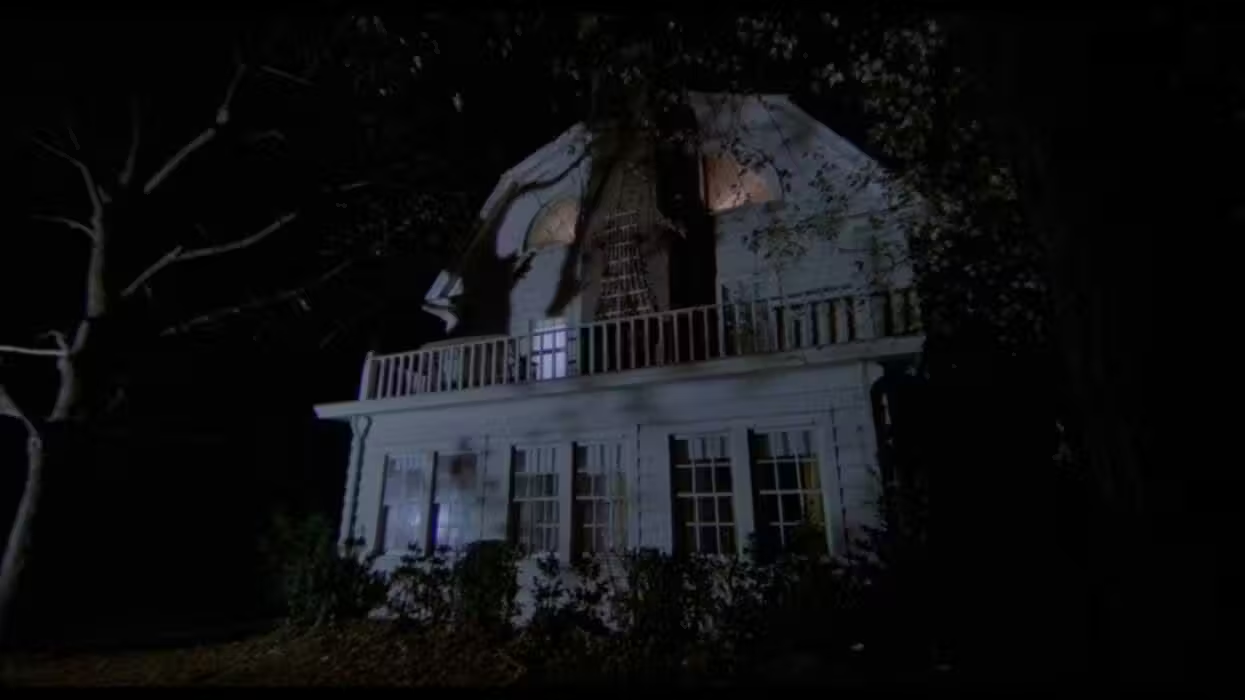
The Amityville Horror (1979)
Horror cinema has always had one address it can never leave behind: the haunted house.
These old houses—sometimes covered in cobwebs and layers of dust—are basically pressure cookers of fear where the walls seem to breathe and history refuses to stay buried. The real horror of a haunted house film lies, not in the gore, but in the way it turns a place of safety—home—into a cage of dread.
So why do these stories keep us awake at night?
Part of it is primal. Houses are supposed to protect us from the outside world, but in these films, the danger is already inside. Ghosts, curses, echoes of the past—each detail strips away the idea of security, leaving only raw fear.
That’s why haunted house films endure: they’re about vulnerability in the one place we shouldn’t feel it.
From Gothic castles to suburban cul-de-sacs to refugee housing projects, the haunted house has evolved alongside our fears. What remains constant is the way these films weaponize place. A creaking stair or flickering light is often more than decoration. It’s storytelling.
With that in mind, here are eight of the creepiest haunted house movies that have defined the genre and left their mark on generations of horror fans.
A Tour Through Cinema's Most Cursed Dwellings
1. The Haunting (1963)
Written by: Nelson Gidding | Directed by: Robert Wise
In The Haunting, Dr. John Markway (Richard Johnson) recruits a small group to investigate Hill House, a mansion with a reputation for the uncanny. Among them is Eleanor (Julie Harris), a fragile woman seeking belonging, and Theo (Claire Bloom), a sharp, independent guest whose intuition runs deep. What begins as a scientific experiment in documenting the paranormal soon descends into psychological chaos as the house itself seems to prey on Eleanor’s insecurities.
What makes the film unforgettable is its restraint. Wise never shows the audience a single ghost. Instead, the terror grows from suggestion—the booming knocks in the night, the shifting shadows, and the oppressive architecture of Hill House. The ambiguity keeps viewers second-guessing whether the hauntings are real or figments of Eleanor’s unraveling mind. It’s a masterclass in psychological horror, proving that what you don’t see is often more terrifying than what you do.
For anyone studying horror, The Haunting demonstrates how atmosphere can outpace spectacle. Budding filmmakers can learn the value of sound design, pacing, and the unsettling power of implication. Sometimes, the scariest ghost is the one left unseen.
2. The Amityville Horror (1979)
Written by: Sandor Stern | Directed by: Stuart Rosenberg
- YouTube
The Amityville Horror follows George Lutz (James Brolin) and Kathy Lutz (Margot Kidder), who move with their children into a Dutch Colonial house on Long Island, only to find themselves tormented by sinister forces. From swarms of flies to blood seeping from the walls, the house seems determined to eject its inhabitants—or destroy them entirely.
Its hook lies in the claim of truth. Marketed as “based on a true story,” the film taps into an unnerving idea: what if the suburban dream home you bought is cursed beyond salvation? The house itself, with its iconic quarter-moon windows, became as recognizable as any horror villain, cementing its place in pop culture. The scares may feel dated to modern audiences, but at the time, the blend of domestic bliss and demonic terror struck a raw cultural nerve.
For storytellers, the lesson here is how powerful marketing can amplify a film’s terror. Pairing a chilling narrative with the illusion of fact can transform a horror movie into a phenomenon, sparking debates that keep the story alive long after its release.
3. The Shining (1980)
Written by: Stanley Kubrick, Diane Johnson | Directed by: Stanley Kubrick
In The Shining, Jack Torrance (Jack Nicholson) takes a job as winter caretaker of the Overlook Hotel, bringing along his wife Wendy (Shelley Duvall) and son Danny (Danny Lloyd). Cut off from the outside world by snow, the Torrances quickly discover that the hotel’s haunted nature stretches to the point of being hungry. Jack’s fragile psyche begins to fracture, with the Overlook seemingly nudging him toward madness and violence.
Kubrick’s film is less about jump scares and more about insidious psychological corrosion. The Overlook itself feels alive, its endless corridors and lavish but empty ballrooms creating a labyrinth that traps both characters and viewers. Nicholson’s performance, coupled with Kubrick’s meticulous visuals and unsettling sound design, elevates the hotel into a full-fledged character—a malevolent presence that never loosens its grip.
For creatives, The Shining is a reminder of how setting can dominate a narrative. It shows that horror comes from much more than just supernatural elements—it comes from isolation, madness, and the weight of an environment that feels too big, too silent, and too watchful.
4. Poltergeist (1982)
Written by: Steven Spielberg, Michael Grais, Mark Victor | Directed by: Tobe Hooper
Poltergeist follows the Freeling family, whose suburban home becomes a gateway for malevolent spirits after their youngest daughter, Carol Anne (Heather O’Rourke), communicates with the other side through a television screen. What begins as small disturbances escalates into full-blown supernatural chaos, including objects flying through rooms and a terrifying sequence where Carol Anne is pulled into another dimension.
What makes the film stand out is its subversion of the American dream. Unlike the Gothic castles of older horror, the Freelings live in a shiny new subdivision—yet terror seeps in through the most ordinary spaces. Add to that the film’s groundbreaking practical effects, from the grotesque face-peeling scene to the collapsing house finale, and you get a spectacle that still resonates with audiences.
The movie’s enduring lesson is how horror can be most effective when rooted in the familiar. By corrupting everyday settings like living rooms and backyards, filmmakers can make the ordinary terrifying, ensuring that viewers never look at their own homes quite the same way again.
5. Beetlejuice (1988)
Written by: Michael McDowell, Warren Skaaren | Directed by: Tim Burton
In Beetlejuice, Barbara (Geena Davis) and Adam Maitland (Alec Baldwin) die in a car accident and find themselves trapped as ghosts in their beloved home. When a new family moves in and starts redecorating, the Maitlands enlist the help of a mischievous “bio-exorcist,” Betelgeuse (Michael Keaton), to scare the living out. Chaos, hilarity, and bizarre hauntings follow.
This isn’t your standard haunted house tale. Burton flips the formula, giving us a ghost-eye-view of the problem. Instead of the living fearing the dead, it’s the dead who are annoyed by the living. The film thrives on Keaton’s unhinged performance and Burton’s gothic-meets-cartoon aesthetic, making it less about terror and more about the absurdity of the afterlife. It showed that haunted house films didn’t have to be bound by tradition—they could be funny, stylish, and wildly original.
Beetlejuice is proof that genre rules are meant to be bent. Playing with tone, perspective, and style can breathe new life into a well-worn trope, offering a fresh angle while still honoring the genre’s spirit.
6. The Grudge (2004)
Written by: Stephen Susco | Directed by: Takashi Shimizu
The Grudge, adapted from Takashi Shimizu’s own Ju-On series, tells the story of an American exchange student, Karen (Sarah Michelle Gellar), who encounters a cursed Tokyo house where anyone who enters is doomed to die. The curse stems from a violent death, and its manifestations—a pale, crawling boy and the croaking spirit of Kayako—spread like a contagion, striking victims in unpredictable ways.
The film’s genius lies in its structure. Unlike traditional haunted house stories, where terror is confined to one family, The Grudge expands the curse beyond the house itself. The fragmented timeline adds to the disorientation, keeping audiences perpetually off-balance. Shimizu’s signature sound design—the infamous death rattle of Kayako—remains one of horror’s most chilling audio cues.
What filmmakers can take from this is the idea that horror thrives in unpredictability. By discarding linear storytelling and allowing dread to spread like a virus, The Grudge shows how breaking narrative rules can intensify fear and keep audiences guessing.
7. The Conjuring (2013)
Written by: Chad Hayes, Carey W. Hayes | Directed by: James Wan
In The Conjuring, paranormal investigators Ed (Patrick Wilson) and Lorraine Warren (Vera Farmiga) are called to assist the Perron family, whose Rhode Island farmhouse is under siege from a malevolent spirit. What begins with simple disturbances—doors creaking, clocks stopping—quickly escalates to possessions and violent attacks, forcing the Warrens to confront one of their darkest cases.
James Wan reinvigorated the haunted house genre by grounding it in character. The Perron family’s bond and the Warrens’ dynamic give the story emotional weight, while Wan’s precise control of atmosphere builds tension without relying on cheap scares. The film’s set-pieces—the clapping game, the wardrobe sequence—have already become iconic for their creativity and timing.
The film highlights how emotion amplifies terror. Filmmakers can learn from Wan’s approach: invest in characters first, then unleash the horror. Fear lands harder when viewers care deeply about the people at risk.
8. His House (2020)
Written by: Remi Weekes, Felicity Evans, Toby Venables | Directed by: Remi Weekes
His House follows Bol (Ṣọpẹ́ Dìrísù) and Rial (Wunmi Mosaku), refugees from South Sudan who resettle in a government-provided house in the UK. While trying to adjust to their new lives, they discover the house is haunted by an apeth, a spirit that forces them to confront the traumas they tried to escape.
What sets His House apart is how it merges horror with social commentary. The film is as much about the lingering scars of war, displacement, and survivor’s guilt, as it is about a haunted house. The haunting becomes both literal and metaphorical, creating a layered story that resonates on multiple levels. Weekes uses the supernatural to give voice to grief that can’t be spoken aloud, making the film as emotionally devastating as it is frightening.
For anyone drawn to storytelling, this film is a reminder that horror can carry profound meaning. By tying supernatural fear to real-world struggles, filmmakers can craft stories that terrify while also shedding light on urgent human truths.
What These Haunts Teach Us
Across these films, certain threads emerge. Haunted house stories often grapple with themes of grief, trauma, and the fragility of family bonds. Whether it’s Eleanor’s loneliness in The Haunting, the fractured trust in The Amityville Horror, or the refugee guilt in His House, the ghosts almost always represent something unresolved. Horror latches onto our deepest wounds, making them impossible to ignore.
The “ghosts” themselves have also shifted over time. In the mid-20th century, they thrived on ambiguity, remaining unseen and mysterious. By the 80s, they became showier, manifesting in practical effects and blockbuster spectacle. Today, haunted house films increasingly blend metaphor with terror, using the supernatural to comment on real-world issues. The evolution of the specter reflects the evolution of our fears, proving that horror is always in dialogue with its era.
Your Next Nightmare Awaits
Haunted house films endure because they weaponize the place itself. They remind us that walls hold stories, and sometimes those stories don’t stay buried. From the oppressive corridors of the Overlook to the peeling walls of a refugee flat, these movies show that horror is never just about ghosts—it’s about what we carry inside, and how our environments echo it back at us.
So, which door will you open tonight? Hill House, Amityville, or perhaps that quiet house down your own street?
After all, the scariest haunted house is the one you realize you’re already living in.
- How the Victorian Mansion Became a Horror Movie Icon ›
- The Ultimate Guide to Horror Subgenres ›
- What Are The Best Horror Movies of All Time? ›
- This is Why You Think ‘The Haunting of Hill House’ is Absolutely Terrifying ›
- How Being Trapped in an Actual Haunted House Inspired This Psychological Horror Short ›
- Check Out These 75 Horror Writing Prompts ›
- Journey Through the Edit of Disney's 'Muppets Haunted Mansion' ›
- The 10 Most Cursed Horror Children to Ever Grace the Screen | No Film School ›