4 Lessons on Building a Storytelling Life
Four lessons on voice, stamina, and the starving-artist myth.

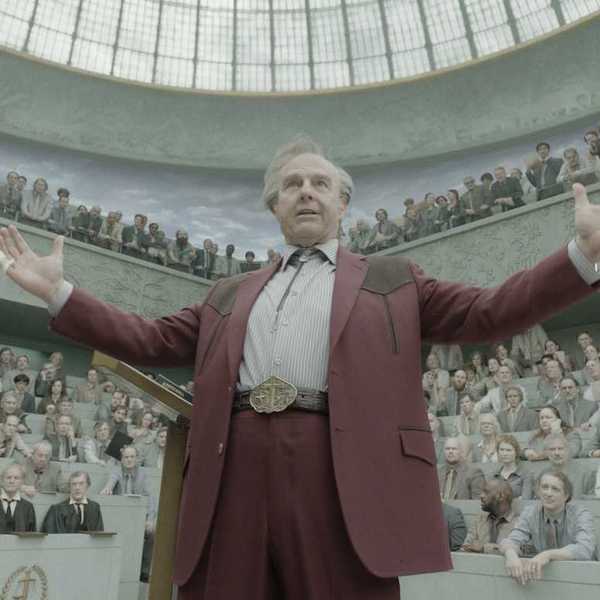
'The Righteous Gemstones'
How do you find your creative voice? Actually, what is a creative voice?
Simply put, your creative voice is how your perspective and experiences shape the way you tell stories. Your background will lead you to notice details, visually or in behavior or in sounds, that others won't.
If you grew up, say, in a place where drought was prevalent, your attitude toward water would likely differ from someone who grew up in a rainy climate. Each would photograph water differently, or have characters treat it differently.
We want to look at this topic today with the help of Bill McDonald. He has been head of cinematography at UCLA's School of Theater, Film and Television since 1998 (formerly, he served as Department of Film, TV and Digital Media chair and is an ASC Associate Member). He has spent decades helping new filmmakers figure out what kind of storytellers they are.
He sat down with the ease podcast at UCLA's Sound Stage 3 for a wide-ranging conversation about voice, curiosity, and the physical and psychological demands of a creative life. Let's learn the big takeaways in the video below.
- YouTube www.youtube.com
Voice Starts with a Question
One thing that filmmakers often get stuck on is aesthetics. And it's understandable why, because filmmaking is a visual medium, and they want things to be "pretty" or "interesting" or "cool." They want to copy a cool shot they saw one time for the heck of it because it seems like the thing they should do.
If you're doing that, you're probably in the process of finding your voice and tone. McDonald says that the wrong metric is aesthetic, and the right one is the question you keep coming back to.
"What are the stories, what are the characters, what are the human actions that you're interested in? You just endlessly explore."
He brought up family dynamics as a topic he constantly comes back to, because he grew up in a large family.
This doesn't mean that you find a voice and have to stick to it forever. You're an artist, and you'll evolve, and the tone of every project you do will change based on the story you're telling. Your through-line is what you keep asking, not what your work looks like, he says.
"We all have a question or questions, and fundamentally it's not that many. Maybe one or two that plagues us, plagues us, always nibbling at us ... And if we can identify that? Sometimes that takes work, people, it's there, but you've got to uncover it."
He calls out brand-thinking as a trap. It's not so much about "branding" yourself, because that's more a content creator's approach. You can tell any story you want in any genre if you're thinking like a creative filmmaker. You can tell a story about family dynamics in space, in true crime, in horror, whatever. You don't pigeon-hole yourself into a brand.
Wes Anderson came up as an example. He tells stories in a very distinct way because of how he sees the world, and now people often copy him.
You Are a Filter
It's really hard to be a storyteller if you're not experiencing anything. If you don't see the world, even a small part of it by going outside once in a while, you're not meeting people and seeing how others speak and expanding your views.
McDonald's model of creativity is that you have inherent DNA, but without input, that DNA plateaus fast.
"You're a filter," he says. He adds, "What makes you a unique creative is how you process the same stimuli that exists throughout the world. How do you process it? How do you think about it? How do you reemerge it in some other way that only you and you can do? And only you can do that is because you've processed it."
Your point of view is your currency, as Kevin Smith has also said.
You need to be endlessly curious, and not just about the same things all the time. Read a lot, watch a lot, talk to people outside your discipline. If you're a cinematographer, learn how to write. Read books that aren't about cinematography. Follow the advice of Baby Billy Freeman: "Go outside, nerd."
Train Your Body, Too
Now for another bit of practical advice. This work is hard on all sides when you get on a set. The hours are long, and depending on your role, you might be lugging around heavy gear. Get your body ready for that, he advises.
"You have to train for this work like an athlete. So your diet has to be good. Your stamina has to be good. You have to be very smart about the shoes that you wear. I can literally be on my feet for 14 hours and not sit down once."
Mentally, you have to be ready, too. With such long, punishing days, your mood can suffer, too. Don't let that ruin the experience.
"We're going to practice the professional skill of excessive politeness. Really. Absolutely. Because if you get in the habit of excessive politeness, it seems funny in a three-hour class ... but when you've worked with the same people, and you're four months into a project, you want to kill everybody."
In short, prepare your body, and practice your manners in advance so you don't have to summon them when you're exhausted.
No Such Thing as a "Starving Artist"
I like this take. McDonald says the starving artist is a myth we should leave behind.
"'Starving artist' is a control mechanism. It's to devalue you. What [is] the first thing fascists do? Get rid of the artists. Why? Because artists teach you and have you think about something beyond what the people in power want you to think about. Art is a challenge to power."
Yes, artists can struggle financially, and yes, there are sacrifices. But treating suffering as a way in, and potentially letting your art suffer in the process, is meant to discourage and stop you from reaching your true potential. You don't have to accept a poverty narrative.
"If you choose to live this life, the life of an artist, you are choosing to live a life. It's not a career. It's not a job. You are choosing a way to live a life as an artist."
Be sure to check out the full conversation for more!