Patrick Hogan wants audiences to hear what they can't see.
The film director and sound professional is a 10-time Emmy-nominated supervising sound editor. Hogan has worked on over 100 television shows and movies, including Cobra Kai, Umbrella Academy, HBO's Six Feet Under, and Reservation Dogs. He's earned three Golden Reel Awards for his sound work.
Now, with his latest horror short, Blindsided, Hogan is combining both halves of his career in a film designed specifically to showcase what sound can do when it becomes the main storytelling tool. We chatted with the filmmaker to learn from his approach.
Hogan created Blindsided after a conversation with his wife and producer Anna Krista Johnson at a film festival.
"I was at a film festival griping to my wife, who's also the producer, about the quality of the sound on some of the films there," Hogan said.
He thought, instead of telling stories that interested him and then figuring out the technical execution, why not start with his greatest strength and build a story around it?
The concept emerged quickly: a woman trapped in her apartment with a monster, but with one twist. She's blind.
- YouTube youtu.be
Horror with a Snorri Cam
Hogan needed a way to keep the film visually engaging for sighted audiences while still putting them inside the protagonist's limited sensory experience.
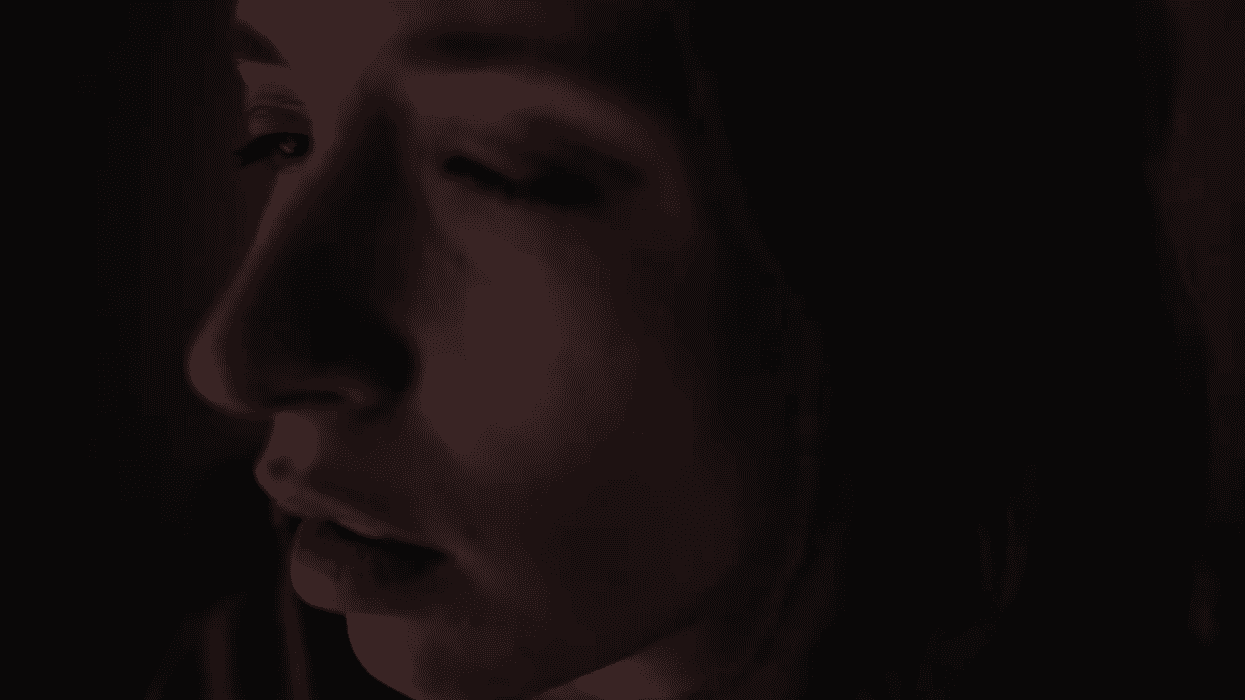
The solution came through a Snorri cam—a vest-mounted camera rig that keeps the lens focused on the actor's face while moving with them through space. It's a disorienting technique at first, creating an almost floating quality to the image. But Hogan realized this unusual choice could solve his storytelling problem.
"Typically, in a film, the camera points towards what's happening in any usual film. When a giant monster jumps into the room, the camera points at the monster, and you see the giant monster," Hogan said. "And we thought, 'Well, what if we flipped that and we just turned the camera away from what's happening and just showed her reacting to it?' And now the audience is going to hear everything instead."
By keeping the camera locked on the protagonist's face throughout the entire film, audiences see her reactions rather than the threats themselves. The background remains visible but slightly out of focus. The monster's location, movements, and actions are conveyed entirely through sound design.
"When you're in a theater, it's an interesting experience because a lot of the sound that's telling the story is coming from behind you, not in front of you," Hogan said.
Working with mixer Jamie Hart, Hogan mixed the film in 7.1 surround sound, taking full advantage of newer audio technology to pan sounds around the theater space and immerse audiences in the protagonist's disorienting experience.
Sound Design Matters More Than You Think
Hogan has noticed a problem in low-budget filmmaking. While aspiring directors obsess over camera gear and lenses, they consistently neglect sound quality. And sound, when it's bad, is usually noticeably bad.
"I always point out every year, the iPhone comes out with a new phone," Hogan said. "And they always tout the improvements in the camera and how much better the camera is. But how often do they talk about how much better the microphone is?"
The same pattern repeats in filmmaking forums and communities. Beginners flood discussion boards asking about cameras and lenses while barely mentioning microphones, lavaliers, or boom placement.
"I've talked to a lot of film festival directors and they say, 'Look, if a film's a little dark or a little bright or a little red or a little green or whatever, visually, if it's a little off, but we love the film, then we overlook that,'" Hogan said. "'But if we can't hear the dialogue, if the dialogue's bad, even if we love the film, we can't play it. We know the audience will just be frustrated.'"
When someone asks what camera to buy with their thousand-dollar budget, Hogan doesn't give an expected answer.
"Shoot it with your iPhone, but spend that thousand dollars on some lights and sound gear. Or on hiring actors who are really good, or spend it on production design," Hogan said. "Good cameras are easy to get. All the other stuff is the challenging part."
Building Organic Monster Sounds
Creating the sonic identity of Blindsided's alien creature required following the guide established by legendary sound designer Ben Burtt on Star Wars. Hogan started with organic recordings and manipulated them.
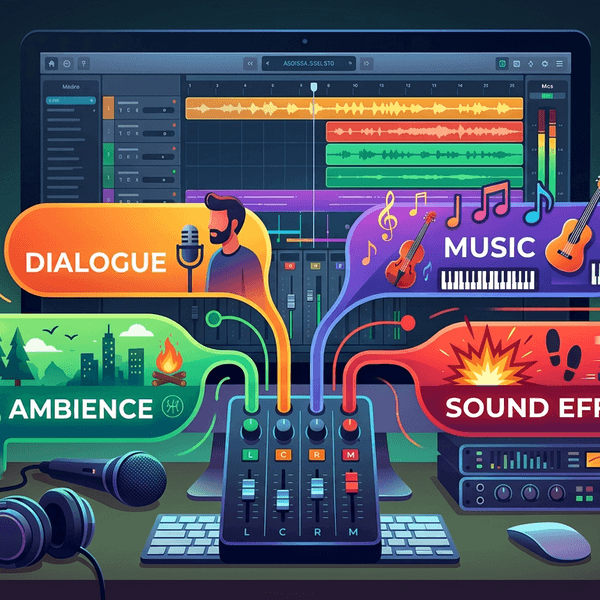
It was important to layer multiple sound elements that could be adjusted and recombined for each appearance.
"Good sound design is usually not just finding one sound, but taking multiple sounds and combining them in new and interesting ways," Hogan said. "Not only does that make the sound more layered and sound more real, but it allows you to subtly change it so that if someone yells or screams, every yell and scream doesn't sound exactly the same."
For Blindsided, the monster's voice combined several unexpected elements. Animal roars from creatures like bears, elephants, lions, and tigers provided the baseline. Hogan and sound designer David Barbee (who worked with Hogan on Netflix's Umbrella Academy) added less obvious layers.
High-pitched cymbal strikes created screeching, metallic undertones. Barbee even recorded his own vocalizations—screams, sniffs, breathing—and manipulated them through pitch-shifting and other effects to sound massive and inhuman.
By adjusting the balance between these layered elements for each of the monster's appearances, every roar carries slightly different emotional weight. Some moments sound angrier, others more curious or predatory. The variation makes the creature feel more alive and unpredictable.
 BlindsidedCredit: JohnHog Danger Productions
Environmental Sound Placement Creates Realism
One of the most common mistakes Hogan sees in student and low-budget films involves environmental shaping, or the way sound behaves differently depending on physical space, distance, and obstacles.
When the monster rampages outside on the street, Hogan added delay and echo to simulate sound waves bouncing off surrounding buildings. Inside the apartment, he applied reverb to show sound reflecting off walls, floors, and furniture. When the creature moves behind a wall or into another room, the audio becomes muffled, with high frequencies filtered out to suggest the sound passing through a physical barrier.
Distance matters too.
"When you're close, you have more treble right there," he said. "When you're further away, it's the low frequency, so it's more muffled, and it's just the low frequencies that are coming through."
These adjustments work together to create a three-dimensional sonic space.
"We're not showing you where the monster is, but we're telling you where the monster is with sound," Hogan said.
The film's opening shows audiences the environment before the terror. The first few shots trace the path the monster will eventually take, giving viewers a mental map.
Try Pre-Recording Sound
Perhaps the most unusual aspect of Blindsided's production involved reversing the traditional filmmaking workflow. Instead of recording visuals first and adding sound later, Hogan created the entire audio landscape before shooting.
"We actually did the whole film and sound first. We did the sound design and the whole thing, the crash, everything in sound made a seven-minute radio play," Hogan said. "And then on set, we played that back so that the actor ... she's actually responding to the sound. She's not having to pretend."
Even the other actors recorded their dialogue first, allowing the lead performer to hear and respond to real voices and performances rather than imagining them.
The technique also allowed Hogan to fine-tune the timing and intensity of sound cues before production, ensuring the audio would work perfectly with the eventual visuals rather than hoping to fix problems in post-production.
 BlindsidedCredit: JohnHog Danger Productions
Accessible Professional Tools
The Snorri cam rig required a camera light enough for an actor to wear on a vest while moving through the apartment set, but capable enough to deliver true cinematic image quality in low-light conditions.
He chose the Blackmagic Cinema Camera 6K, which offered the best combination of image quality and manageable weight. The film takes place at night in a blind person's apartment, where there's no logical reason for lamps to be switched on. Lighting came primarily from moonlight through a window and, after the alien crash, fires burning outside.
To capture enough light in these conditions, Hogan paired the camera with a Sigma Art lens capable of opening to f/1.4 or f/1.5. The wide aperture created an extremely shallow depth of field, blurring the background and keeping focus primarily on the protagonist's face and eyes.
"The DP is actually walking right there with her because he's literally, he's got his hands on the lens and he's doing minute little focus adjustments," Hogan said.
But the shallow depth of field served the story, isolating the protagonist in the frame and blurring the threatening environment.
For post-production, Hogan edited everything except the sound in DaVinci Resolve Studio, which he switched to in 2020. The visual effects, color grading, and picture editing all happened within a single program.
Horror typically benefits from darkness, but if you push the shadows too far, audiences can't see anything. Make it too bright, and you lose the threatening atmosphere. Hogan and his colorist experimented with some of DaVinci Resolve 20's newest features, though he acknowledges they took a risk by upgrading software mid-project.
"We broke the rule, we backed up everything," Hogan said.
For sound work, he stuck with Pro Tools, which remains the industry standard and what he uses in his day job.
The whole project came together on what Hogan describes as a very, very low budget.
"The dollar barrier of getting into good quality cameras and editing equipment is really not there anymore," Hogan said. "In the grand scheme of things, compared to movies that cost hundreds of millions of dollars, what they're charging for a camera and software. And it's most companies, not just Blackmagic, it's come down across the board."
For young filmmakers looking at professional work and feeling intimidated by the apparent resource gap, Hogan sees the current moment as uniquely promising. The tools are accessible.
"16-year-old me would be very jealous of what 16-year-old beginning filmmakers today get to play with," Hogan said.
Advice for First-Time Filmmakers
After decades of working in both sound editing and directing, Hogan has learned what matters.
"Find the story that you're uniquely situated to tell," Hogan said. "Blindsided is a great example of that, right? There aren't maybe that many of us who could tell this story the way we told it."
Hogan could make Blindsided the way he did because he possesses expertise in filmmaking and sound design. Another filmmaker with different skills might tell a completely different story.
The second piece of advice is about people.
"Find people to collaborate with and make connections. Work on other people's films," Hogan said.
Learning the technical aspects of every filmmaking position makes you a better director because you can communicate more effectively with department heads. Building a network of trusted collaborators lays important groundwork.
Blindsided operated on a tiny budget with a small crew, but still required about 18 to 20 people to complete.
"Equipment comes and goes, good people who you trust and who trust you, who you can work with together. That's the key," Hogan said.
This article was brought to you by Blackmagic Design. For more horror filmmaking interviews and insights, check out the rest of our Horror Week 2025 coverage here!