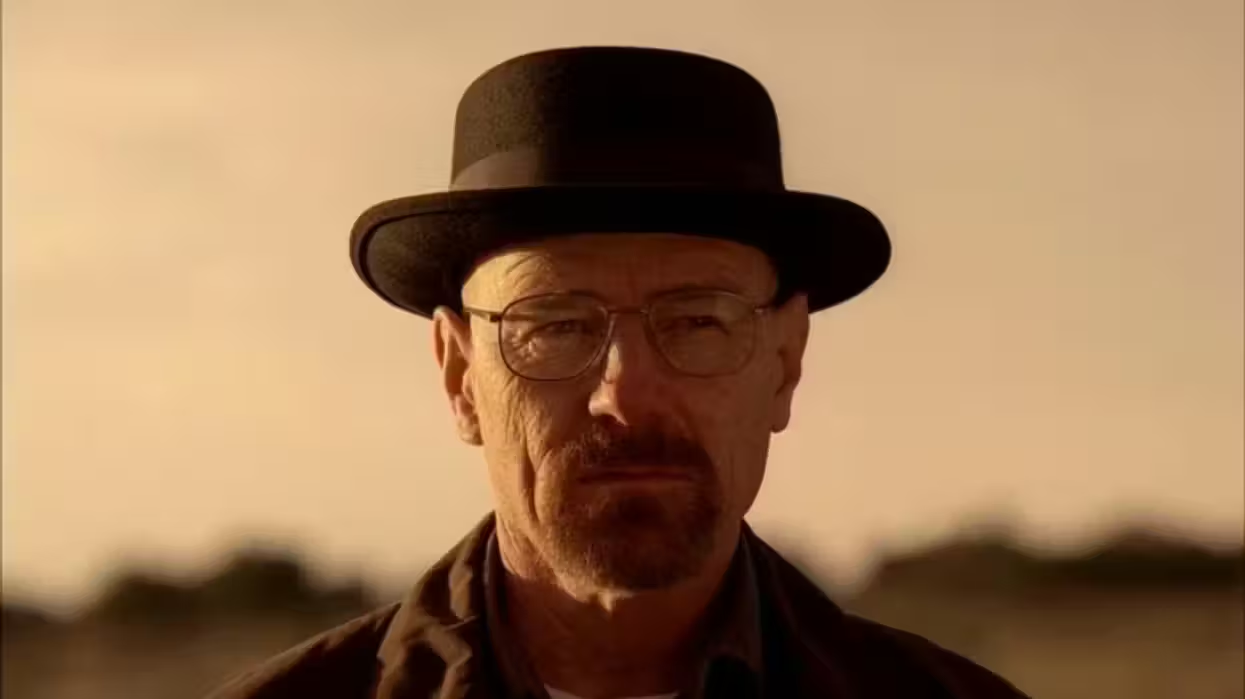
Breaking Bad (2008–2013) is about a Chemistry teacher—a decent, intelligent man—transforming into a drug lord—a vile monster. This transformation is insidious, precise, and brutal.
Walter White (Bryan Cranston) begins as someone we can sympathize with. A man cornered by life. But as the series unfolds, we watch that cornered man redraw the map.
We watch him become Heisenberg.
In a story packed with shootouts, betrayals, and poisoned kids’ juice boxes, it’s not a gun or a murder that marks Walter’s scariest moment. It’s a sentence. One line, delivered in a quiet rage, that makes the shift official.
It stands out because it hits like a gavel. That’s the moment Walt stops pretending. The nice-guy mask slides off. And what’s underneath is chilling.
This article is about how this famous line elementally translates Walter White into Heisenberg. It’s about where it lands in the story, how it was built, and why it’s still echoing across TV history.
The Scene: Context & Delivery
The line drops in the episode Cornered—Season 4, Episode 6. At this point in the show, Walt has survived more than he should have. His ego has bloated, but his house is still falling apart. Skyler (Anna Gunn) is catching on to the fact that Walt’s little “meth side hustle” isn’t so little anymore. She’s scared. She wants him to go to the police. And when she voices that fear—suggesting that someone might come knock on their door—Walt snaps.
He delivers the line not in a particularly raised voice, but with razor clarity:
“I am not in danger, Skyler. I am the danger. A guy opens his door and gets shot, and you think that of me? No. I am the one who knocks.”
When he says this, he is not making a point; he is giving a warning. To Skyler. To us. To anyone who is still clinging to the hope that it was going to be a redemption story.
What makes the moment unforgettable is how Bryan Cranston plays it. He doesn’t yell. He coils inward, like a spring that’s just reached its limit. His voice is low but firm, and his eyes don’t blink. It’s the performance equivalent of a pressure cooker hissing—not quite exploding, but absolutely ready to.
Breaking Down the Line: What It Really Means
On the surface, the line is about dominance. Walt is telling Skyler—and, by extension, the world—that he’s no longer prey. He’s not waiting for danger to arrive. He is the danger. He’s the one making the threats now, not dodging them.
But symbolically, it’s so much more. This is Walt discarding the last pieces of victimhood he once clung to. No more “I’m doing this for the family.” No more “I had no choice.”
In that moment, Walt owns it. He’s not a man forced into crime. He’s a man who likes the power it gives him. The line splits Walter from Heisenberg completely—and Heisenberg wins.
That’s also where we see the full psychological shift. The humility is gone. The self-image is warped. He’s built a throne out of meth barrels and pride, and he’s sitting on it like it’s his birthright. The man who once wouldn’t even swear in front of his son is now justifying murder as a business necessity.
That line, in context, is narcissism in its purest form.
The Point of No Return: Walter’s Full Descent
You don’t come back from “I am the one who knocks.” Not as a husband, not as a father, not as a human being. This is the moment Walt completes his pivot from Mr. Chips to Scarface. And unlike other pivotal TV antiheroes, he doesn’t feel torn about it. He’s proud.
This line is a character-defining decision. Walt chooses pride over peace. He chooses control over compassion. And he lets Skyler know, in no uncertain terms, that she’s not his partner. She’s an observer, maybe even an obstacle. The man who once cooked meth to leave money behind now uses intimidation to assert his dominance. That’s not about providing. That’s about winning.
From here on out, the decisions get uglier. Walt orchestrates the prison massacre. He poisons a child to manipulate Jesse (Aaron Paul). This line foreshadows these actions, but also makes them inevitable.
Once you declare yourself the danger, you have to prove it.
Fan & Critical Reception: Why It Resonates

(Image Source: Printerval | Photo Credit: MarshalGoldsmith | Copyright: Printerval.com)
For a line that turned into a meme, its actual context is anything but funny. On Tumblr and Twitter, it’s been remixed, GIF-ed, and slapped onto T-shirts. But when you revisit the scene, the humor evaporates. You’re left with something raw. Ugly. Real.
Critics have pointed to this moment as a showcase of Breaking Bad’s surgical writing. It’s clean, efficient, and cuts deep. One sentence redefines everything you thought you knew about Walt. The writers didn’t need exposition or a long monologue. They needed ten words.
The audience reaction? Equal parts awe and horror. For many, this is when the rooting stopped. Until now, Walt had rationalizations—some flimsy, some convincing. But this was ego, undiluted. It felt like betrayal, even if we’d been warned all along.
Behind the Scenes: Crafting the Moment
Vince Gilligan and his writing team had been building to this for a while. The arc wasn’t accidental. Walt’s evolution was designed to feel slow but irreversible. In interviews, Gilligan often said he wanted to turn Mr. Chips into Scarface—not overnight, but piece by piece.
According to the official Breaking Bad Insider Podcast (Episode: S4E6 ”Cornered”), the line was always planned. It wasn’t a spontaneous stroke of genius—it was structured into the episode. The writers knew this was the point where Walt needed to cross a line, not just ethically, but rhetorically.
Bryan Cranston’s performance didn’t happen in a vacuum either. He had conversations with Gilligan about how far Walt had sunk, and how the delivery needed to feel like a controlled explosion. It was more than just acting. It was precise emotional math. And it paid off.
Legacy: The Line’s Place in TV History
It’s not hyperbole to say “I am the one who knocks” sits alongside the greatest TV quotes ever. It’s up there with The Wire's “All in the game” and Mad Men's “That’s what the money is for!” And it’s no accident that it shares the stage with another iconic Walt line: “I did it for me.” That’s the epilogue. This was the confession.
What it also did was raise the bar for antihero storytelling. After Walt, writers couldn’t get away with vague morality or surface-level bad behavior. The audience now expected a deeper dive into ego, motive, and power. And they wanted it sharp.
You can even see the ripple effect in Better Call Saul (2015–2022). Jimmy McGill (Bob Odenkirk) doesn’t get a “knock” moment in the same way, but his transformation into Saul Goodman carries the same kind of slow-burn dread. These shows taught us that the real danger isn’t always physical. Sometimes, it’s a man convincing himself he’s the hero when he’s already the villain.
The Knock That Changed Everything
There are TV quotes that sound cool. And then there are the ones that shift the ground beneath the story. “I am the one who knocks,” did the latter. It was the line that pulled the mask off Walter White once and for all—and made it clear that Heisenberg wasn’t a persona. He was the real Walter all along.
Even years after Breaking Bad ended, that line sticks. It’s a turning point you can feel. The moment where everything kind, noble, and decent about the character drops dead behind his eyes.
Skyler wasn’t the only one who heard it. It was us too.
- Our Favorite Lessons on Screenwriting from 'Breaking Bad' ›
- Was Walter White a Cannibal? ›
- Deconstructing a Masterpiece: How Vince Gilligan Wrote 'Breaking Bad' ›
- Why Does 'Breaking Bad' Owe 'The X-Files' a Debt of Gratitude? ›
- Film Quote of the Day: The Oddest Trust Test in 'Once Upon a Time in the West' | No Film School ›