Set against the backdrop of World War II, Michael Curtiz’s Casablanca premiered in 1942 (a year before its official U.S release on February 1, 1943), at a time when there were U.S. troops actively deployed in North Africa.
Not only did the film skyrocket the careers of the two leading actors (Ingrid Bergman and Humphrey Bogart), but it also left a mark on countless other movies and television shows that came after it, across the globe. Movies such as Woody Allen’s Play It Again, Sam, Alfred Hitchcock’s Notorious, Howard Hawks’ To Have and Have Not, and Jean Negulesco’s The Conspirators are just a few. The movie has also inspired iconic reboots such as Robert Zemeckis’ Allied and Michael Flatley’s Blackbird.
One of the greatest films ever made, but not many know that Casablanca is living proof of the magic of cinematic improvisation. Filming this timeless classic was infamously chaotic, especially owing to an unfinished script and the ongoing World War.
In this article, we’re unveiling how filming on the go without a bound script proved to be a boon in disguise for the film and how the creative chaos might have helped in enhancing Casablanca.
Casablanca’s Scripting and Filming
Casablanca’s first draft was originally an unproduced play, Everybody Comes to Rick's, written by Murray Burnett and Joan Alison. Retaining the primary structure and themes, the draft was then passed on to Julius and Philip Epstein, who worked on the story arcs and dialogue before it was passed to Howard Koch for further editing. Later, Casey Robinson (uncredited) worked on it to enhance the romantic scenes. Ultimately, the formal credits for the screenplay went to Epstein and Koch, who shared the Academy Award for Best Screenplay in 1944.
Studio reader Stephen Karnot reviewed the play draft on December 8, 1941, the day after Pearl Harbor was bombed by the Japanese, and despite not having a bound script, filming began on May 25, 1942, at the Warner Bros. movie set. The timing was crucial for Casablanca, and naturally, the makers didn’t want to waste any time. Reportedly, Warner Bros. bought the rights to the unproduced play for a whopping, record-breaking $20,000, which would be about $370,000 today —talk about money well spent!
Ironically, deciding on a climax that made everyone happy, from the audience to the censor board, was as challenging back in those days as it is today. Reportedly, all three writers were on call throughout the filming period. For the longest time, the writers couldn’t even decide how to close the love triangle. Does Ilsa end up with Rick or Laszlo? In the source material, Ilsa and Rick end up together, but that didn’t comply with the Hays Code (adultery was a moral abomination), so it had to be changed. But to what? That took a long time to brew.
Naturally, the actors had no clarity about their character arcs. The fog especially bugged Bergman, as she didn’t know who her character really ended up with, almost until the day of the shoot. The ambiguity was also bothering Bogart, who was portraying a romantic hero for the first time as an actor.
The filming heavily relied on resourcefulness. For instance, the climax had to be shot on a soundstage instead of on location, as shooting at an airport after dark during an ongoing war was out of the question due to security reasons. The plane that you see behind Ilsa and Rick is a cardboard cutout. Also, except for Rick's cafe, the rest of the movie was primarily shot on the recycled sets from previous Warner Bros. productions, as resources were scarce with the war ongoing. The biggest irony lies in the fact that a majority of the extras in this film about refugees were real refugees.
 'Casablanca' Credit: Warner Bros.
The Impact of Scripting On The Go
At its heart, Casablanca is a tale of love and morality in the face of serious political adversity. It centers on Rick, turning him into an allegory for the U.S. itself, who was initially reluctant to participate in World War II but then was ultimately forced to act out of morality. At the same time, it is a story of duty and sacrifice.
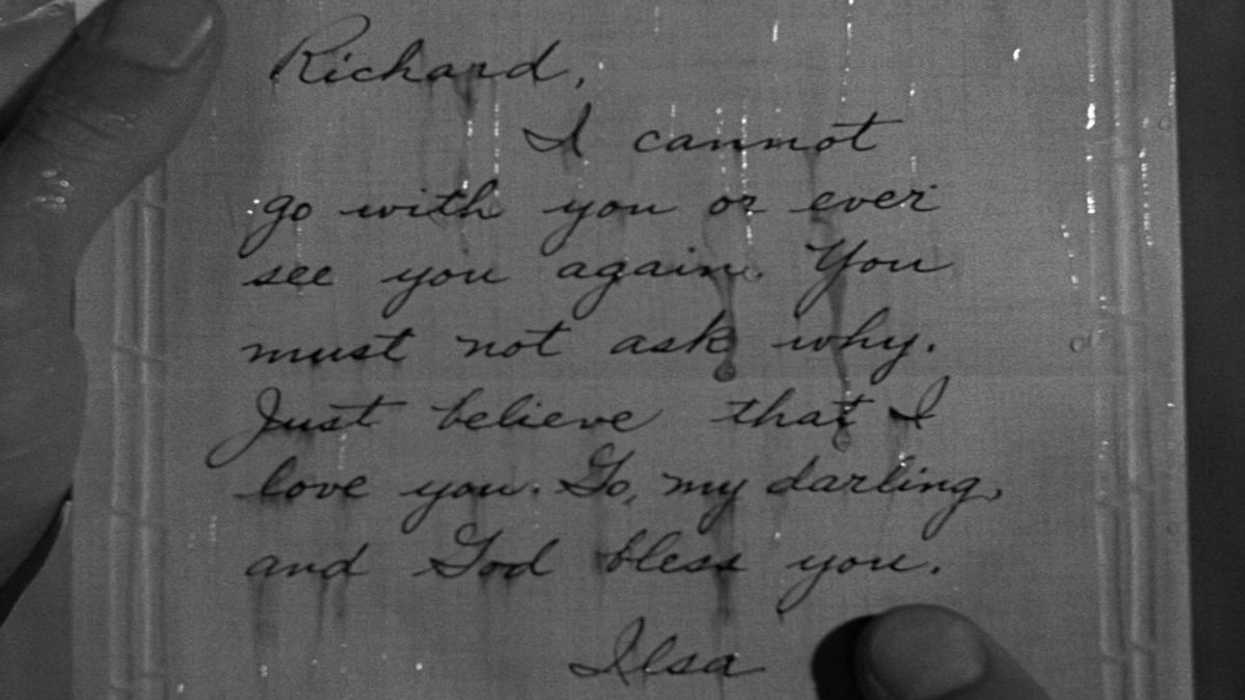
Rick and Ilsa were very much in love when they broke off, after their affair in Paris, so definitely, he was upset with Ilsa for abandoning him. So when she comes before him years later, a lot of emotions rush in. But, since Casablanca's script was unfinished, nobody knew what would happen to Ilsa and Rick, now that fate had brought them together once again.
This lack of clarity, a prominent situational element and stake in Ilsa and Rick’s story, has beautifully made its way into the actors' performance. While they’re still in love, they don’t know what’s in store for them. So initially, while the lack of clarity was hindering the actors’ chemistry on screen, it soon began complementing the character portrayals. The chemistry was steaming and intense to the point that Bogart’s wife had begun suspecting that he was having an affair with Bergman.
As Bogart had never been a romantic hero before this, the ambiguity in the script also prevented him from scripting his own performance.
Filming Casablanca was like playing a game of “situations”: the actors were merely living in the moment!
While Casablanca is also widely considered to be a propaganda film, it is definitely, as Italian novelist Umberto Eco wrote, “...not just a movie, it is THE movie.”