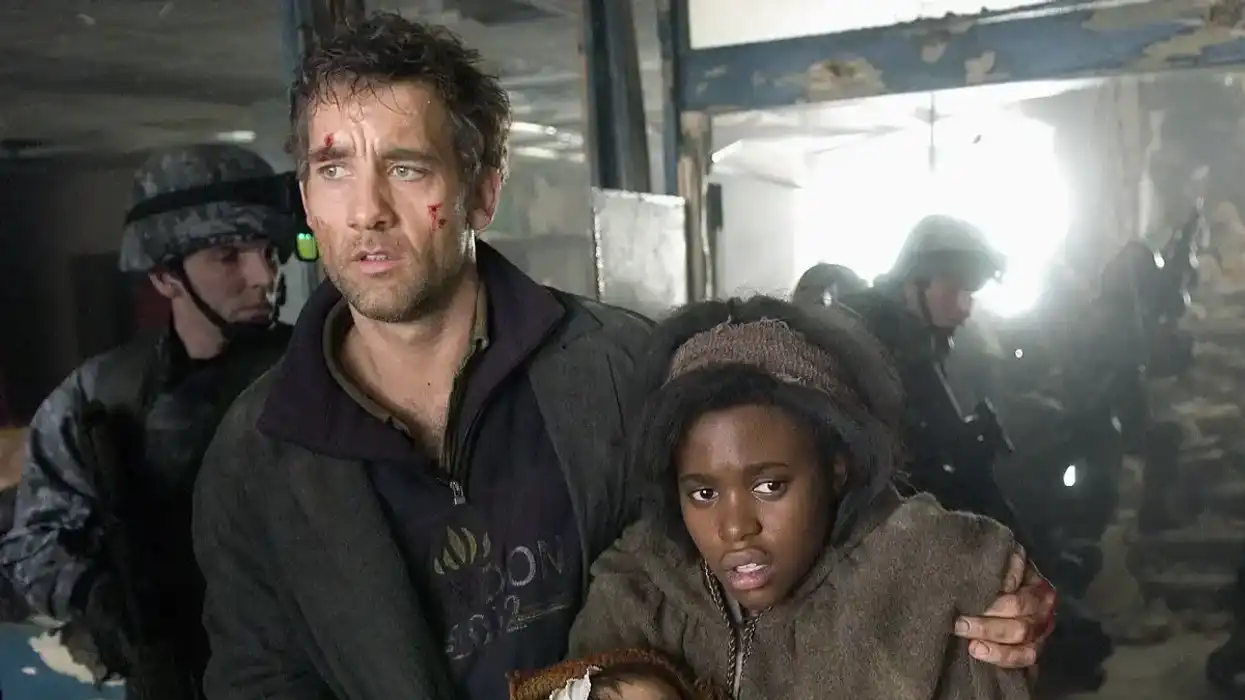
Children of Men is one of Alfonso Cuarón's masterpieces. It's a dystopian sci-fi story set in a world where the birth rate has plummeted to literally zero—no babies are being born, plunging the world into a mix of grim chaos and mundanity. The United Kingdom is a totalitarian police state. The film is set in 2027, and sometimes its reality seems too near.
It was released, if you can believe it, in 2006, making this its 20th anniversary year. You probably remember the famous tinnitus line about "cells dying," which isn't fully truthful but still packs a punch. Or maybe you know that famous oner.
Today we want to take a look at a slightly more overlooked moment that comes from Michael Caine's character.
"Everything is a mythical, cosmic battle between faith and chance."
Watch the scene below.
- YouTube www.youtube.com
The Scene
The film follows Theo Faron (Clive Owen), a disillusioned activist. He's kidnapped by a group led by his estranged wife, Julian Taylor (Julianne Moore), who reveals they need his help transporting a refugee named Kee (Clare-Hope Ashitey). Motivated by money, Theo agrees, but then their group is ambushed, and Julian is killed. Kee then reveals she is pregnant.
Later on, the characters have come to Jasper's (Caine) hidden woodland cabin, where he welcomes Theo, Kee, and midwife Miriam (Pam Ferris). Jasper lives out there with his wife Janice, off the grid, growing his own weed. He's the closest thing Theo has to a father. He's also the one person Theo trusts.
Jasper tells Miriam Theo's backstory... that Theo and Julian lost their young son Dylan in the 2008 flu pandemic, which was the reason for their estrangement.
Theo overhears the conversation, entering the kitchen while Jasper and Miriam speak.
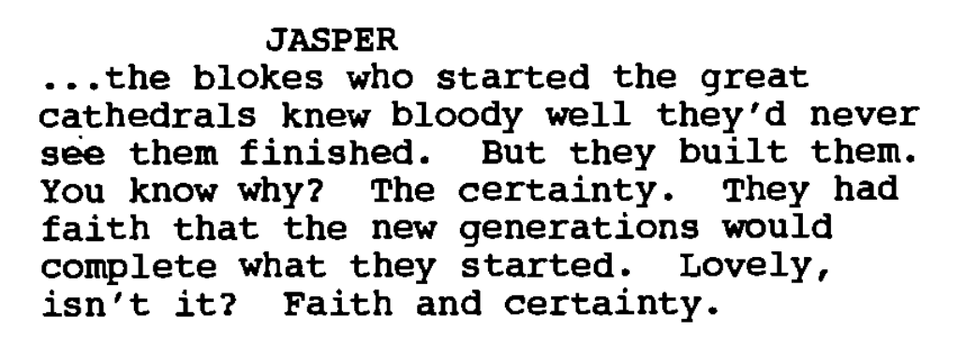
"Everything is a mythical, cosmic battle between faith and chance," Jasper begins.
Then he keeps going. He tells Miriam about Theo and Julian meeting by chance at a rally, but being there because of what they believed in.
He tells her about their son Dylan, born by chance out of their beliefs.
"Magical child," he says. "Beautiful. Their faith put in practice."
But he was gone, by chance, in the 2008 flu pandemic.
He lands on the question the whole scene has been building toward.
"You see, Theo's faith lost out to chance. So why bother if life's going to make its own choices?"
Miriam says everything happens for a reason. Jasper says he doesn't know about that. The scene ends. Theo walks off quietly.
What Jasper Is Actually Saying
The debate between fatalism and determinism is as old as time. Heck, it was one of the main themes of LOST. Science vs. faith. Choice vs. fate. Which is real? Which really matters? Do we choose our endings? Or has everything been predetermined by a higher force? Do humans have agency? What is agency?
Jasper isn't picking sides. He's saying both things are real and both are operating all the time. Faith is what you believe in and what you build. Chance is what happens to you regardless.
Theo and Julian's faith was that they could change the world. Their chance was that they met, had a son, and lost him to something they didn't choose. Neither force cancels the other. They co-exist, and humans have to deal with the consequences.
Jasper is a pot-growing recluse who lost his career and is caring for his catatonic wife. He has watched faith get beaten by chance in his own life, and he still believes in both. The fact that everyone in the scene is high doesn't lessen the conversation's impact, either.
 Credit: Universal Pictures
How the Film Pays Off the Line
The rest of the movie is Cuarón and his co-writers showing us both sides.
Chance is everywhere. Julian is shot dead in a car through a window. Here one second, gone the next. Jasper is murdered on his own doorstep after buying his friends time. Theo takes a bullet on the rowboat at the end, and we don't know if he survives it.
Faith is everywhere, too. Kee has her baby in a world that's totally infertile. That baby should not exist. Theo, who at the start of the film couldn't be bothered to care about anything, keeps choosing to protect her.
British soldiers in the middle of a firefight lower their weapons at the sight of the newborn. The ship called Tomorrow actually arrives.
The movie's argument is that chance keeps happening, and people keep choosing to have faith anyway, and that those choices matter.
Cuarón said as much in a 2017 Vulture interview, reflecting on the film a decade after making it. He described himself as "absolutely pessimistic about the present" and "very optimistic about the future," a pessimist about his own generation, hopeful about younger ones.
"Now I think that the only thing is to think of the unimaginable. For the new generation, the unimaginable is not as unimaginable. You know what I mean?"
The world will keep being a fight. You bother because the people coming next might do something with what you leave them.
What to Use in Your Screenplay
You might think you need to have your theme in a big, dramatic moment set to music and an obvious camera flourish. This line comes as characters are smoking "Strawberry Cough," a new marijuana strain, and they aren't even in focus in the scene. The camera stays on Theo, overhearing everything.
The philosophy is delivered like a stray thought at the head of the scene. When you have a big idea you want your movie to convey, you don't always need to build a scene around it. Tuck it in a scene that's supposedly about something else and make the audience work for it.
Children of Men gives you its theme and then stress-tests it. The film keeps giving chance the wins and asking whether faith survives anyway. The theme of your movie is a question that can be argued. And the movie should be the argument. That's where the tension comes from.