2 Minutes That Made Darth Vader Terrifying Again
And how the filmmakers pulled it off.
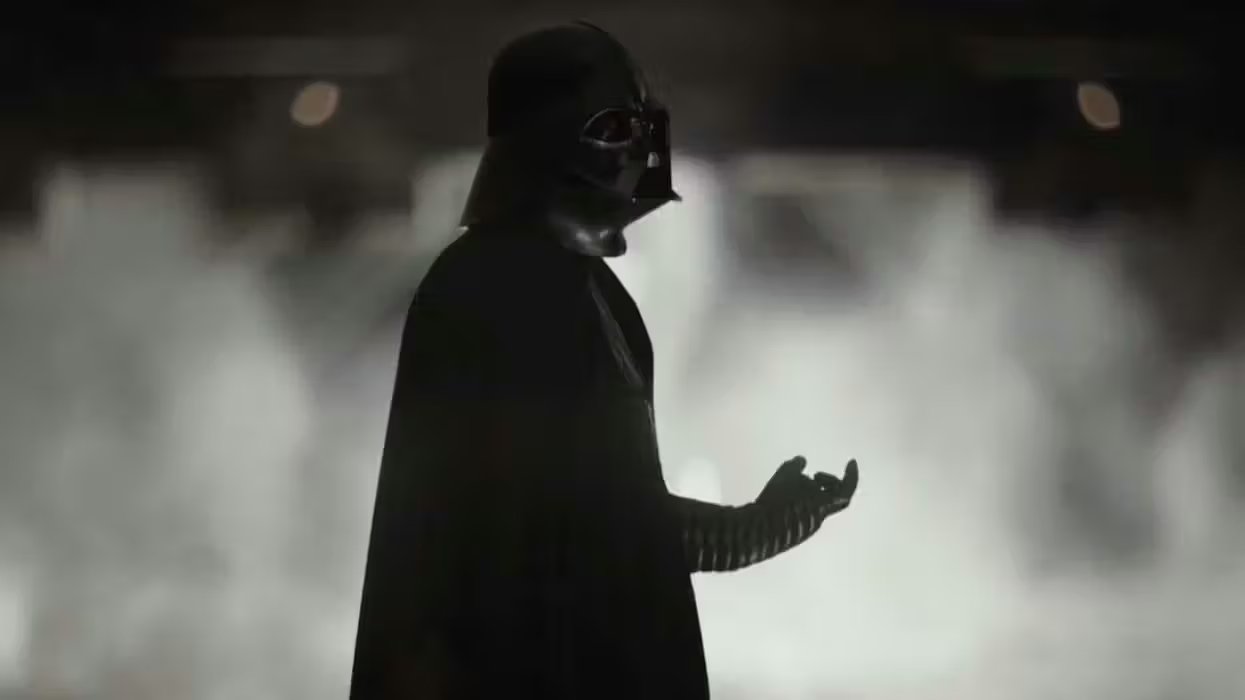
'Rogue One'
Say what you will about Rogue One—some people feel it’s flawed or gimmicky, other people love it. Personally, I think it’s the best new Star Wars film we’ve gotten yet in the Disney era. (Please, I don’t want to fight you about this. Let’s be friends.) Written by Chris Weitz and Tony Gilroy and directed by Gareth Edwards, it’s got an incredible pedigree and cast, and is only made better if you’ve watched Andor too.
Rogue One ends with a scene that runs just a few minutes, but it’s become absolutely iconic to bridge the last moments of Rogue One with A New Hope. Vader traps a squad of Rebels in a ship’s hallway and kills nearly all of them while the Death Star plans get passed hand to hand toward Princess Leia's ship. It’s one of the most graphic and horrifying things we’ve ever seen in Star Wars. It’s as terrifying as a horror movie. I get chills every time.
Edwards has talked about how the scene came together with about four months left before release, sparked by a suggestion one of his editors tossed out almost as an aside.
- YouTubewww.youtube.com
The Pitch Came in the Edit
As Edwards tells it, the film's ending, before this scene existed, just showed Vader watching a blockade runner get away. Nothing more. Then editor Jabez Olssen spoke up.
"So we knew we were going to be dealing with a blockade runner escaping from the Calamari ship. We were cutting the film together, and my editor, Jabez Olssen, he said, ‘I think you need to see one last moment with Darth Vader, like I think he needs to have like a badass moment,’" Edwards told Wired.
Four months from release is not exactly when you want your editor pitching a new sequence. Edwards knew it too.
"And we all felt the same way. When he mentioned this, it was about four months maybe from release, and so we thought, ‘Oh, maybe we've missed the opportunity to do this.’ Kathy Kennedy came in, and Jabez pitched this idea to her, and she really loved it," Edwards said.
If anything, this shows it’s rarely too late for a good idea. If something is missing, it’s missing, and the film will suffer. Better to try for the pick-ups than to send out a film you’re not happy with. Edwards listened, even though listening meant blowing up a schedule everyone thought was locked.
He Built the Scene from Images, Not a Script
Once Kennedy said yes, Edwards didn't necessarily sit down and write the sequence. He built it out of pictures in his head.
"The way I like to work is you try and come up with visual milestones, of like, 'Well, I'd love to see this, and I'd love to see this, and I'd love to see this. I'm not sure how they all connect.' And then what you do is you create visuals of things that would be great, and then you try and find a way of linking them all," Edwards said. "And we had three days to shoot this sequence.”
Three days for a VFX-heavy action sequence is pretty bonkers. Maybe steal that approach the next time you're staring down a short shoot with no time to overthink structure. Start with the images you know you want on screen, storyboard it, and trust that the connective tissue will show up in the edit.
One of those images required building a prop with almost nothing to go on—the data card the rebels pass along as Vader closes in.
"What's interesting about that card, actually, is that there is no record whatsoever of what that looks like. The only reference whatsoever is in the Blu-ray of A New Hope, and there's one close-up where she starts to slide it in," Edwards said.
All they had was one blurry close-up from a movie shot nearly 40 years earlier. It became one of the key visuals in this sequence, desperately handed off as characters flee Vader.
One Rule Kept Vader Recognizable
There had to be a massive amount of pressure to get a character as iconic as Darth Vader right. The team set one restriction on how Vader could act in that corridor.
"I think the golden rule was not to let Vader do anything you haven't seen or established in the original trilogy, and so everything you see him doing down that corridor is pretty much something from the previous films," Edwards told Wired.
This Vader is a little more sprightly than the one we see in A New Hope (and definitely more brutal), but all his powers and his fighting style are accurate to what fans know. In that way, Vader doesn't feel reinvented for 2016. He feels like himself, just finally allowed to cut loose and be the killer we all knew he was.
The Trick Behind the Silhouette
The shot everyone remembers from this sequence is when Vader first appears in shadow, lightsaber igniting through a wall of smoke. Getting there meant solving a problem… in that the effect only worked if you couldn't actually see him clearly.
Edwards and his cinematographer, Greig Fraser, pulled it off like this:
"Greig, the DOP, actually had Vader hold a real lightsaber, so, in the sense that it would, when you turn it on, it would actually light up, and the problem was, if when you turn that on you can't see Vader, you just see the lightsaber. So we put a light behind Vader and smoked up the background, so that as, it was synchronized, as the lightsaber turns on, the background illuminates and you see the silhouette, cuz it feels like the most iconic thing about Vader is that silhouette."
Sometimes the fix for a lighting problem isn't a bigger budget. It's a smarter rig.
Edwards also cut between two very different camera languages inside the same sequence.
"With the film, we tried to do a mixture of the very classical, very considered camera moves that you saw in the original trilogy, and then more frenetic, handheld, sort of embedded photography, and this sequence, I really like the way it sort of intercuts both styles, and I think that contrast is what keeps it energetic," Edwards said.
For more on how editing shapes the emotional beats of this franchise, check out our breakdown of three editing techniques Star Wars uses to communicate emotion.