9 Iconic Directors Who Remade Their Own Movies
Movies that got a second chance from their own filmmakers.
'Frankenweenie' (2012)
I don’t think there’s any filmmaker who wouldn’t want to hit the bull’s-eye with their movie on the very first attempt.
Sometimes we do; sometimes we don’t. So many times, it has nothing to do with our talent. If that were all that mattered, filmmakers like Tim Burton and Alfred Hitchcock wouldn’t have made this list.
A lot of the time, it’s about a perspective that you missed the first time. Sometimes, the resources fail you. The rest of the time, you’ve got to move on, accepting that it wasn’t your best work.
However, sometimes life presents you with a second chance. There was a time when I believed that a story already told was wasted, as it was already out there. Only I couldn’t be any more wrong. If that were true, legends, lore, and fairy tales wouldn’t have lived through generations, passed down like heirlooms.
In this article, we’re listing films remade by their filmmakers.
Directors Who Remade Their Own Films
1. Cecil B. DeMille—The Ten Commandments (1923, 1956)
The first time Cecil B. DeMille made The Ten Commandments (1923), it was less biblical and used the Exodus only to establish parallelism in the opening, then focused on the story of two morally corrupt brothers set in the 1920s.
In his second go, DeMille decided to abandon modernism and presented The Ten Commandments as a biblical epic, focusing on recreating the story in all its glory, with full Technicolor cinematography, expansive production design, and an orchestral score to bind it all together.
The only similarities between the two versions are that Moses is presented as a Christ-like figure and that Technicolor is used.
2. Michael Haneke—Funny Games (1997, 2007)
What Michael Haneke did with Funny Games is something Bollywood does all the time. If you make a good film, making it in a different language makes it accessible to more people.
The original Funny Games is an Austrian film that follows two violent psychopaths who take an entire family hostage to force them into playing violent and sadistic games with each other.
The 2007 remake is in English. Haneke hardly changed anything in the story.
3. Ken Scott—Starbuck (2011) and Delivery Man (2013)
Ken Scott’s Starbuck follows an ordinary man who one day discovers that he has fathered over 500 kids through sperm donation. Also, his kids have filed a class action suit against the sperm donor, Starbuck, to find the real identity of their biological father.
The 2013 remake isn’t too different in terms of plot and approach; only Scott adapts the story against the backdrop of New York, with new faces.
4. Alfred Hitchcock—The Man Who Knew Too Much (1934, 1956)
Alfred Hitchcock’s 1956 version of The Man Who Knew Too Much is Hitchcock's revamp of his story, filling in everything that was lacking in the original—star cast, elaborate setups, and a tension that feels like a burn.
The movie follows a couple who end up witnessing a murder during their vacation and are entangled in an elaborate crime plot after their son is kidnapped.
5. Michael Mann—L.A. Takedown (1989), Heat (1995)
Michael Mann’s Heat was originally conceptualized as a TV series. Mann shot an entire pilot episode over 19 days. Only it didn’t get picked up to series. It aired as a TV movie instead.
Eventually, Mann went on to rework the script, working backward from the climax, and finally, Heat was ready as a screenplay and was eventually picked up by Warner Bros. This cat-and-mouse thriller, centering on a detective and a heist mastermind, is widely considered a masterpiece in crime thrillers, even three decades after its release.
6. Sam Raimi—The Evil Dead (1981), Evil Dead II (1987)
While Evil Dead II is technically a sequel, I don't think it's wrong to analyze it as a remake of The Evil Dead.
The latter might not follow exactly the same plot, but it fundamentally revisits the original film’s concepts, using it as a central backdrop—the cabin in the woods and a book of evil—with a new addition in the recording of a professor.
At the same time, Raimi ditches pure horror in the second movie and shifts the tone to horror comedy.
7. Takashi Shimizu—Ju-On: The Grudge (2002), The Grudge (2004)
Takashi Shimizu did something like Michael Haneke here. But he took it up a notch.
The second movie is an American remake, adapted from the Japanese original to better suit American audiences. At the same time, Shimizu simplifies the narrative structure in the remake by replacing a non-linear presentation with a linear one.
Visually, the first movie reflects minimalism and presents its themes through metaphors or subtext. But the latter film exploits technology's gifts, using CGI to turn every frame into a spectacle.
8. Paul Thomas Anderson—The Dirk Diggler Story (1988), Boogie Nights (1997)
Paul Thomas Anderson made The Dirk Diggler Story as a short film in 1988. Eventually, Anderson went on to make Boogie Nights, in which he expanded the story into a full-fledged feature film.
While both movies follow a young man, Dirk, as he pursues a career in the adult film industry, their endings differ. In the short film, Dirk dies of a drug overdose. But in the feature film, Anderson redeems Dirk, as he survives his addiction and finally reunites with his family, suggesting that community and family can salvage even the most damaged lives.
9. Tim Burton—Frankenweenie (1984, 2012)
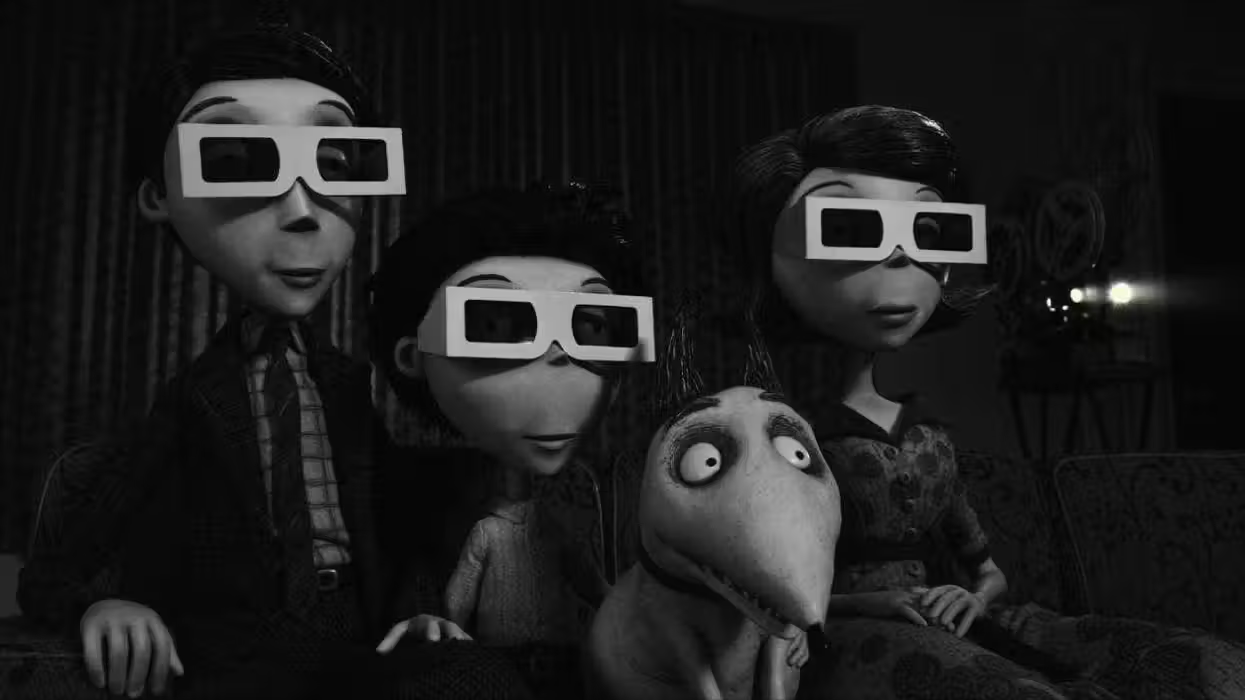
Tim Burton’s 1984 short film, Frankenweenie, follows a little boy who resurrects his dead dog using science. Burton’s 2012 remake follows the same premise but is a dramatic expansion of the story, shot in stop-motion. Burton also introduces new plot points to the 2012 film to further ground the narrative in realism, as it explores how community helps overcome genuine alienation.
Finally, the short film features low-budget practicality, with real locations and practical effects. However, the stop-motion feature is a more refined version that echoes the aesthetics of classic monster films, with black-and-white cinematography.
Let us know whether you love the originals or remakes of the movies above.
- Who Are the 12 Greatest Directors You've Never Heard About? ›
- The Best Action Movie Directors (and What You Can Learn from Them) ›
- 11 Famous Directors Who Write Their Own Screenplays ›
- 8 Movie Directors Best Known for One Defining Movie ›
- Who Are The Best Directors of All Time? ›
- 15 Iconic Movies You Didn't Know Were Remakes ›
- 6 Filmmakers Who Started as Actors | No Film School ›