'Doc Meets World' Shines a Light on Young Stardom and the Fandom That Follows
The new documentary, premiering at Tribeca, aims to rewrite a long-accepted narrative about teen stars and '90s nostalgia.
'Doc Meets World'
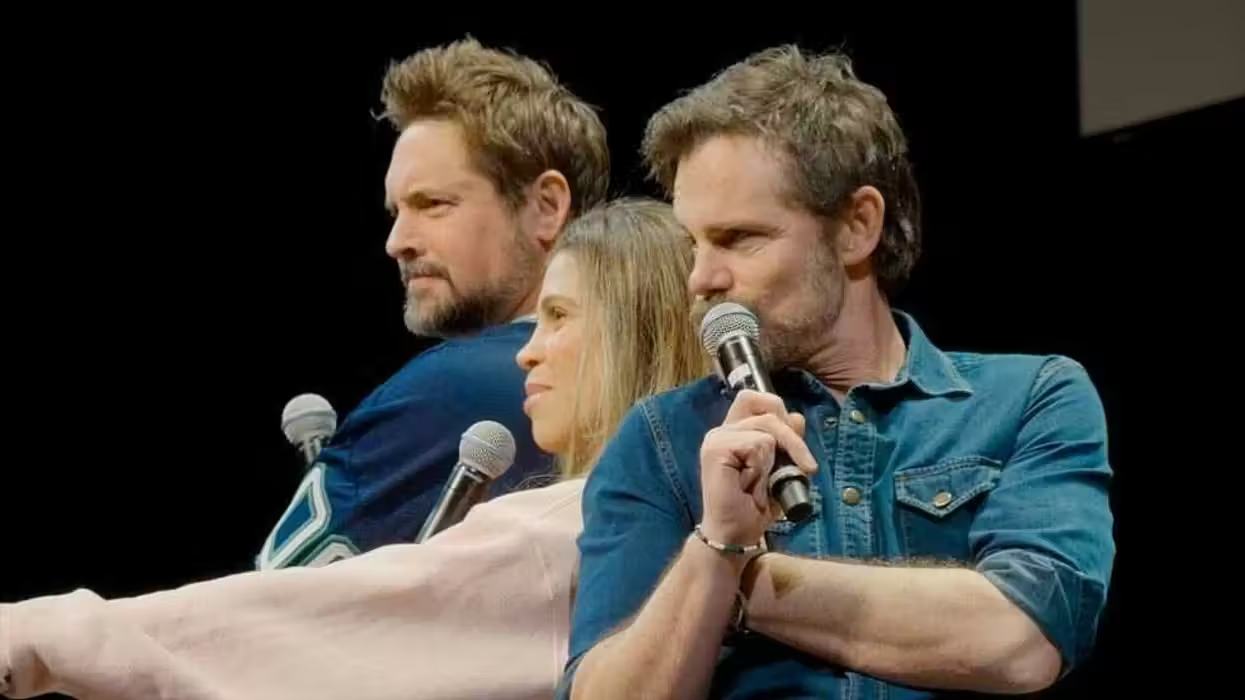
After living out their teenage years on one of television’s most popular shows of the time, Danielle Fishel, Will Friedle, and Rider Strong reunited to launch a podcast that revisited their experiences in the spotlight and the making of the iconic show, Boy Meets World. What the trio didn’t anticipate when they premiered their first episode of “Pod Meets World” in 2022 was the virality that awaited them.
As the podcast became increasingly popular in a storm of '90s nostalgia, Fishel, Friedle, and Strong set out on a live podcast tour across the nation. During an early show in New York, Chris Levitus and Zane Rubin—friends of the trio and filmmakers—chased them around before and after their show, recording the way fans reacted and the unique chemistry between the three. “As soon as we shot them all walking down the street together, and saw people reacting to them, we knew we had a movie,” said Levitus.
From then on, the two embarked on the national podcast tour with the group, capturing over 350 hours of footage over two years on tour. With massive amounts of tour material, and an additional 150 episodes of Boy Meets World and 600 episodes of “Pod Meets World,” Levitus and Rubin looked to Premiere to seamlessly manage and assemble the abundance of material into an 84-minute feature. For this, Levitus and Rubin relied heavily on Text-Based Editing to pinpoint specific moments in the trio’s whirlwind story, saving countless hours of manual sifting.
Levitus (director/editor/DP) and Rubin (director/DP) gave us a behind-the-scenes look into the making of this film—discover more below.
Chris, tell us what this documentary is about, and what made you want to get involved?
Chris Levitus: Rider (Strong) and I met on a little indie I directed way back in 2007. Since then, we've collaborated on short films, music videos, and feature scripts. The one thing we never discussed was ‘Boy Meets World.” So, when he had the idea for the podcast, Zane and I were really curious how he was going to respond to something that he's kept at such a distance for so long.
Then the podcast blew up—Rider, Will, and Danielle mounted a live, nationwide tour, and they found themselves in scenarios none of them expected to be in. We knew we had to make something more of this tour and show the engaging relationships between the three of them.
Chris, what did your conversations with Zane look like to align on the creative vision for the project? What did your collaboration look like throughout production and post?
CL: When we got back to LA, we put together a teaser so everyone could see the potential of the project. Our editorial inspiration was the work of Kirk Baxter & Angus Wall. Their cutting style in both features and music videos has been so influential and informed the rhythm we were trying to achieve with “Doc Meets World.”
We shot whenever we could over the course of a few years, but it wasn't until last July that we started cutting the footage every day. We brought in Jason Makiaris as an assistant editor, and he had a lot of work to do, and helped us out in the long run, because we were originally editing with proxies that were made internally by our FX3. Maybe it wasn’t the “right” way to go about the workflow, but we were learning as we went.
What Adobe tools did you use on this project, and why did you choose them?
CL: We shot about 350 hours of footage; there are over 150 episodes of Boy Meets World and 600 episodes of Pod Meets World, all of which we had on our primary drive. The Text-Based Editing tool was really handy when it came to sifting through all that material.
Tell us about a favorite scene or moment from this project, and why it stands out to you.
Zane Rubin: There is a scene in the film where Rider, Will, and Danielle are having lunch in Rider's backyard. They are debating where the line is between someone pushing you into deeper artistic discovery vs. emotional abuse. I think this scene makes both arguments so well and leaves it up to the audience to decide what they believe is right and wrong. As a filmmaker, anytime you can engage your viewer in a deep and meaningful way, it feels like a success.
CL: Balancing two sides of an argument was a structural device we tried to employ whenever we could. As Danielle says, “There are two sides to every story.” We went to a convention celebrating 90s culture and captured the enthusiasm of thousands of fans, as well as the economics of this machine that is being fueled by nostalgia.
When you see it from Danielle, Will, and Rider’s perspective, it’s a demanding job that streaks past in a colorful blur. We contrast their perspective by focusing on moments with individual fans, many of whom are having a deeply emotional, singular experience.
Who is your creative inspiration?
ZR: I have so many! Today I will say, Mike White. I was rewatching Enlightened last night and was blown away again. That show, like all his work, is so effortlessly funny while simultaneously making me want to cry.
CL: Ondi Timoner’s Dig! is the most exciting movie ever made. The idea of being on the road with a cadre of charismatic people is similar, and to me, is an inherently cinematic conceit. We were also inspired by Grant Gee’s Meeting People Is Easy—it’s a wonderfully impressionistic vision of 90s success and melancholy.
What advice do you have for aspiring filmmakers or content creators?
ZR: Don't spend a lot of money on your first (or second or third) short film. Write something that you can do with your friends in a location you have access to. Then just do it.