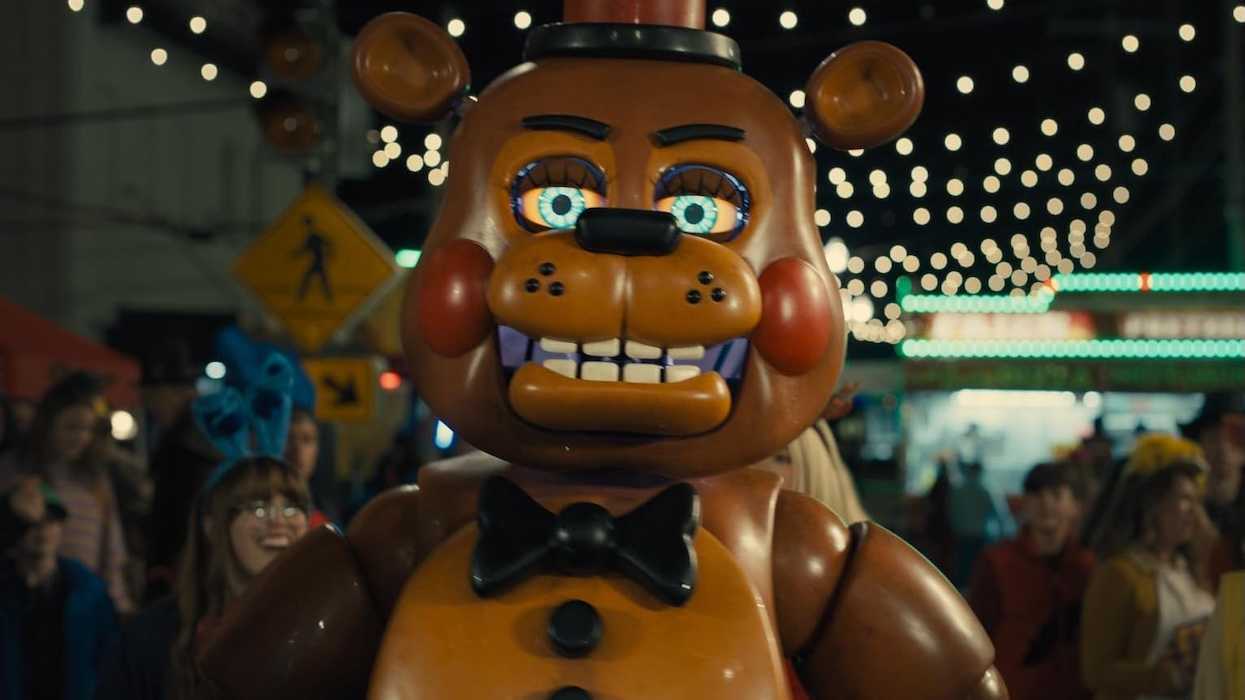
For the return to Freddy Fazbear's pizza parlor from hell, costume designer Whitney Anne Adams had her work cut out for her.
Her job on Five Nights at Freddy's 2 required diving into the world of a sequel (2023's successful Five Nights at Freddy's) and the famously dedicated fanbase that knows every detail of Scott Cawthon's universe. She threw herself headfirst into Reddit threads, cosplay photos, and reference folders for every character (yes, even Cupcake).
It also meant solving problems she didn't see coming, like hand-knitting four sweaters in under a month when visual effects suddenly needed something physical for important character transformations.
The movie follows characters recovering from the trauma of the first film, in which haunted animatronics torment an overnight security guard played by Josh Hutcherson. A year later, he and his family learn of another troubled soul seeking revenge in the form of an enormous, creepy marionette puppet.
We spoke with Adams about organizing her massive amounts of research, the technical challenges of designing for puppet-human hybrids, and why the fitting room is where the magic happens. Enjoy, Freddy fans!
- YouTube www.youtube.com
Editor's note: Spoilers for FNAF 2. The following conversation has been edited for length and clarity.
No Film School: I want to start with what got you excited about this film and about coming on board.
Whitney Anne Adams: I was really excited about this massive fanbase and these really fun characters. And getting to work with Emma [Tammi]. I loved her work, seeing her [film] The Wind, and getting to work with her.
Then getting to work with Jim Henson Creature Shop. I've been a huge fan of The Muppets and Jim Henson's work for a really long time, so getting to work with the iconic Creature Shop was a huge draw. We got to actually work together and overlap on characters. I didn't know that at the time, though, but just to be in their presence and see their work up close was very cool.
And just to be a part of a franchise that's really touched a lot of people's lives and that gives a lot of people joy. I think walking into something that special, you really want to treasure that and do the best to make it as amazing as possible.
 Behind the scenes of Five Nights at Freddy's 2Credit: Whitney Anne Adams/Universal Pictures
No Film School: I read that you had done a ton of research for this project. Once you have that amount of information, what do you do to organize it and make it useful?
WAA: It was definitely overwhelming from the jump because I didn't know very much about the community and the games, and so I got literally all the official guides that Scott [Cawthon] had written. I started digging into every Reddit corner that I could find and every different platform, social media, and just seeing how fans interacted with these characters, and loved seeing people's theories. I watched endless YouTube videos.
So, seeing what's official, what's unofficial, what's theorized, it's a lot to keep track of, but I have very organized folders on my computer where I pop different things in.
I knew from the beginning I had FazFest to prepare for. Literally any cosplay photos I found, I would stick them in each character folder. Every single character had a folder, including Cupcake, and I could separate things out. When we started building everything, I had so many references.
Also, it's a way for me to give directly back to the fans who have made this franchise what it is.
No Film School: Do you do boards when you're getting closer to production?
WAA: Yes, I did lots of boards. I think FazFest, I had over 40 boards of reference images, especially for our tailor. And every single person in my department helped hand-make all 150-plus costumes. We had them posted on the wall.
If someone had a free moment between tasks, they could go over to the wall, see what hasn't been made yet, and start constructing things. It was just nice to have us surrounded by the fans, and they were our inspiration the whole time.
 Five Nights at Freddy's 2 Credit: Whitney Anne Adams/Universal Pictures
No Film School: Did you hide anything else in other costumes that fans might not have been able to see?
WAA: I think for me it was keeping a throughline of purple throughout the movie, especially. Purple is such an important color in the games and for William Afton himself, so I made sure to put Matthew [Lillard] in purple, but the whole Afton family is wearing purple at one point or another.
Vanessa [Elizabeth Lail] wears purple in her dream. Young Vanessa is wearing the same outfit. Michael's [Freddy Carter] wearing purple the first time we meet him. And so that was a really fun throughline. And even young Vanessa in the flashback sequence in 1982, she's wearing purple Converse.
I love doing those little hints to showcase who she is and who her family is. She's tied to it whether she likes it or not. I liked doing a color story in that way.
No Film School: You've talked about how you do this mix of puppetry and CG in the film, and you ended up being part of it in a way you didn't expect. Can you talk about the technical challenges of that?
WAA: I initially thought these Marionette-human hybrids were going to be fully visual effects. I wanted to put Piper [Rubio] as Abby in a striped sweater for that main outfit that she's wearing before she gets possessed by the Marionette and becomes the Abbionette. I put her in this striped sweater, as, at the very least, it was a foreshadowing to her eventual fate.
But then, visual effects, I sent them the fitting photos so they knew what she'd be wearing in that scene, and they circled back to me, and they're like, "I think we need to make something physical, something real for the actors to wear for Piper and her stunt doubles to wear." They had this idea of a grayscale version of the sweater. I took that idea, and I ran with it for them.
We had to hand-make four sweaters, hand-knitted sweaters, in less than a month, so I called my knitter that I've worked with before. She started working right away. But it was finding the right yarn, finding the right pattern. She had to match the sweater perfectly, and then we had to fray it so it was distressed—but then you can't actually fray knitting, so you had to do these holes very specifically.
It all took a lot of time. We were down to the wire to finish all we needed to make four sweaters for Piper, her stunt double, and a different proportionally sized one for the puppet itself. That was a whole challenge.
We'd filmed the Lisa segment after we filmed Abby. So we knew how the transition was going to happen with Lisa.
When I was designing her costume, I was like, "Okay, we did the stripes for Abby. Let's focus on the buttons for Lisa." So I found this amazing henley that we'd dyed to a gray color already. She was already partially the way into the gray, so it wasn't a big jump. And also, it wouldn't give the Piper game away. That comes later in the movie itself. I gave Lisa those three white buttons and was able to do this tiered tunic, but everything proportionally was hard to get right. We had to make sure that the sweater looked like a sweater, and not like a sweater dress. And that the shirt for Lisa looks like a shirt and not a dress.
It was a tough technical challenge. It was a lot of math, a lot of math involved on both of those.
 Five Nights at Freddy's 2 Credit: Whitney Anne Adams/Universal Pictures
No Film School: It's so much work and so many different elements that have to come together.
WAA: It was so fun to do and such a great challenge. And then to get to work with our amazing visual effects department, and then also scheduling fittings with the puppet with the Creature Shop was also a very cool thing to get to do.
No Film School: You've designed for several horror films, but you've also worked in period settings and stage, as well. Does your approach differ between genres?
WAA: It doesn't. It really is about who these characters are, what is the story? So much research goes into everything. So I sort of have the same process no matter what it is, but with horror, I try to strive to be super, super grounded because the rest of the story sometimes is so fantastical. So you want it to feel very grounded, and the same with anything that takes place in the real world. So everything has this through line of research, and why is it being worn? Who is the character wearing it? How do they store their clothes? There's a million questions you have to ask for every single costume piece: how long have they had it? Does it mean something to them? Does it not mean something to them? Do they store it crinkled on the ground? Do they hang it up in a closet? Is it very old? Is it worn?
So you ask yourself all these questions for each piece, and then the entire costume sort of starts being figured out, but then you're also collaborating with the actor and what feels right on their body that would look wrong and say someone else's, but right on them. So there are so many factors that go into it, especially the collaboration too, between working with every department and making sure that the actor isn't wearing a red dress with a red wall behind her—unless that's what you're going for.
But that's my favorite part about it, all the collaboration. Each project I do starts the same way: reading the script and then breaking it down and starting to figure out all those questions.
 Five Nights at Freddy's 2 Credit: Whitney Anne Adams/Universal Pictures
No Film School: What does that collaboration with an actor look like?
WAA: I try to talk to them as soon as I'm allowed to. I always have to wait for each actor's deal to close, and then the second they close, I'm like, "Please, I need their contact information."
I try to hop on a call with them immediately to see, "Do you have thoughts or feelings about this character? Is anything percolating in your brain?" Sometimes actors, they let me do my thing with the costume until we get into the fitting room. Sometimes they have specific ideas, but I need to check in with them immediately so I don't shop something that totally feels wrong in their head.
So we're already meeting in the fitting room on the same page. And, hey, we can get in the fitting room and try all the things we thought would be perfect, and it all ends up feeling wrong, but we're at least heading in the same direction together. And then we like, "Okay, that didn't work. What do we do next?"
But if an actor doesn't feel comfortable in their costume, they're never going to feel like the character. You're going to be able to tell. You really love the moment in the fitting room where the character just appears before both of us, both the actor and I, then see the character, and it's the best part of the job.
No Film School: I imagine it's like magic.
WAA: Yeah, absolutely magical.
 Five Nights at Freddy's 2 Credit: Whitney Anne Adams/Universal Pictures
No Film School: What is your favorite costume from this film?
WAA: I definitely am partial to the Lisaonette and the Abbionette, just because those were so complicated and tough to figure out. But I also super love our River Freddy's uniforms from the 1982 pizzeria. That was a really fun thing, too.
I did a lot of research on every pizzeria you could find in the late '70s, early '80s, and then I also bought a bunch of uniforms from that era on eBay and on Etsy and got them all there. I picked my favorite aspects, design styles of each one, and then we got to build all of our uniforms, so it just feels so of the time. It needed to feel earlier than the uniforms we saw in the first movie and has that late '70s vibe to them. So that was a very fun thing to design.
No Film School: It did feel very fun to be in that time period.
WAA: I loved getting to do the '80s flashback, and we had so many kids and so many people who are not used to wearing jeans without stretch in them. That was definitely a rude awakening for some of them.
 Five Nights at Freddy's 2 Credit: Whitney Anne Adams/Universal Pictures
No Film School: Do you have anything that you would tell an aspiring costume designer?
WAA: Definitely watch as many movies and TV shows as possible. The more you know your film history and TV history, the more you're going to have talking points with collaborators who you're going to meet. So you have a shorthand. I know that there are so many references that we all make back to films that we love, and all these little callbacks. The more that you have that film history under your belt, the more you're going to understand people's references and directions and moods and feelings. Also, you're going to learn about costume history and fashion history, and you need to be a historian, a researcher, a psychologist.
You need to wear so many different hats as a costume designer. So the more well-rounded you can be in all of those areas, though, the better set up you're going to be to be a good designer, because design is only a small part of what we do. So much of it is about context and setting and who people are, much more than, say, what the fashion is at the time.
Also, learning how to sew. You will go very far if you know how to sew, because I know I've had to build a lot of my own costumes when I was starting out in the industry. I started as a tailor. So having the ability to make my own clothes, it definitely allowed me to have more freedom to design what exactly what I wanted to.
Speaking of advice, I have this podcast, Tales from a Costume Designer, and at the end of every episode, I have our guests give their advice to filmmakers up-and-coming in the industry. I love hearing different people's advice, because it's all extremely different, and everyone has started in different places. How do they come up in this industry? And everyone has started in different places, and it's really fun to hear their stories. I interview not just people in the costume department and costume designers, but filmmakers of all kinds. I just love hearing all of those stories, which is why I started it.
No Film School: Would you like to add anything about the film?
WAA: I would love to say I loved working with all of my actors so much. It was a joy getting to create the next stage of their journey and seeing where they're at, a year and a half later into this story. I just want to say how fun it was to create the next chapter of these characters' stories.