Hollywood Is Squeezing Producers to Death (and Killing the Industry in the Process)
The current environment will make the job of producer extinct within the decade.
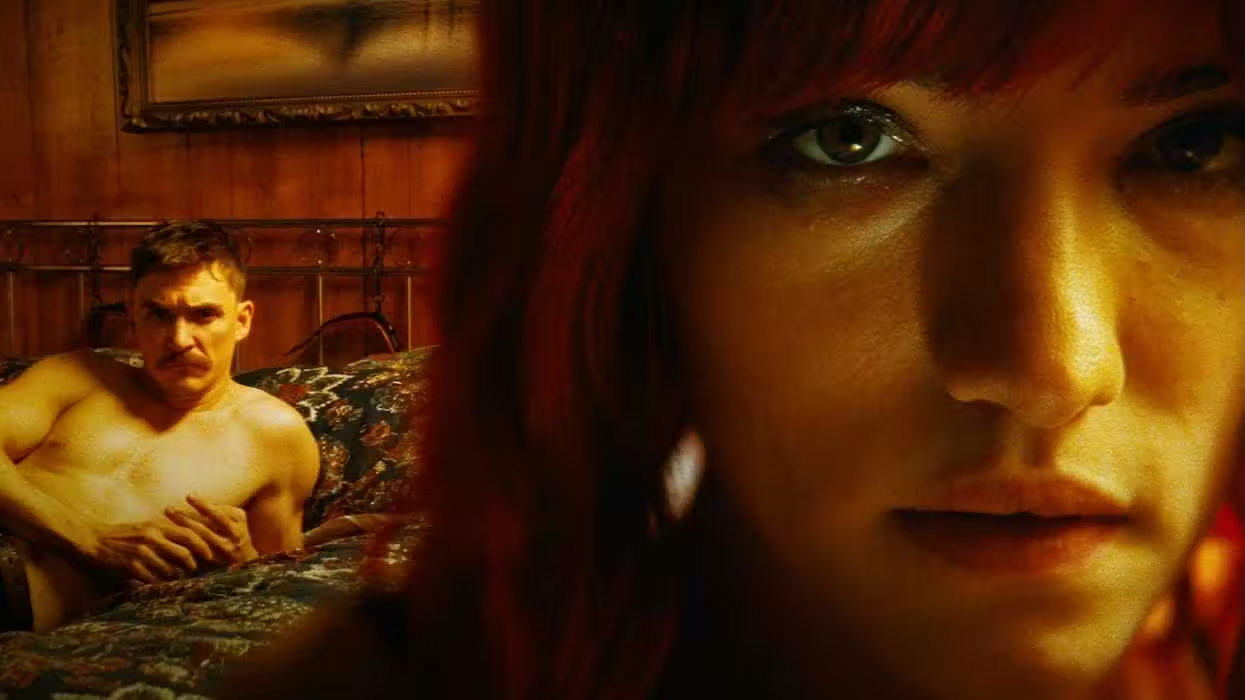
'Strange Darling'
I got up yesterday morning and did something I hate. I drove to one of my favorite coffee shops in Los Angeles and had a goodbye coffee and bagel with a producer I've known for 15 years. They were leaving the industry not because their passion had waned, but because the town no longer supports most producers financially.
This particular producer has made films and TV shows that millions of you have watched, but since COVID, they have found it increasingly hard to get paid.
That's because Hollywood is squeezing out indie producers in ways I have never seen before. They are pretty much making the entire career path economically unviable for the next generation, and that's created a ripple effect in a fragile ecosystem, negatively affecting every other job in the industry.
Let's talk more about it.
How Hollywood Used to Work
We used to have a lot of people taking meetings at Spago, The Ivy, and The Polo Lounge, claiming to be producers with their hands on the hottest spec in town. These were people in expensive suits or cheap suits, but they were suits -- or sometimes flowery dresses.
Their hustle allowed them to set up movies at studios in exchange for payment. And eventually, Hollywood thought the best and most sustainable way to do that was to pay them a retainer so they would bring their best ideas to them first.
This became known as a first-look deal, and it kept the lights on for producers all over town.
We had this even exchange for decades.
Independent producers did the heavy lifting in development, and movie studios got to release hits, find new voices, and seem like the smartest in the room.
And here's the thing: this worked because money flowed, and people could live in Los Angeles, have families, and take a vacation every year.
Producers scouted books, optioned specs, attached talent, refined scripts, and solved production nightmares before a single camera ever rolled.
This stuff actually saved studios more than they paid, whether they acknowledged it or not.
But then private equity stepped in, and cost-cutting became the norm. The first things to get tossed were overall and first-look deals. The ones that kept the lights on.
Hollywood went dark.
Producers Get the Squeeze
Those producing deals have virtually vanished these days, unless you're a very famous producer, and even then, they are few and far between.
You might be able to get one with a famous actor who brings the studio money or stays a star, but if they fade at all or want to take a year off to start a family, your deal and paycheck may come crashing down.
Studios have aggressively pivoted to in-house franchise management and talent-packaged projects.
Now, independent producers are expected to work for free for three, five, or even seven years while a project sits in development hell.
They only get paid if and when cameras roll.
You can't sustain a career in Hollywood without making any money. And no matter how many side gigs you get, most will never pay enough to support a family in LA while also using all available free time to read new scripts and set up projects.
This has created an environment where, if you want to be a producer, you either have to have a rich family that can support you long enough to break in and get one of these deals, or you have to do it part-time and choose to forgo a lot of the things that cost money in order to chase your career.
And let's say you find a few projects you love. Well, without studios, you have no access to development funds, so you have to convince writers to let you have them for free to shop around, which puts you at a disadvantage as well.
It is easy for executives to view producer fees as negotiable overhead on a balance sheet. But this short-term financial squeezing directly damages the quality and longevity of film and television.
We're going to lose Hollywood if this continues.
The Trickle-Down Effect
Fewer producers with deals have meant fewer producers working overall. This is bad for writers, directors, and actors because it means fewer people to meet overall to start your career.
It has also translated to fewer film and TV productions being made.
All of these things have massive ripples that then cost jobs in production and across all trades, and they disturb the broader economics of the business.
Let's dive into the biggest ones.
1. The Death of Original Material
When studios eliminate development capital for outside producers, they eliminate the filter that discovers original stories and voices.
If you're complaining about diversity in Hollywood, look no further than producers from different backgrounds who don't exist anymore. If we just have rich people in place, we're just going to get stories they identify with, and that may not reflect the life and times you see out your window.
Producers are the risk-takers who champion weird, original, high-concept scripts that studios are too risk-averse to initiate internally, but who have no problem taking credit for them later.
Without them, development devolves into a repetitive cycle of sequels, reboots, and pre-packaged IP.
2. Homogenization of Voices
If developing a movie requires working for free for five years, who can afford to be a producer?
When I hugged my friend goodbye, that was the question that stuck with me.
The current financial landscape self-selects exclusively for individuals who are already independently wealthy.
Are they tastemakers?
I think some of them might be, but we're going to completely shortchange perspectives or people with connections to working-class storytelling.
The talent pool for big-time deals will shrink as well. Today's producers are the same people who run studios tomorrow.
Except, what do you do if the only people left are not necessarily the best?
Well, you have an industry that stagnates.
3. Production Efficiency Collapse
Here's the biggest thing that should make studios want to spend a little money every year empowering new producers to bring them projects.
A great producer saves a studio millions of dollars on set through foresight, creative problem-solving, and effective management of crew dynamics.
The bad ones cost them a lot more to fix.
So why not spend that cash right away to find the best people and projects?
Vanity Producing Credits
Here's the last issue, one that I think is worth mentioning. See, back in the day, anyone could call themselves a producer, and you kind of had to suss out their actual credits to see if they were the real deal.
Now, fake producers with no power or taste come in all shapes and sizes...and that's kind of our fault in Hollywood.
See, lots of people started asking for producer credits, and we granted them just ot get movies and TV shows going.
But here's the thing: production fees are often capped as a percentage of the total budget. So, every vanity EP attached to a package drains funds from the finite producer fee pool.
And it means the producer who believed in the project and got it this far, being paid nothing, is now getting paid less than they thought just ot make sure an actor or someone else is tagged as an EP.
This actually got so bad that the PGA stepped in, and now that's why you see the PGA tag next to the names of the real producers who got the work done.
Summing It All Up
Being a producer in Hollywood has never been harder, and all these things are holding back the next generation of voices.
They're killing Hollywood from the inside, and we're ruining an industry that used to be a great place to follow your dreams and live your best life.
If that goes away, who will be left, and what will they make?
Let me know what you think in the comments.