How a Bunch of YouTubers Got Their Movie Into Theaters Nationwide—And Rewrote Indie Filmmaking in the Process
Inside Creator Camp, the creator-led collective that took a $100,000 rom-com from cold emails to cinemas across North America.
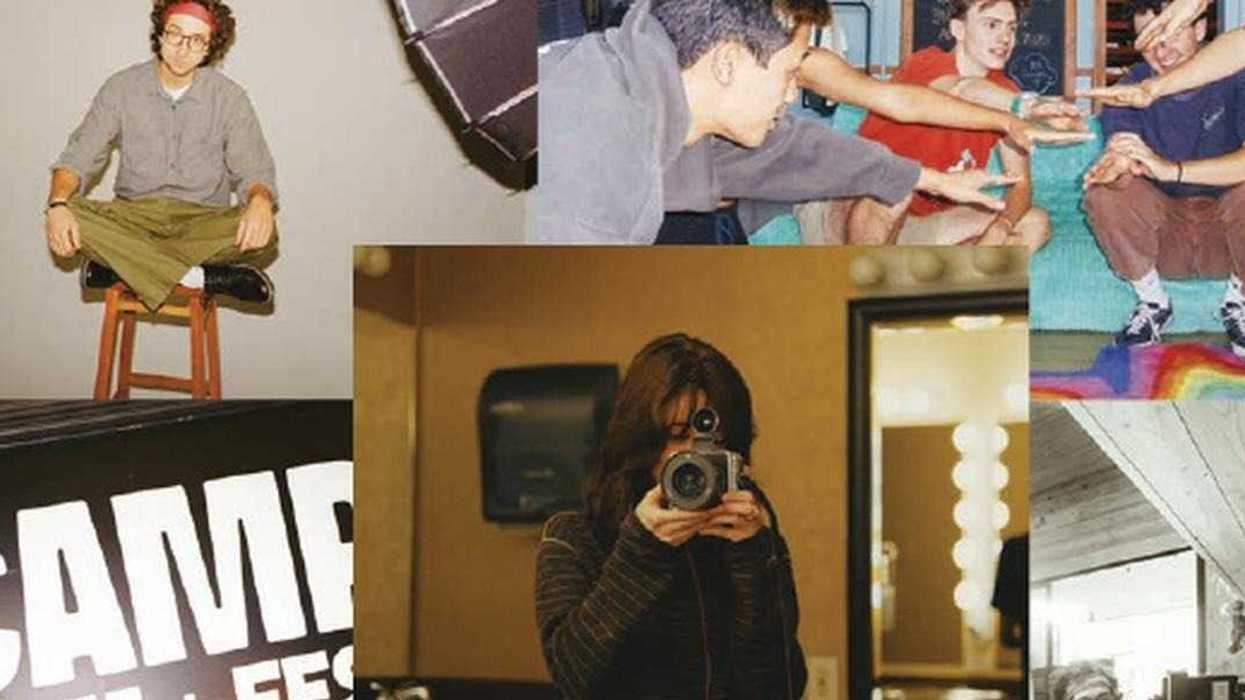
It's hard to pin down exactly what Creator Camp is: part-studio, part-startup, part-school – but also none of those things. Its founders describe it as a “lab for cultural experiments”, and what this means in practice is a collective of aspiring filmmakers, commercial directors, cinematographers, strategists, writers, musicians, and designers going against the grain of how things are usually done when it comes to filmmaking.
Creator Camp began life in 2021 when a handful of content creators (namely YouTubers then in their early 20s) – most of them gap-year kids or dropouts with no film-school pedigree between them – rented cabins in the Montana woods for a month, simply looking for others who understood the isolation of building an audience alone online.
Those gatherings kept growing, eventually leading to a partnership with the Swiss government to fly a hundred creators out to the Alps for a week of collaboration.
The ambition now is to become something like the A24 for the internet generation, bridging internet-born stories with real-world execution and commercial opportunity. And Creator Camp has proven that's possible: last year it made Two Sleepy People, a romantic comedy written and shot in 100 days for $100,000, then self-distributed it with zero marketing budget – the founders literally drove an RV from theater to theater – before Kickstarter came on as a partner to expand it into a nationwide release.
The whole project neatly encapsulates a few things at the core of Creator Camp itself: a dogged belief that things should, and can, be done differently – and that the traditional barriers to entry for filmmakers like budget, education, and background are increasingly becoming irrelevant. Here, Creator Camp's co-founder and CEO Max Reisinger and its Chief Creative Officer Cristina Colina chat to one another about the future of film, the rise of creator-turned-director, what they wish they'd known when starting out, and more.
This year two films directed by YouTube creators became box office phenomena: Curry Barker made Obsession for around $750,000 and it's now grossed $400 million worldwide; Kane Parsons' Backrooms became A24's biggest opening ever and saw the 20-year-old director become the youngest ever to top the box office.
Curry Barker cut his film in Adobe Premiere, the same editing software he used for years on YouTube. Do you see that YouTube-to-theatrical path as the future of serious film production, or a moment that only works for a certain kind of creator? And where does that leave someone coming up the traditional route?
Max Reisinger: I think it creates more opportunity in each area – it's not a zero-sum game. The YouTube-to-theatrical route has worked for creators – and been profitable for them – for many years now, but this level of success is new, and that really validates what's possible. I do think 99% of creators who are posting on YouTube today now have a much easier path towards getting into theaters with their own work, but that doesn't necessarily look like a typical movie production.
In regard to space being left for someone coming up a more traditional route, I think that sometimes the power of existing YouTube audiences is overhyped in certain cases, especially with Obsession. What made that movie good, and the reason it performed well, isn't just because of Curry's audience: it's because YouTube made him a better filmmaker, and he put in many reps over many years. That made him a good director, and that's what matters most. That's not to say having an audience doesn't help. I think ultimately, if you're making work that audiences enjoy at scale, there's a pretty high likelihood that that will translate onto the big screen well.
With multiple voices in the room, how do you protect a shared point of view, and how do you handle it when you don't agree?
Cristina Colina: A shared point of view isn't something you really protect, I think it's something you build trust around once and then keep pointing everyone back to. We protect our collective voice by agreeing on the why up front: why we do what we do, and who we're doing it for.
We can fight about how we do things; we just need to always anchor everything back to the why. And that's honestly my main job: taking all of our team's different voices and interpretations of the how and channeling them into a singular perspective across our visuals, writing, designs, and media.
Creator Camp's work has a clear point of view. Where did that taste come from, and how did you get to a place where you trusted it enough to build on it?
CC: Honestly, a lot of our taste just comes from being chronically online. We grew up on the internet, and have been creating on it for years, so we know it from the inside. But the more time you spend in it, the more you feel this growing frustration. It's kind of isolating, and it leaves you wanting more from the internet than what it's giving you.
That's really where our point of view comes from. In a digital landscape that rewards drama and stakes and conflict, the question we're always asking ourselves is, “ok, can you still tell a human story inside all that noise? Who's still making things that make us go ‘wow, I've never seen anything like that', or ‘wow, that made me truly feel something'?”
Everything we do comes back to finding those people, spotlighting them, creating opportunities for them. Trying to make the internet feel like the tool of infinite inspiration and possibility it started as.
What gave you the confidence to go against the grain when it comes to how you navigate the industry? Was there a moment where you decided to just go for it?
CC: To actually change an industry you have to be a little crazy enough to try, and outside enough to see it differently. Two years ago, we didn't really know how the film industry worked. We had to learn about financing, pitching, creative development, and theatrical distribution all from scratch. But that turned out to be our advantage, because we weren't carrying around everyone's rules about what isn't possible.
The “just go for it” moment was at the start of 2025, when we set this genuinely crazy goal: make a movie that was fully creator-led – meaning develop it with people who learned filmmaking and are practicing it in this new-gen way (social media), but don't have the traditional experience or connections to get on the screens they want. And we gave ourselves less than a year to go from developing it to actually getting it into real theater chains. (And I promise, none of us had any nepo connections into this industry, we were stepping in fully cold…)
So we did it the only way we knew how. A lot of cold emails, asking anyone who'd talk to us for advice, from producers to directors to financiers. Along the way, we found and teamed up with the Fithian Group, a group of ex-theater owners trying to shake up the industry the same way we were. And when it came to distribution, we defaulted to the one thing we actually knew: telling our story online.
We ended up with 20,000 people in the credits [for romantic comedy Two Sleepy People], and hundreds of cinemas across North America saying yes to a multi-week run of this fully self-distributed indie film. That's something that rarely happens. The industry's starting to be more open with wild bets like this. And I still kind of can't believe we pulled it off.
What's the one piece of advice you'd give a student looking to get into a similar career?
CC: Reach out to more people in the industry sooner. People are super willing to help and are easier to reach with a cold email than you might imagine.
How do you keep human creativity at the center of your work while staying on top of tools like AI?
MR: Interacting with humans is pretty much our whole job – whether it's working with our team, creators, or other businesses that we're partnering with. The tools I come back to are the ones that allow us to deepen that connection, or that allow us to “be more human”, whatever that means.
For example, using Notion AI's notetaker during meetings allows me to focus a lot more on the call, meaning I don't have to worry about missing details. Funnily enough, I still write on a piece of paper in addition to it, but it's a nice safety net.
What do you think the next era of creative work will look like? What do you wish someone had told you at the very start?
CC: For decades we've been primed to think of a career as one singular, lifelong path. You pick the thing, you climb the ladder, you do it for 40 years.
So as a student, I wish I was told that I didn't have to build my identity around a single title or a single skill, because job titles are changing faster than any of us can train for them. Yes, you should learn about the software, industries, and skill sets relevant to the times today. But I think it's getting more and more important to build the stuff underneath: your point of view, your ability to actually understand people and be of service to them, making authentic connections, and building things with your actual hands.
The whole internet's about to be flooded with stuff that's technically perfect and says nothing. Soon, anyone will be able to generate high-end animations, clone the exact sound of their favorite music artist, or make things that used to take a large studio. What'll matter now more than ever before is having a unique perspective and the ability to combine mediums and/or tools in ways no one's thought of before.
This article was originally produced and written for Adobe Education and is republished here with permission.